Department of Zoology, Wildlife and Fisheries, University of Agriculture, Faisalabad, Pakistan.
Department of Community Health Sciences, College of Applied Medical Sciences, King Saud University, Riyadh, Saudi Arabia.
Sci Rep. 2022 Aug 12;12(1):13783. doi: 10.1038/s41598-022-18148-1.
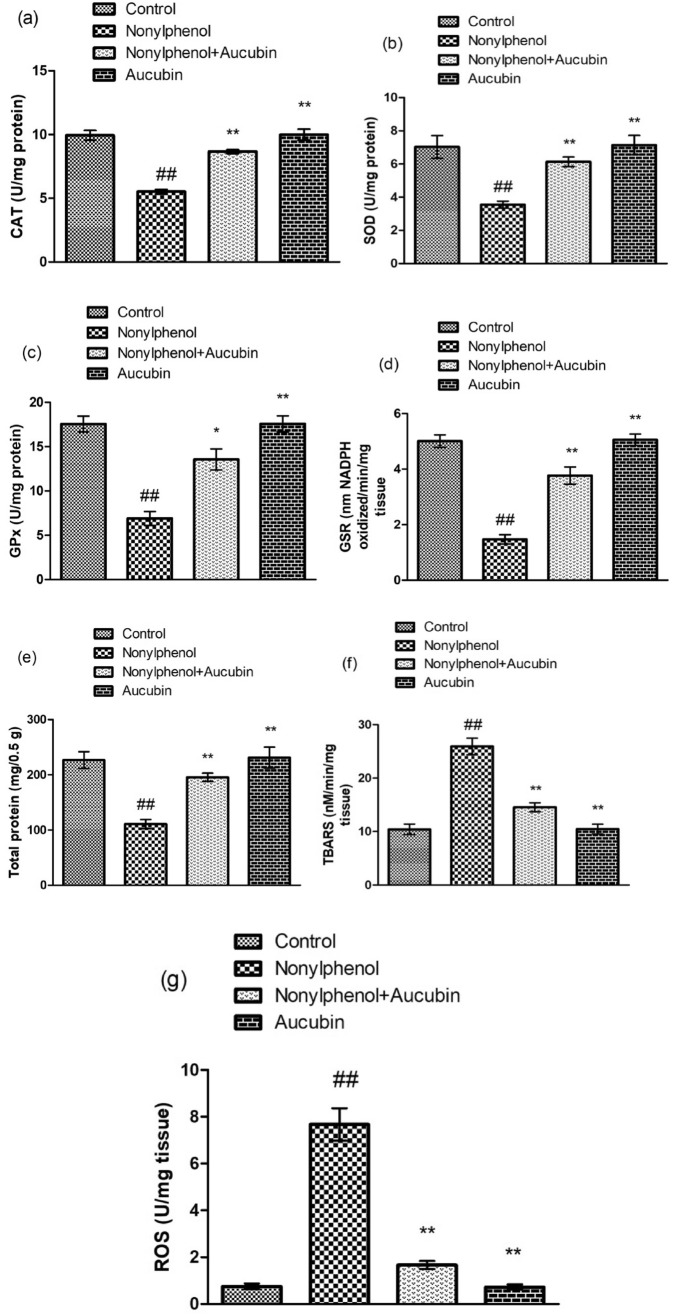
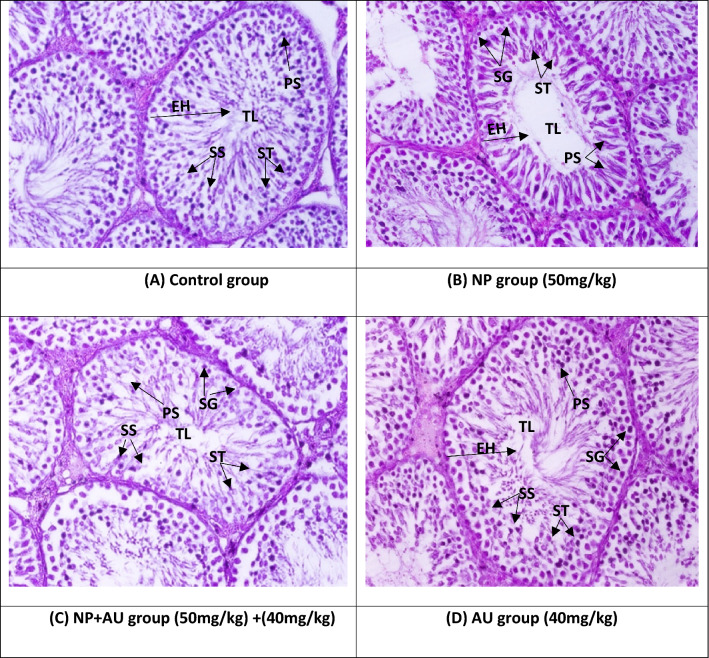
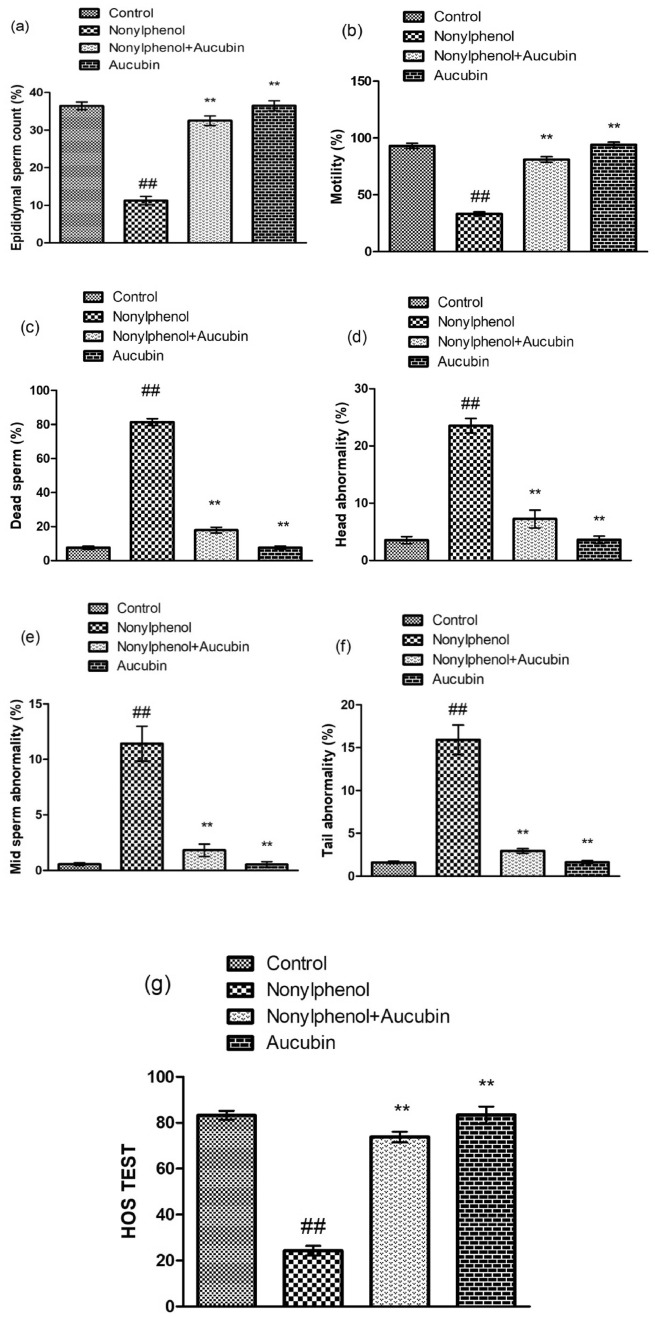
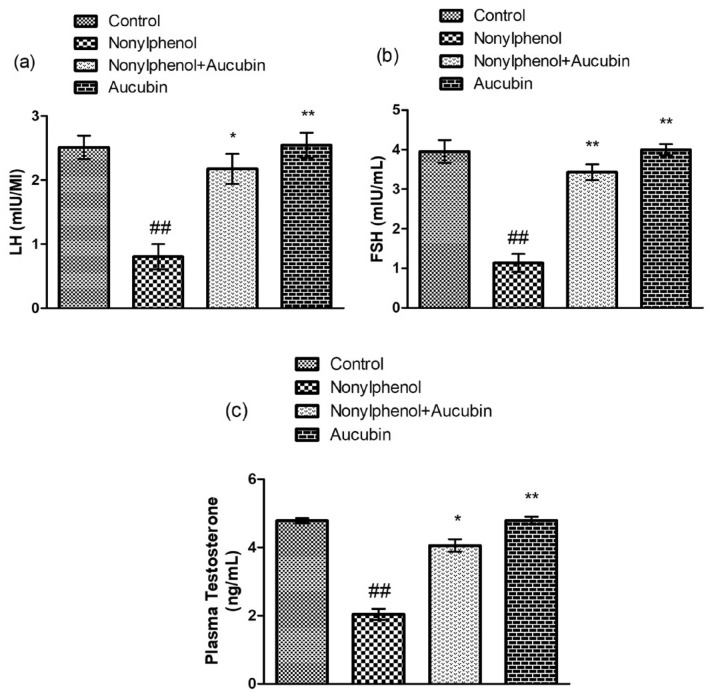
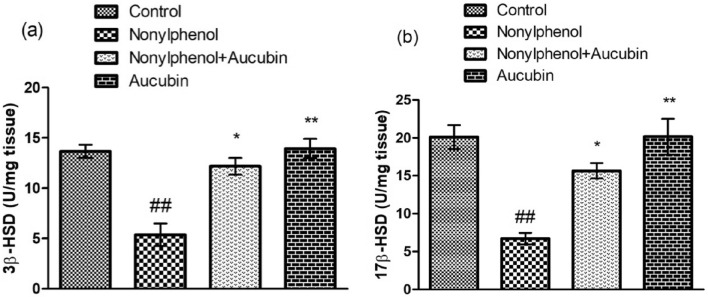
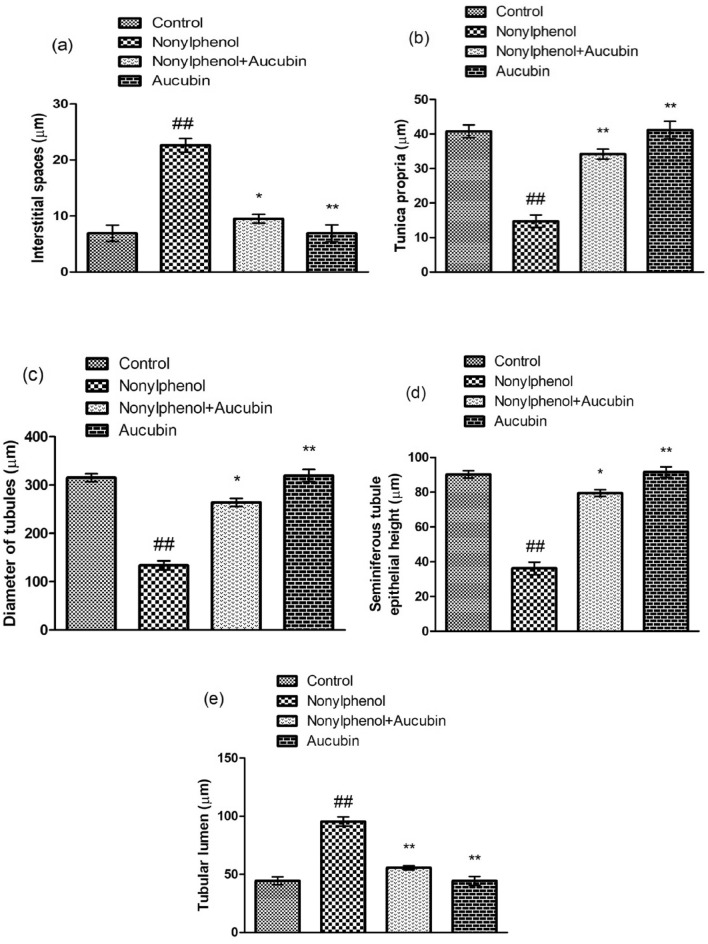
Aucubin (AU) is one of the widespread compounds belonging to the group of iridoid glycosides, which possesses numerous beneficial properties. Nonylphenol (NP), is a synthetic environmental toxicant that has the potential to cause male infertility through excessive production of reactive oxygen species. In the current study, the remedial potential of Aucubin was assessed against NP-generated testicular damage in male rats. Animals were distributed into four groups and treated for 56 days in this study. Control-group (0.1% DMSO + food), NP group (100 µg/kg), NP + AU group (100 µg/kg + 5 mg/kg) and AU group (5 mg/kg). NP exposure significantly (p < 0.05) reduced the activity of antioxidant enzymes i.e., glutathione reductase, catalase (CAT), superoxide dismutase, glutathione peroxidase (GPx), and total protein content (TPC), whereas the level of reactive oxygen species (ROS) and thiobarbituric acid reactive substances (TBARS) was enhanced substantially (p < 0.05). Treatment with AU substantially (p < 0.05) recovered activities of antioxidant enzymes, TPC, ROS, and TBARS levels. Moreover, decrease in the levels of follicle-stimulating hormone (FSH), luteinizing hormone (LH), plasma testosterone, sperm count, motility, sperm membrane integrity, and the number of spermatocytes of different stages along with the level of steroidogenic enzymes i.e., 17β-hydroxysteroid dehydrogenase (17β-HSD), 3β-hydroxysteroid dehydrogenase (3β-HSD), and B-cell lymphoma 2 (Bcl-2) by NP administration were recovered to control values by AU treatment. However, AU mitigated the sperm abnormalities (head/midpiece/tail), the number of dead sperms, and proapoptotic proteins i.e., Bcl-2 associated X protein (Bax), caspase-9, and caspase-3 that were increased by NP. Besides, AU treatment recovered the NP-induced potential histopathological alterations in the testicular tissues such as the height of epithelium, seminiferous tubules diameter as well as the height of tunica propria. Overall, NP-induced toxicity was effectively recuperated by the AU administration. These results indicate that AU might be considered as a potential protective agent against testicular damage. The observed protection may be due to its antioxidant, anti-apoptotic, anti-inflammatory and androgenic potential.
aucubin (AU) 是广泛存在的一组环烯醚萜苷类化合物之一,具有许多有益的特性。壬基酚 (NP) 是一种合成环境毒物,通过过量产生活性氧物种,有可能导致男性不育。在本研究中,评估了 aucubin 对雄性大鼠睾丸 NP 生成损伤的修复潜力。动物在本研究中分为四组,治疗 56 天。对照组(0.1% DMSO+食物)、NP 组(100μg/kg)、NP+AU 组(100μg/kg+5mg/kg)和 AU 组(5mg/kg)。NP 暴露显著(p<0.05)降低了抗氧化酶的活性,即谷胱甘肽还原酶、过氧化氢酶(CAT)、超氧化物歧化酶、谷胱甘肽过氧化物酶(GPx)和总蛋白含量(TPC),而活性氧(ROS)和硫代巴比妥酸反应物质(TBARS)的水平显著升高(p<0.05)。AU 处理显著(p<0.05)恢复了抗氧化酶、TPC、ROS 和 TBARS 水平的活性。此外,NP 给药导致的卵泡刺激素(FSH)、黄体生成素(LH)、血浆睾酮、精子计数、活力、精子膜完整性和不同阶段精母细胞数量以及类固醇生成酶水平降低,如 17β-羟甾脱氢酶(17β-HSD)、3β-羟甾脱氢酶(3β-HSD)和 B 细胞淋巴瘤 2(Bcl-2),均通过 AU 处理恢复至对照值。然而,AU 减轻了由 NP 引起的精子异常(头部/中段/尾部)、死精子数量以及促凋亡蛋白 Bcl-2 相关 X 蛋白(Bax)、半胱天冬酶-9 和半胱天冬酶-3 的增加。此外,AU 处理恢复了 NP 诱导的睾丸组织潜在组织病理学改变,如上皮高度、生精小管直径以及固有层高度。总的来说,AU 的给药有效地恢复了 NP 诱导的毒性。这些结果表明,AU 可能被认为是一种对抗睾丸损伤的潜在保护剂。观察到的保护作用可能归因于其抗氧化、抗凋亡、抗炎和雄激素作用。