Centre for Improving Health-Related Quality of Life, School of Psychology, Queen's University Belfast, Belfast, BT7 1NN, UK.
School of Social Sciences and Psychology, Penrith Kingswood Campus, Western Sydney University Locked Bag 1797, Penrith, NSW, 2751, Australia.
BMC Palliat Care. 2022 Aug 13;21(1):145. doi: 10.1186/s12904-022-01032-0.
Death literacy includes the knowledge and skills that people need to gain access to, understand, and make informed choices about end of life and death care options. The Death Literacy Index (DLI) can be used to determine levels of death literacy across multiple contexts, including at a community/national level, and to evaluate the outcome of public health interventions. As the first measure of death literacy, the DLI has potential to significantly advance public health approaches to palliative care. The current study aimed to provide the first assessment of the psychometric properties of the DLI in the UK, alongside population-level benchmarks.
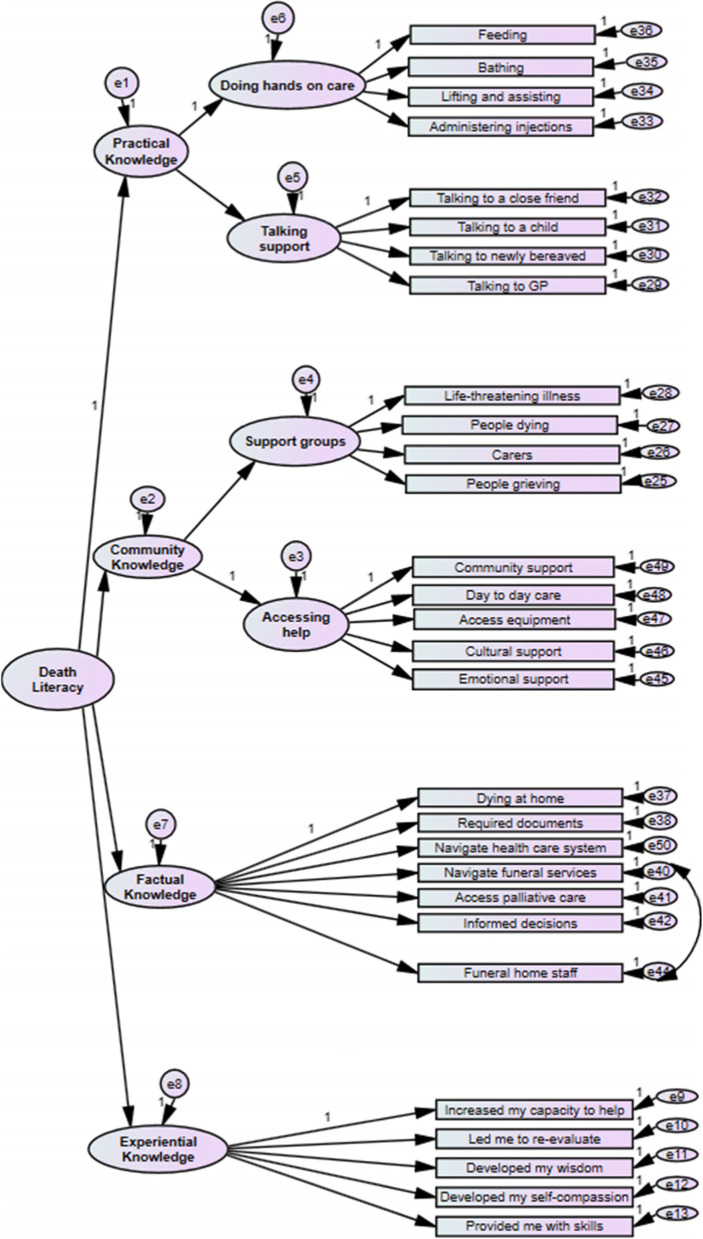
A large nationally representative sample of 399 participants, stratified by age, gender and ethnicity, were prospectively recruited via an online panel. The factor structure of the 29-item DLI was investigated using confirmatory factor analysis. Internal consistency of subscales was assessed alongside interpretability. Hypothesised associations with theoretically related/unrelated constructs were examined to assess convergent and discriminant validity. Descriptive statistics were used to provide scaled mean scores on the DLI.
Confirmatory factor analysis supported the original higher-order 8 factor structure, with the best fitting model including one substituted item developed specifically for UK respondents. The subscales reported high internal consistency. Good convergent and discriminant validity was evidenced in relation to objective knowledge of the death system, death competency, actions relating to death and dying in the community and loneliness. Good known-groups validity was achieved with respondents with professional/lived experience of end-of-life care reporting higher levels of death literacy. There was little socio-demographic variability in DLI scores. Scaled population-level mean scores were near the mid-point of DLI subscale/total, with comparatively high levels of experiential knowledge and the ability to talk about death and dying.
Psychometric evaluations suggest the DLI is a reliable and valid measure of death literacy for use in the UK, with population level benchmarks suggesting the UK population could strengthen capacity in factual knowledge and accessing help. International validation of the DLI represents a significant advancement in outcome measurement for public health approaches to palliative care. PRE-REGISTRATION: https://osf.io/fwxkh/.
死亡素养包括人们获取、理解和就生命末期和死亡护理选择做出明智决策所需的知识和技能。死亡素养指数(DLI)可用于确定多个背景下(包括社区/国家层面)的死亡素养水平,并评估公共卫生干预措施的结果。作为衡量死亡素养的第一个指标,DLI 有可能极大地推动姑息治疗的公共卫生方法。本研究旨在对 DLI 在英国的心理测量特性进行首次评估,并提供人群水平的基准。
通过在线小组,前瞻性地招募了 399 名年龄、性别和种族分层的大型全国代表性样本。使用验证性因子分析研究了 29 项 DLI 的因子结构。评估了子量表的内部一致性和可解释性。检验了与理论上相关/不相关的构念的假设关联,以评估收敛和判别效度。使用描述性统计提供了 DLI 的标度平均得分。
验证性因子分析支持了最初的高阶 8 因素结构,最佳拟合模型包括为英国受访者专门开发的一个替代项目。报告的子量表具有较高的内部一致性。与死亡系统的客观知识、死亡能力、社区中与死亡和临终相关的行动以及孤独感相关,证明了良好的收敛和判别效度。在具有临终关怀专业/生活经验的受访者中,实现了良好的已知组有效性,他们报告了更高水平的死亡素养。DLI 得分的社会人口统计学变异性较小。DLI 子量表/总分的人口水平平均得分接近中点,实际知识和谈论死亡和临终的能力水平相对较高。
心理测量评估表明,DLI 是英国死亡素养的可靠有效测量工具,人群水平基准表明英国人口可以加强事实知识和获取帮助的能力。DLI 的国际验证代表了姑息治疗公共卫生方法的结果测量的重大进展。预注册:https://osf.io/fwxkh/。