Centre for Improving Health-Related Quality of Life, School of Psychology, Queen's University Belfast, Belfast, UK.
Marie Curie Palliative Care Research Centre, Cardiff University, Cardiff, UK.
BMC Public Health. 2022 May 6;22(1):906. doi: 10.1186/s12889-022-13319-1.
Advance care planning is a key preparatory step in ensuring high-quality palliative and end of life care, and should be considered as a process, beginning with community-level conversations among lay persons. There is, however, indication that death talk among community-dwelling adults is not occurring, and there is a dearth of research examining why this is the case. This study aims to provide the first examination of barriers and facilitators to talking about death and dying among the general population in a UK region (Northern Ireland), and to provide a novel application of health behaviour change theory towards developing a theoretical understanding of the sources of this behaviour.
The study involved qualitative analysis of responses (n = 381 participants) to two open-ended questions within a cross-sectional online survey, with recruitment via social media of adults currently living in Northern Ireland. Reflexive thematic analysis was conducted on open text responses per question, with the barriers and facilitators mapped on to health behaviour change models (the Behaviour Change Wheel COM-B and the Theoretical Domains Framework).
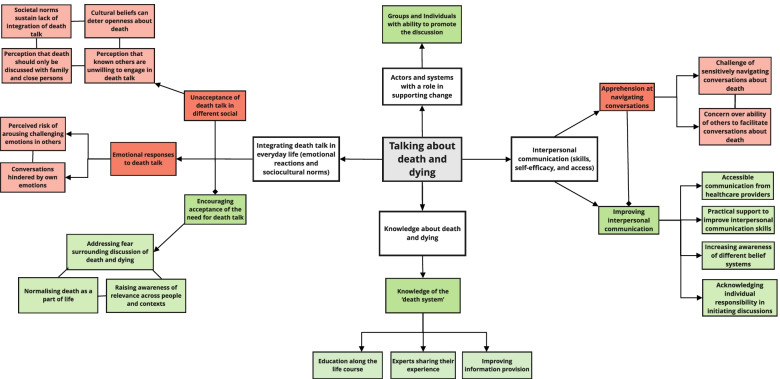
The findings evidence a myriad of barriers and facilitators to engaging in death talk, with themes aligning to areas such as lack of acceptance of death in social contexts and fear of upsetting self or others, and a need to improve interpersonal communication skills for facilitating conversations and improve knowledge of the existing services around death and dying. A theoretical understanding of the drivers of death talk is presented with findings mapped across most components of the COM-B Behaviour Change Model and the Theoretical Domains Framework.
This study contributes to a small but emergent research area examining barriers and facilitators to talking about death and dying. Findings from this study can be used to inform new public health programmes towards empowering adults to have these conversations with others in their community towards upstreaming advance care planning.
预先医疗照护计划是确保高质量的缓和医疗和临终关怀的关键预备步骤,应被视为一个过程,从社区层面上非专业人士之间的对话开始。然而,有迹象表明,社区居民之间并没有进行死亡话题的讨论,而且缺乏研究来探讨为什么会这样。本研究旨在首次检查在英国北爱尔兰地区(英国的一个地区),普通人群谈论死亡和临终的障碍和促进因素,并应用健康行为改变理论来深入了解这种行为的来源。
该研究涉及对横断面在线调查中两个开放式问题(n=381 名参与者)的定性分析,通过社交媒体招募目前居住在北爱尔兰的成年人。对每个问题的开放文本回复进行反思性主题分析,并将障碍和促进因素映射到健康行为改变模型(行为改变车轮 COM-B 和理论领域框架)上。
研究结果表明,参与死亡话题讨论存在诸多障碍和促进因素,主题与社交环境中对死亡的接受度低、害怕让自己或他人不安以及需要提高人际沟通技巧以促进对话和提高对现有死亡和临终服务的了解等领域相关。提出了对死亡话题驱动因素的理论理解,研究结果映射到 COM-B 行为改变模型和理论领域框架的大多数组成部分上。
本研究为一个小型但新兴的研究领域做出了贡献,该领域检查了谈论死亡和临终的障碍和促进因素。本研究的结果可用于为新的公共卫生计划提供信息,以使成年人能够与社区中的其他人进行这些对话,从而推动预先医疗照护计划的实施。