Department of Nephrology and Rheumatology, University Medical Center Göttingen, Göttingen, Germany.
Institute of Pathology, University Medical Center Göttingen, Göttingen, Germany.
J Nephrol. 2023 Jan;36(1):125-132. doi: 10.1007/s40620-022-01414-w. Epub 2022 Aug 13.
The activation of the complement system contributes essentially to the pathogenesis of anti-neutrophil cytoplasmic antibody (ANCA)-associated renal vasculitis. We here aimed to directly compare levels of C3 and C4 for outcome prediction in ANCA-associated renal vasculitis.
Serum levels of complement components C3 and C4 were directly compared in association with clinical and outcome data in a retrospective cohort of ANCA-associated renal vasculitis.
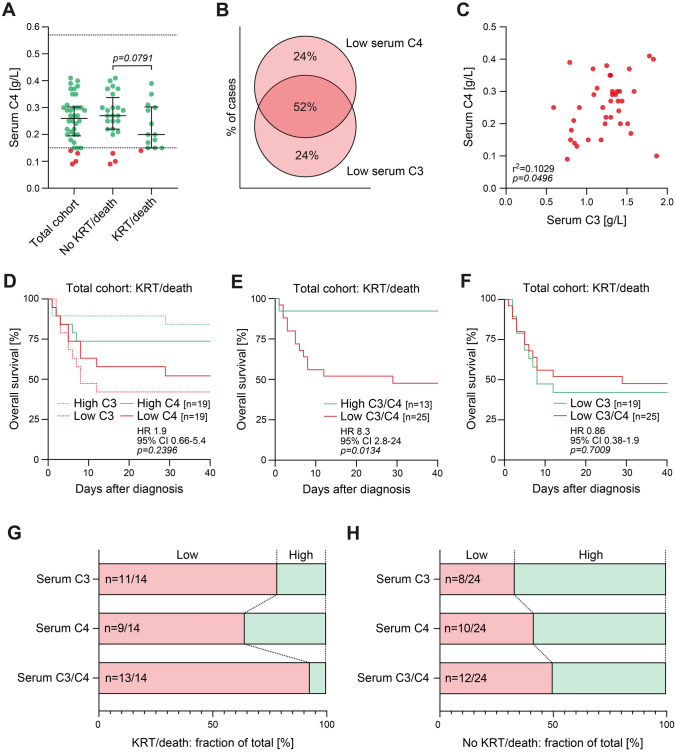
As compared to poor outcome prediction by low levels of complement C3 (p = 0.0093), low levels of complement C4 did not associate with early requirement of kidney replacement therapy (KRT) or death (p = 0.2396). In the subgroup that experienced KRT or death, low C3 levels identified 11/14 (78.6%, p = 0.0071) and C4 levels 9/14 (64.3%, p = 0.1786) cases. Interestingly, 2/14 (14.3%) patients that experienced KRT or death had isolated C4 lowering, and combining low C3 and/or C4 levels identified 13/14 (92.3%, p < 0.0001) cases in this subgroup. Non-superiority to predict poor outcome by low C3 and/or C4 as compared to C3 alone in the total cohort was attributed to 4/24 (16.7%) patients with isolated C4 lowering in the subgroup that did not experience KRT or death.
While low levels of complement C3 were superior in predicting poor outcome in ANCA-associated renal vasculitis, a minor fraction with poor outcome had isolated C4 lowering not captured by serum C3 measurements. Therefore, detailed knowledge of distinct complement components contributing to kidney injury could be of relevance to improve current strategies targeting the complement system in ANCA-associated renal vasculitis.
补体系统的激活对抗中性粒细胞胞浆抗体(ANCA)相关性血管炎的发病机制起着重要作用。本研究旨在直接比较 C3 和 C4 水平在 ANCA 相关性血管炎中的预后预测价值。
本研究为回顾性队列研究,直接比较了 ANCA 相关性血管炎患者的补体成分 C3 和 C4 水平与临床和预后数据的关系。
与补体 C3 水平低(p=0.0093)预示不良预后相比,补体 C4 水平低与早期需要肾脏替代治疗(KRT)或死亡无关(p=0.2396)。在经历 KRT 或死亡的亚组中,低 C3 水平识别出 14 例中的 11 例(78.6%,p=0.0071),C4 水平识别出 14 例中的 9 例(64.3%,p=0.1786)。有趣的是,在经历 KRT 或死亡的 14 例患者中有 2 例患者仅出现 C4 降低,而联合低 C3 和/或 C4 水平在该亚组中识别出 14 例中的 13 例(92.3%,p<0.0001)。在未经历 KRT 或死亡的亚组中,有 4 例(16.7%)患者仅出现 C4 降低,这导致低 C3 和/或 C4 水平预测总队列不良预后的非优越性。
虽然补体 C3 水平降低可更好地预测 ANCA 相关性血管炎的不良预后,但一小部分不良预后患者的 C4 降低未被血清 C3 测量所捕捉。因此,深入了解导致肾脏损伤的不同补体成分可能有助于改善目前针对 ANCA 相关性血管炎中补体系统的治疗策略。