Tampe Désirée, Korsten Peter, Ströbel Philipp, Hakroush Samy, Tampe Björn
Department of Nephrology and Rheumatology, University Medical Center Göttingen, 37075 Göttingen, Germany.
Institute of Pathology, University Medical Center Göttingen, 37075 Göttingen, Germany.
J Clin Med. 2021 Apr 6;10(7):1538. doi: 10.3390/jcm10071538.
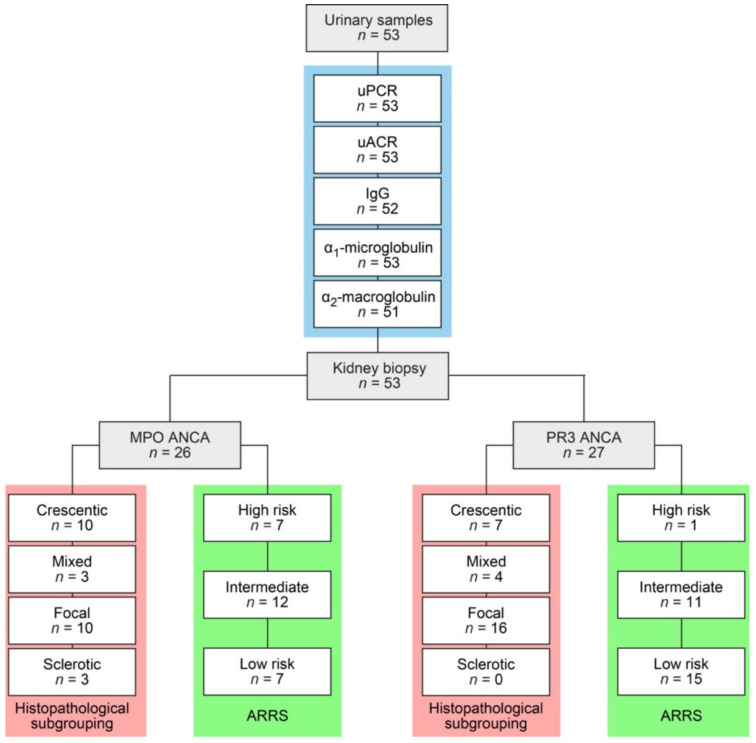
Renal involvement is a common and severe complication of antineutrophil cytoplasmic antibody (ANCA)-associated vasculitis (AAV), potentially resulting in a pauci-immune necrotizing and crescentic ANCA glomerulonephritis (GN) with acute kidney injury (AKI), end-stage renal disease (ESRD) or death. There is recent evidence that the degree of proteinuria at diagnosis is associated with long-term renal outcome in ANCA GN. Therefore, we here aimed to systematically describe the association between proteinuria and clinicopathological characteristics in 53 renal biopsies with ANCA GN and corresponding urinary samples at admission.
A total number of 53 urinary samples at admission and corresponding renal biopsies with confirmed renal involvement of AAV were retrospectively included from 2015 to 2021 in a single-center study.
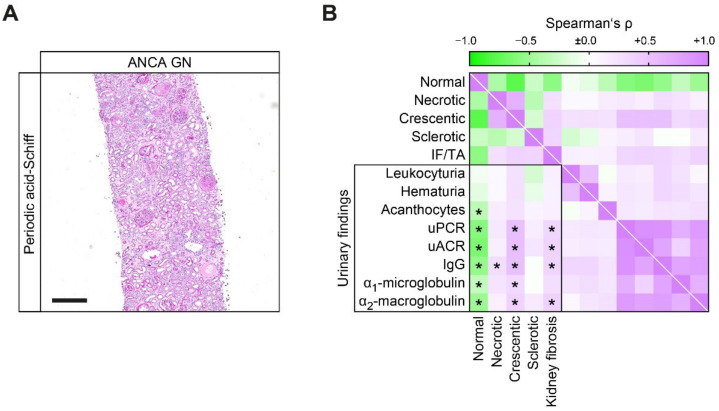
Proteinuria correlated with myeloperoxidase (MPO) subtype, diagnosis of microscopic polyangiitis (MPA) and severe deterioration of kidney function. Proteinuria was most prominent in sclerotic class ANCA GN and ANCA renal risk score (ARRS) high risk attributed to nonselective proteinuria, including both glomerular and tubular proteinuria. Finally, there was no association between proteinuria and systemic disease activity, suggesting that proteinuria reflected specific renal involvement in AAV rather that systemic disease activity.
In conclusion, proteinuria correlated with distinct clinicopathological characteristics in ANCA GN, mostly attributed to a reduced fraction of normal glomeruli. Furthermore, proteinuria in ANCA GN reflected specific renal involvement in AAV rather than systemic disease activity. Therefore, urinary findings could further improve our understanding of mechanisms promoting kidney injury and progression of ANCA GN.
肾脏受累是抗中性粒细胞胞浆抗体(ANCA)相关血管炎(AAV)常见且严重的并发症,可能导致寡免疫坏死性新月体性ANCA肾小球肾炎(GN),并伴有急性肾损伤(AKI)、终末期肾病(ESRD)或死亡。最近有证据表明,ANCA GN诊断时的蛋白尿程度与长期肾脏预后相关。因此,我们旨在系统描述53例ANCA GN肾活检及入院时相应尿液样本中蛋白尿与临床病理特征之间的关联。
在一项单中心研究中,回顾性纳入了2015年至2021年期间53份入院时的尿液样本及确诊有AAV肾脏受累的相应肾活检样本。
蛋白尿与髓过氧化物酶(MPO)亚型、显微镜下多血管炎(MPA)的诊断以及肾功能严重恶化相关。蛋白尿在硬化型ANCA GN和ANCA肾风险评分(ARRS)高风险组中最为突出,这归因于非选择性蛋白尿,包括肾小球性和肾小管性蛋白尿。最后,蛋白尿与全身疾病活动度之间无关联,这表明蛋白尿反映了AAV中特定的肾脏受累情况,而非全身疾病活动度。
总之,蛋白尿与ANCA GN中不同的临床病理特征相关,主要归因于正常肾小球比例降低。此外,ANCA GN中的蛋白尿反映了AAV中特定的肾脏受累情况,而非全身疾病活动度。因此,尿液检查结果可进一步增进我们对促进ANCA GN肾损伤和进展机制的理解。