Division of Behavioral Medicine, Department of Medicine, Jacobs School of Medicine, University at Buffalo, Buffalo, NY, USA.
School of Social Work, New York University, New York, NY, USA.
Trials. 2022 Aug 13;23(1):651. doi: 10.1186/s13063-022-06554-9.
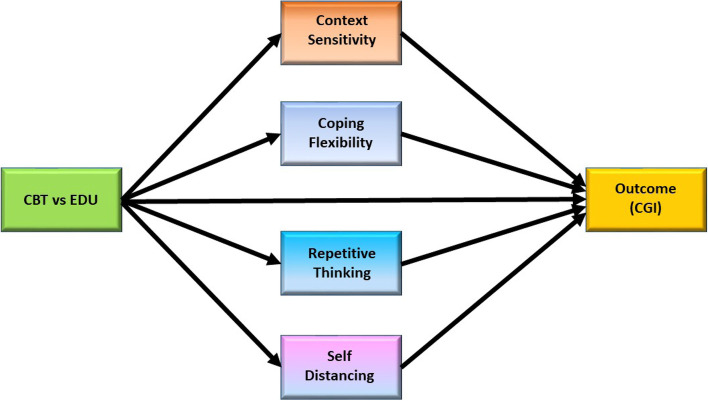
Urologic chronic pelvic pain syndrome (UCPPS) encompasses several common, costly, diagnoses including interstitial cystitis/bladder pain syndrome and chronic prostatitis/chronic pelvic pain syndrome that are poorly understood and inadequately treated with conventional medical therapies. Behavioral strategies, recommended as a first-line treatment for managing symptoms, are largely inaccessible, time and labor intensive, and technically complex. The Easing Pelvic Pain Interventions Clinical Research Program (EPPIC) is a clinical trial examining the efficacy of low-intensity cognitive behavioral therapy (Minimal Contact CBT or MC-CBT) for UCPPS and its durability 3 and 6 months post treatment. Additional aims include characterizing the operative processes (e.g., cognitive distancing, context sensitivity, coping flexibility, repetitive negative thought) that drive MC-CBT-induced symptom relief and pre-treatment patient variables that moderate differential response.
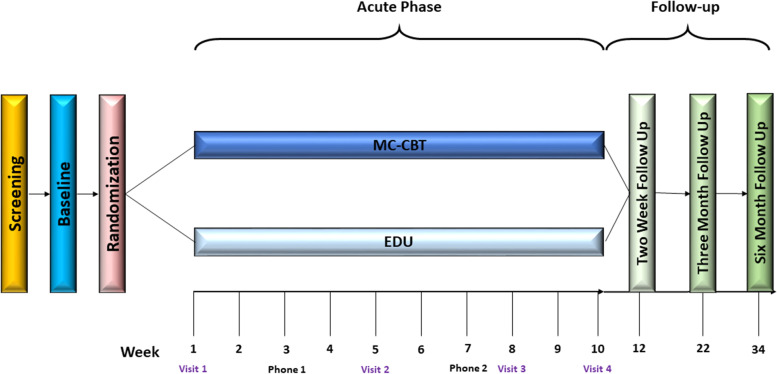
UCPPS patients (240) ages 18-70 years, any gender, ethnicity, and race, will be randomized to 4-session MC-CBT or a credible, non-specific education comparator (EDU) that controls for the generic effects from simply going to treatment. Efficacy assessments will be administered at pre-treatment, 2 weeks, and 3 and 6 months post treatment-week acute phase. A novel statistical approach applied to micro-analytic mediator assessment schedule will permit the specification of the most effective CBT component(s) that drive symptom relief.
Empirical validation of a low-intensity self-management therapy transdiagnostic in scope has the potential to improve the health of chronic pelvic pain patients refractory to medical therapies, reduce social and economic costs, conserve health care resources, as well as inform evidence-based practice guidelines. Identification of change mechanisms and moderators of treatment effects can provide proactive patient-treatment matching fundamental to goals of personalized medicine.
Clinicaltrials.gov NCT05127616. Registered on 9/19/21.
泌尿科慢性盆腔疼痛综合征 (UCPPS) 包含几种常见的、昂贵的诊断,包括间质性膀胱炎/膀胱疼痛综合征和慢性前列腺炎/慢性盆腔疼痛综合征,这些疾病的发病机制尚不清楚,且常规医学治疗效果不佳。行为策略被推荐为管理症状的一线治疗方法,但这种方法在很大程度上难以获得,需要耗费大量时间和精力,并且技术复杂。Easing Pelvic Pain Interventions Clinical Research Program (EPPIC) 是一项临床试验,旨在研究低强度认知行为疗法(最低接触认知行为疗法或 MC-CBT)对 UCPPS 的疗效及其在治疗后 3 个月和 6 个月的持久性。其他目标包括描述驱动 MC-CBT 缓解症状的操作过程(例如,认知距离、上下文敏感性、应对灵活性、重复消极思维)和治疗前患者变量,这些变量会影响不同的反应。
将年龄在 18-70 岁之间的 UCPPS 患者(240 名)随机分为 4 节 MC-CBT 或可信的、非特定的教育对照组(EDU),以控制单纯接受治疗的一般效果。在治疗前、治疗后 2 周以及 3 个月和 6 个月进行疗效评估。一种应用于微分析调解人评估时间表的新型统计方法,将允许指定驱动症状缓解的最有效的 CBT 成分。
对一种具有广泛范围的低强度自我管理疗法的实证验证有可能改善对医学治疗有抗药性的慢性盆腔疼痛患者的健康状况,降低社会和经济成本,节约医疗资源,并为循证实践指南提供信息。识别治疗效果的变化机制和调节因素可以为个性化医疗的目标提供主动的患者治疗匹配。
Clinicaltrials.gov NCT05127616。注册于 2021 年 9 月 19 日。