Zuro Darren M, Vidal Gabriel, Cantrell James Nathan, Chen Yong, Han Chunhui, Henson Christina, Ahmad Salahuddin, Hui Susanta, Ali Imad
Department of Radiation Oncology, University of Oklahoma Health Science Center (HSC), Oklahoma City, OK, United States.
Department of Radiation Oncology, City of Hope, Durate, CA, United States.
Front Oncol. 2022 Jul 28;12:955004. doi: 10.3389/fonc.2022.955004. eCollection 2022.
The goal of this study is to investigate treatment planning of total marrow irradiation (TMI) using intensity-modulated spot-scanning proton therapy (IMPT). The dosimetric parameters of the intensity-modulated proton plans were evaluated and compared with the corresponding TMI plans generated with volumetric modulated arc therapy (VMAT) using photon beams.
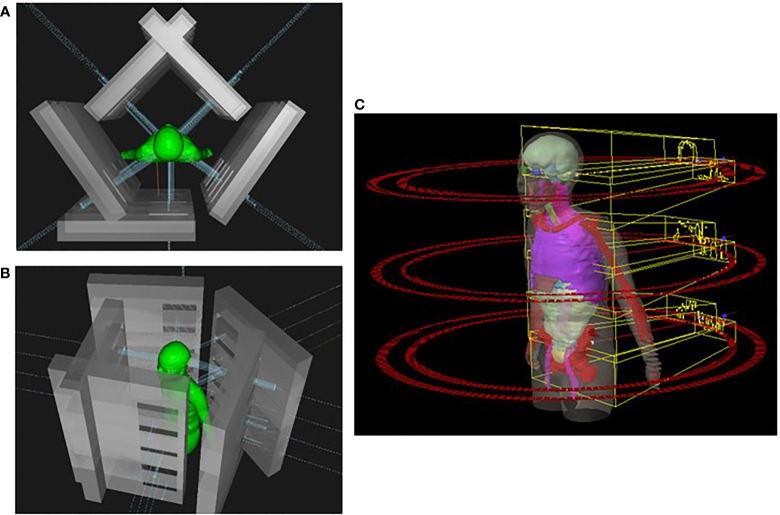
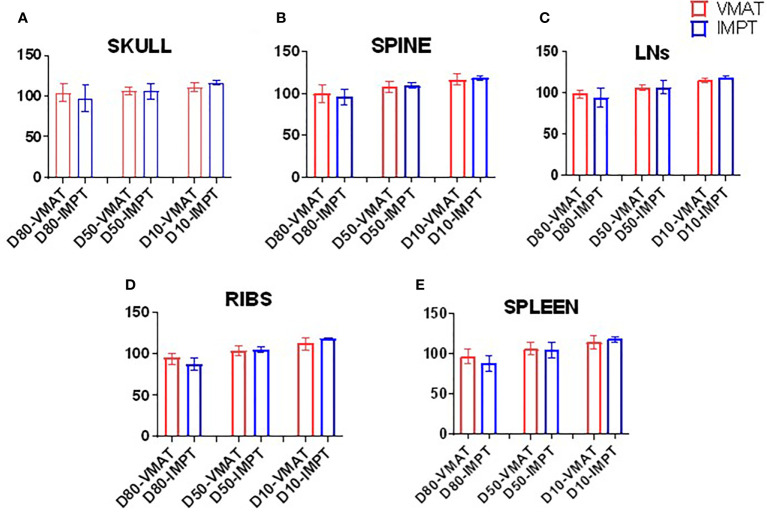
Intensity-modulated proton plans for TMI were created using the Monte Carlo dose-calculation algorithm in the Raystation 11A treatment planning system with spot-scanning proton beams from the MEVION S250i Hyperscan system. Treatment plans were generated with four isocenters placed along the longitudinal direction, each with a set of five beams for a total of 20 beams. VMAT-TMI plans were generated with the Eclipse-V15 analytical anisotropic algorithm (AAA) using a Varian Trilogy machine. Three planning target volumes (PTVs) for the bones, ribs, and spleen were covered by 12 Gy. The dose conformity index, D80, D50, and D10, for PTVs and organs at risk (OARs) for the IMPT plans were quantified and compared with the corresponding VMAT plans.
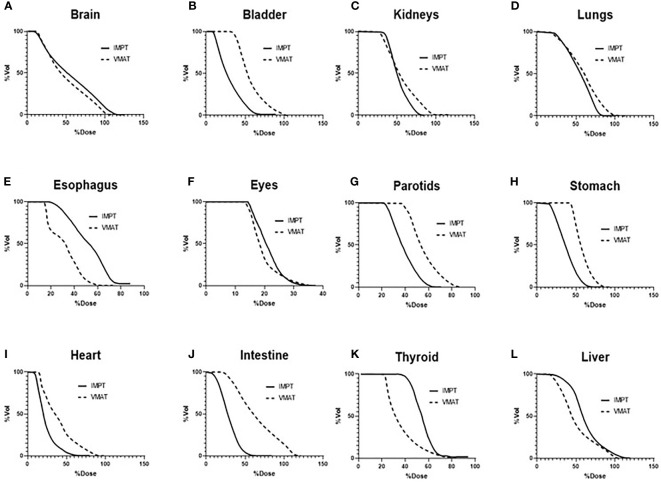
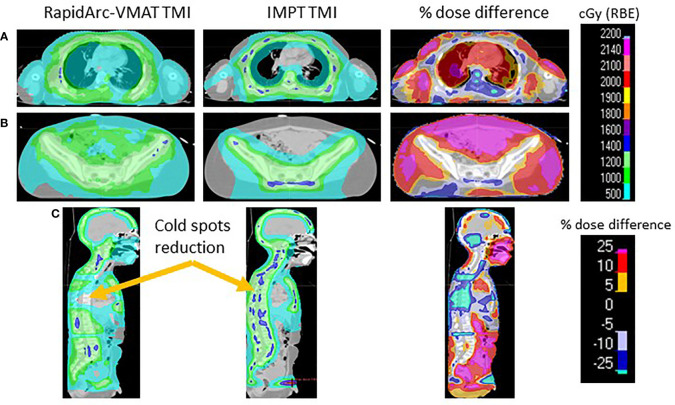
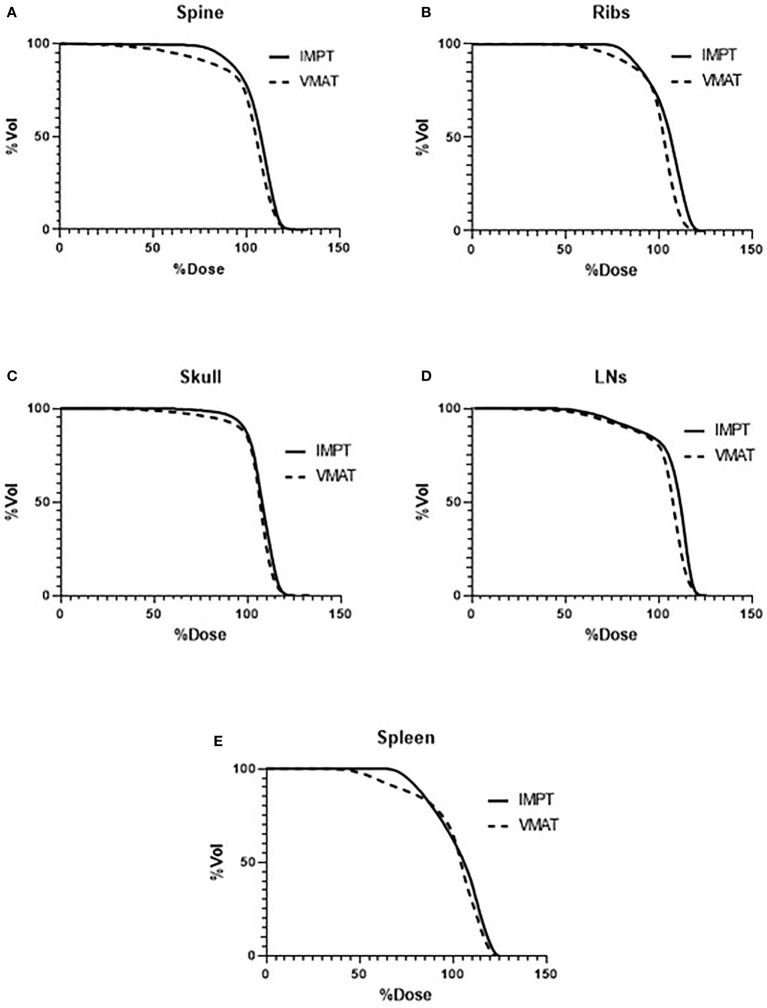
The mean dose for most of the OARs was reduced substantially (5% and more) in the IMPT plans for TMI in comparison with VMAT plans except for the esophagus and thyroid, which experienced an increase in dose. This dose reduction is due to the fast dose falloff of the distal Bragg peak in the proton plans. The conformity index was found to be similar (0.78 vs 0.75) for the photon and proton plans. IMPT plans provided superior superficial dose coverage for the skull and ribs in comparison with VMAT because of increased entrance dose deposition by the proton beams.
Treatment plans for TMI generated with IMPT were superior to VMAT plans mainly due to a large reduction in the OAR dose. Although the current IMPT-TMI technique is not clinically practical due to the long overall treatment time, this study presents an enticing alternative to conventional TMI with photons by providing superior dose coverage of the targets, increased sparing of the OARs, and enhanced radiobiological effects associated with proton therapy.
本研究的目的是探讨使用调强点扫描质子治疗(IMPT)进行全骨髓照射(TMI)的治疗计划。评估调强质子计划的剂量学参数,并与使用光子束的容积调强弧形治疗(VMAT)生成的相应TMI计划进行比较。
使用Raystation 11A治疗计划系统中的蒙特卡罗剂量计算算法,结合MEVION S250i超扫描系统的点扫描质子束,创建TMI的调强质子计划。治疗计划通过沿纵向放置四个等中心生成,每个等中心有一组五束射线,共20束射线。使用瓦里安Trilogy机器,通过Eclipse-V15分析各向异性算法(AAA)生成VMAT-TMI计划。三个针对骨骼、肋骨和脾脏的计划靶体积(PTV)接受12 Gy的照射。对IMPT计划的PTV和危及器官(OAR)的剂量适形指数、D80、D50和D10进行量化,并与相应的VMAT计划进行比较。
与VMAT计划相比,TMI的IMPT计划中,除食管和甲状腺剂量增加外,大多数OAR的平均剂量大幅降低(5%及以上)。这种剂量降低是由于质子计划中远端布拉格峰的快速剂量下降。发现光子和质子计划的适形指数相似(分别为0.78和0.75)。与VMAT相比,IMPT计划为颅骨和肋骨提供了更好的浅表剂量覆盖,这是因为质子束增加了入射剂量沉积。
IMPT生成的TMI治疗计划优于VMAT计划,主要原因是OAR剂量大幅降低。尽管由于总体治疗时间长,目前的IMPT-TMI技术在临床上不实用,但本研究通过提供更好的靶区剂量覆盖、增加OAR的 sparing以及增强与质子治疗相关的放射生物学效应,为传统光子TMI提供了一个诱人的替代方案。