Taylor Douglas J, Deese Jennifer, Bahamondes Luis, Brache Vivian, Veiga Nelio, Fuchs Rachael, Halpern Vera, Dorflinger Laneta J
FHI 360, Durham, NC, United States.
RTI International, Research Triangle Park, North Carolina, United States.
Contracept X. 2022 Jul 25;4:100080. doi: 10.1016/j.conx.2022.100080. eCollection 2022.
To characterize return to ovulation after injecting Sayana Press (104 mg/0.65 mL medroxyprogesterone acetate [MPA] in the Uniject device) every 4 months for 1 year of treatment.
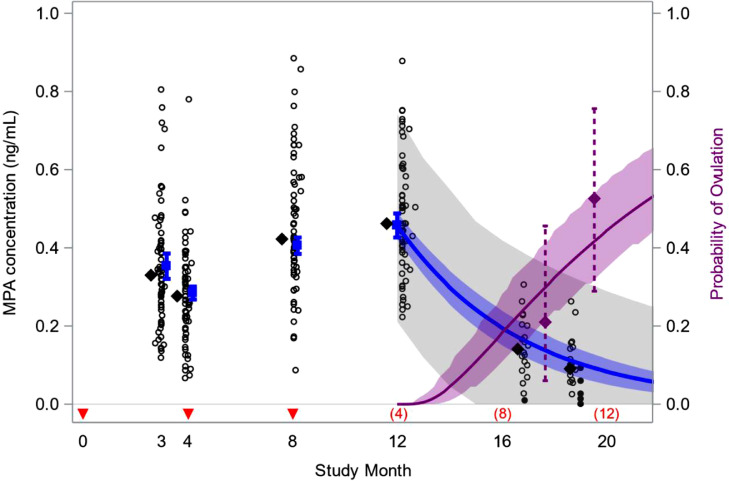
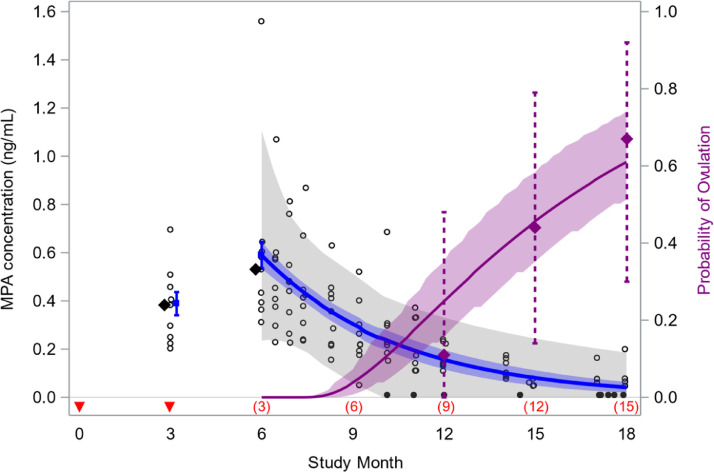
We followed a subset of women for return to ovulation in a trial that demonstrated Sayana Press remains highly effective when the subcutaneous reinjection interval is extended from 3 to 4 months. We measured serum progesterone in weeks 38 to 42 and 46 to 50 after a final (third) injection and used a concentration ≥4.7 ng/mL as a surrogate for ovulation. We also performed pharmacokinetic and pharmacodynamic modeling to predict differences in MPA accumulation and return to ovulation had - contrary to fact - injections been given every 3 months.
Ten of 19 women (53%; 95% confidence interval: 29-76) ovulated within 50 weeks of their last injection. We predicted that typical 12-month trough MPA concentrations are 34% lower (0.46 vs 0.69 ng/mL) and the median time from last dose to ovulation is 1.1 months shorter (13.1 vs 14.2 months) when injections are given every four months for 1 year.
Extending the Sayana Press reinjection interval from 3 to 4 months leads to less drug accumulation, without a noticeable loss in efficacy. Although the Sayana Press patient leaflet specifies that over 80% of women desiring pregnancy will conceive within a year of stopping the method (independent of treatment duration), our empirical and modeling results indicate women should anticipate waiting a year or more for fertility to return after repeat dosing, with a somewhat shorter delay were the reinjection interval extended to four months.
Providers should counsel women regarding the distinct possibility that return to fertility will take a year or longer following repeat use of Sayana Press. Extending the dosing interval from 3 to 4 months would result in approximately a 1-month shorter delay, without any appreciable reduction in contraceptive efficacy.
描述在接受为期1年的治疗中,每4个月注射一次赛妮亚(Uniject装置中含104mg/0.65mL醋酸甲羟孕酮[MPA])后恢复排卵的情况。
在一项试验中,我们对一部分女性进行随访以观察其恢复排卵的情况,该试验表明当皮下再次注射间隔从3个月延长至4个月时,赛妮亚仍具有高效性。我们在最后一次(第三次)注射后的第38至42周以及第46至50周测量血清孕酮,并将浓度≥4.7ng/mL作为排卵的替代指标。我们还进行了药代动力学和药效学建模,以预测如果每3个月注射一次(与实际情况相反),MPA蓄积和恢复排卵的差异。
19名女性中有10名(53%;95%置信区间:29 - 76)在最后一次注射后的50周内排卵。我们预测,当每4个月注射一次,持续1年时,典型的12个月MPA谷浓度低34%(0.46对0.69ng/mL),从最后一剂到排卵的中位时间短1.1个月(13.1对14.2个月)。
将赛妮亚的再次注射间隔从3个月延长至4个月会减少药物蓄积,且疗效无明显损失。尽管赛妮亚患者说明书指出,超过80%希望怀孕的女性在停止使用该方法后的一年内会怀孕(与治疗持续时间无关),但我们的实证和建模结果表明,女性应预期在重复给药后等待一年或更长时间才能恢复生育能力,如果将再次注射间隔延长至4个月,延迟时间会稍短一些。
医疗服务提供者应告知女性,在重复使用赛妮亚后,恢复生育能力很有可能需要一年或更长时间。将给药间隔从3个月延长至4个月会使延迟时间缩短约1个月,且避孕效果无明显降低。