Dean Charles A, Metzbower Sarah R, Dessain Scott K, Blanpied Thomas A, Benavides David R
Department of Neurology, University of Maryland School of Medicine, Baltimore, MD, United States.
Department of Physiology, University of Maryland School of Medicine, Baltimore, MD, United States.
Front Mol Neurosci. 2022 Jul 28;15:940005. doi: 10.3389/fnmol.2022.940005. eCollection 2022.
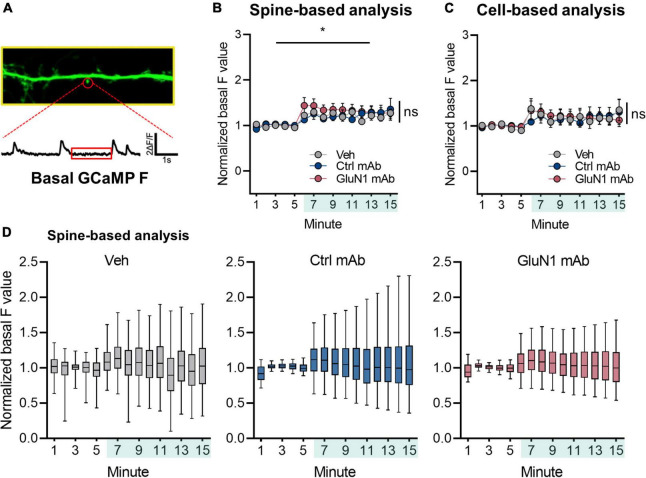
The NMDA receptor (NMDAR) subunit GluN1 is critical for receptor function and plays a pivotal role in synaptic plasticity. Mounting evidence has shown that pathogenic autoantibody targeting of the GluN1 subunit of NMDARs, as in anti-NMDAR encephalitis, leads to altered NMDAR trafficking and synaptic localization. However, the underlying signaling pathways affected by antibodies targeting the NMDAR remain to be fully delineated. It remains unclear whether patient antibodies influence synaptic transmission direct effects on NMDAR channel function. Here, we show using short-term incubation that GluN1 antibodies derived from patients with anti-NMDAR encephalitis label synapses in mature hippocampal primary neuron culture. Miniature spontaneous calcium transients (mSCaTs) mediated NMDARs at synaptic spines are not altered in pathogenic GluN1 antibody exposed conditions. Unexpectedly, spine-based and cell-based analyses yielded distinct results. In addition, we show that calcium does not accumulate in neuronal spines following brief exposure to pathogenic GluN1 antibodies. Together, these findings show that pathogenic antibodies targeting NMDARs, under these specific conditions, do not alter synaptic calcium influx following neurotransmitter release. This represents a novel investigation of the molecular effects of anti-NMDAR antibodies associated with autoimmune encephalitis.
N-甲基-D-天冬氨酸受体(NMDAR)亚基GluN1对受体功能至关重要,并在突触可塑性中起关键作用。越来越多的证据表明,针对NMDARs的GluN1亚基的致病性自身抗体,如在抗NMDAR脑炎中,会导致NMDAR转运和突触定位的改变。然而,受针对NMDAR的抗体影响的潜在信号通路仍有待全面阐明。患者抗体是否直接影响NMDAR通道功能从而影响突触传递仍不清楚。在这里,我们通过短期孵育表明,来自抗NMDAR脑炎患者的GluN1抗体在成熟海马原代神经元培养物中标记突触。在致病性GluN1抗体暴露条件下,突触棘处由NMDAR介导的微小自发钙瞬变(mSCaTs)没有改变。出乎意料的是,基于突触棘和基于细胞的分析产生了不同的结果。此外,我们表明,在短暂暴露于致病性GluN1抗体后,钙不会在神经元突触棘中积累。总之,这些发现表明,在这些特定条件下,针对NMDAR的致病性抗体不会改变神经递质释放后突触钙内流。这代表了对与自身免疫性脑炎相关的抗NMDAR抗体分子效应的新研究。