Medical School of Chinese People's Liberation Army, Beijing, China.
Department of Endocrinology, The First Clinical Medical Center of Chinese People's Liberation Army General Hospital, Beijing, China.
Front Endocrinol (Lausanne). 2022 Jul 28;13:955241. doi: 10.3389/fendo.2022.955241. eCollection 2022.
Obesity, especially visceral obesity, seems to be one of the most decisive risk factors for chronic kidney disease. A Body Shape Index (ABSI) is an emerging body size measurement marker of visceral obesity. This study aimed to explore whether ABSI is associated with albuminuria in Chinese community adults.
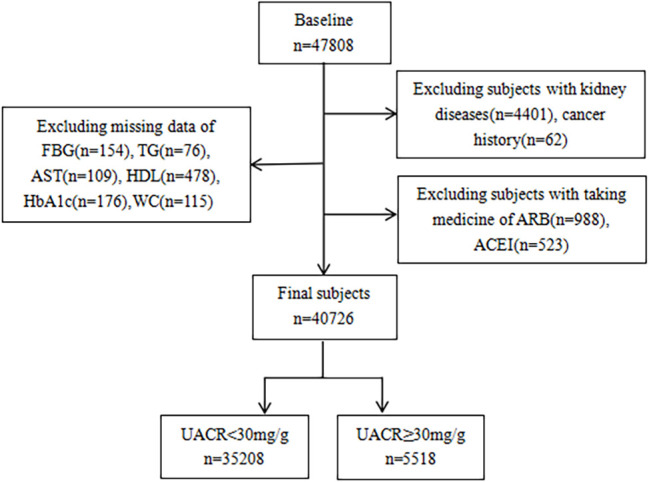
This cross-sectional study enrolled 40,726 participants aged 40 or older from seven provinces across China through a cluster random sampling method. ABSI was calculated by body mass index, waist circumference, and height. Increased albuminuria was defined as urinary albumin-creatinine ratio (UACR) ≥ 30 mg/g, indicating kidney injury. For ABSI, we divided it by quartile cutoff points and tried to determine the association between ABSI levels and UACR by multiple regression analysis. DAG (Directed Acyclic Graph) was plotted using literature and expert consensus to identify potential confounding factors.
The average age of subjects with elevated UACR was 61.43 ± 10.07, and 26% were men. The average age of subjects with normal UACR was 57.70 ± 9.02, and 30.5% were men. Multiple logistic regression analysis was conducted and demonstrated that the ABSI quartiles were related to elevated UACR positively (OR [95% CI] Q2 vs. Q1: 1.094 [1.004, 1.197]; OR [95% CI] Q3 vs. Q1: 1.126 [1.030, 1.231]; OR [95% CI] Q4 vs. Q1: 1.183 [1.080, 1.295], for trend < 0.001) after adjustments for confounding factors. The stratified analysis further showed that with the mounting for ABSI levels, elevated UACR more easily occurred in the people characterized by the elderly, men, and hypertension.
In Chinese community adults, people with higher ABSI levels can be deemed as high-risk individuals with UACR elevation, and it will be beneficial for them to lose weight and significantly reduce visceral fat.
肥胖,尤其是内脏肥胖,似乎是慢性肾脏病的最重要决定因素之一。身体形状指数(ABSI)是一种新兴的内脏肥胖身体大小测量标志物。本研究旨在探讨 ABSI 是否与中国社区成年人的蛋白尿有关。
本横断面研究通过整群随机抽样方法从中国七个省份招募了 40726 名年龄在 40 岁及以上的参与者。ABSI 通过体重指数、腰围和身高计算得出。白蛋白尿增加定义为尿白蛋白-肌酐比值(UACR)≥30mg/g,提示肾脏损伤。对于 ABSI,我们按四分位截断点进行划分,并尝试通过多元回归分析确定 ABSI 水平与 UACR 之间的关联。使用文献和专家共识绘制 DAG(有向无环图),以确定潜在的混杂因素。
UACR 升高者的平均年龄为 61.43±10.07 岁,其中 26%为男性;UACR 正常者的平均年龄为 57.70±9.02 岁,其中 30.5%为男性。进行多因素逻辑回归分析表明,ABSI 四分位数与 UACR 升高呈正相关(OR[95%CI]Q2 与 Q1:1.094[1.004,1.197];OR[95%CI]Q3 与 Q1:1.126[1.030,1.231];OR[95%CI]Q4 与 Q1:1.183[1.080,1.295],趋势 P<0.001),调整混杂因素后。分层分析进一步表明,随着 ABSI 水平的升高,高龄、男性和高血压人群更容易出现 UACR 升高。
在中国社区成年人中,ABSI 水平较高的人群可视为 UACR 升高的高危人群,减轻体重和显著减少内脏脂肪将对他们有益。