Ratnik Kaspar, Rull Kristiina, Aasmets Oliver, Kikas Triin, Hanson Ele, Kisand Kalle, Fischer Krista, Laan Maris
Department of Biomedicine, Institute of Biomedicine and Translational Medicine, University of Tartu, Tartu, Estonia.
SYNLAB Eesti OÜ, Tallinn, Estonia.
Front Cardiovasc Med. 2022 Jul 27;9:932480. doi: 10.3389/fcvm.2022.932480. eCollection 2022.
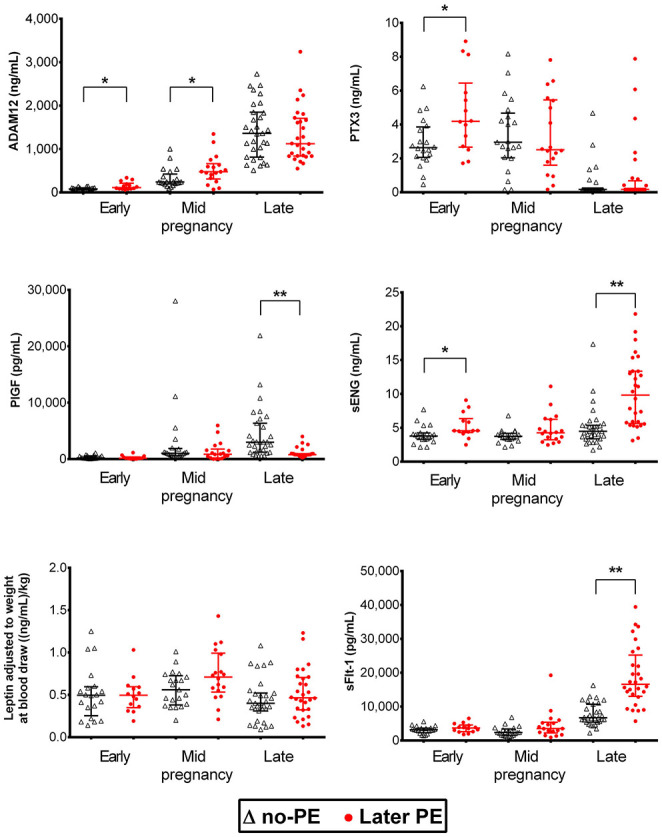
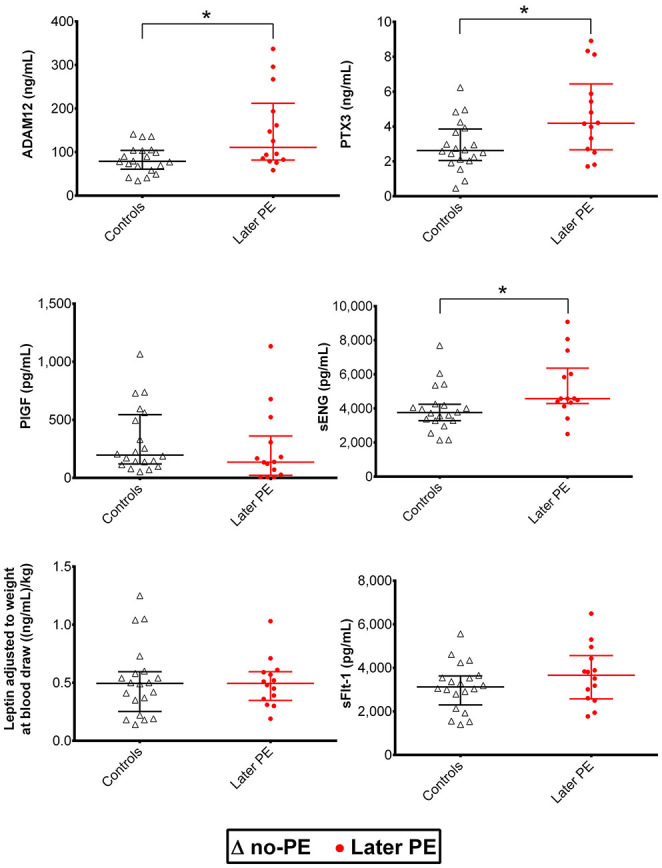
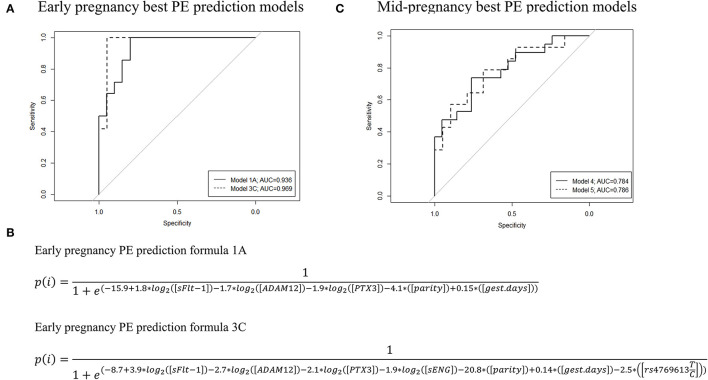
Preeclampsia (PE) is a common pregnancy-linked disease, causing preterm births, complicated deliveries, and health consequences for mothers and offspring. We have previously developed 6PLEX, a multiplex assay that measures PE-related maternal serum biomarkers ADAM12, sENG, leptin, PlGF, sFlt-1, and PTX3 in a single test tube. This study investigated the potential of 6PLEX to develop novel PE prediction models for early pregnancy. We analyzed 132 serum samples drawn at 70-275 gestational days (g days) from 53 pregnant women (PE, = 22; controls, = 31). PE prediction models were developed using a machine learning strategy based on the stepwise selection of the most significant models and incorporating parameters with optimal resampling. Alternative models included also placental rs4769613 T/C genotypes, a high-confidence risk factor for PE. The best performing PE prediction model using samples collected at 70-98 g days comprised of PTX3, sFlt-1, and ADAM12, the subject's parity and gestational age at sampling (AUC 0.94 [95%CI 0.84-0.99]). All cases, that developed PE several months later (onset 257.4 ± 15.2 g days), were correctly identified. The model's specificity was 80% [95%CI 65-100] and the overall accuracy was 88% [95%CI 73-95]. Incorporating additionally the placental rs4769613 T/C genotype data increased the prediction accuracy to 93.5% [AUC = 0.97 (95%CI 0.89-1.00)]. However, 6PLEX measurements of samples collected at 100-182 g days were insufficiently informative to develop reliable PE prediction models for mid-pregnancy (accuracy <75%). In summary, the developed model opens new horizons for first-trimester PE screening, combining the easily standardizable 6PLEX assay with routinely collected antenatal care data and resulting in high sensitivity and specificity.
子痫前期(PE)是一种常见的妊娠相关疾病,会导致早产、分娩并发症以及对母亲和后代的健康产生影响。我们之前开发了6PLEX,这是一种多重检测方法,可在单个试管中检测与PE相关的母体血清生物标志物ADAM12、sENG、瘦素、PlGF、sFlt-1和PTX3。本研究调查了6PLEX用于开发早期妊娠新型PE预测模型的潜力。我们分析了53名孕妇(PE患者22例;对照组31例)在妊娠70 - 275天(g天)采集的132份血清样本。使用基于逐步选择最显著模型并结合具有最佳重采样参数的机器学习策略开发PE预测模型。替代模型还包括胎盘rs4769613 T/C基因型,这是PE的一个高置信度风险因素。使用在妊娠70 - 98天采集的样本建立的最佳PE预测模型包括PTX3、sFlt-1和ADAM12、受试者的产次以及采样时的孕周(AUC 0.94 [95%CI 0.84 - 0.99])。所有几个月后发生PE(发病孕周257.4 ± 15.2 g天)的病例均被正确识别。该模型的特异性为80% [95%CI 65 - 100],总体准确率为88% [95%CI 73 - 95]。另外纳入胎盘rs4769613 T/C基因型数据可将预测准确率提高到93.5% [AUC = 0.97 (95%CI 0.89 - 1.00)]。然而,对在妊娠100 - 182天采集的样本进行6PLEX检测所提供的信息不足以建立可靠的中期妊娠PE预测模型(准确率<75%)。总之,所开发的模型为孕早期PE筛查开辟了新视野,将易于标准化的6PLEX检测与常规收集的产前护理数据相结合,具有高灵敏度和特异性。