Gao Yuchen, Liu Xiaojie, Wang Lijuan, Wang Sudena, Yu Yang, Ding Yao, Wang Jingcan, Ao Hushan
Department of Anesthesiology, Fuwai Hospital, State Key Laboratory of Cardiovascular Disease, National Center of Cardiovascular Diseases, Chinese Academy of Medical Sciences and Peking Union Medical College, Beijing, China.
Department of Anesthesiology, The Affiliated Hospital of Qingdao University, Qingdao, China.
Front Cardiovasc Med. 2022 Jul 28;9:881881. doi: 10.3389/fcvm.2022.881881. eCollection 2022.
Postoperative major bleeding is a common problem in patients undergoing cardiac surgery and is associated with poor outcomes. We evaluated the performance of machine learning (ML) methods to predict postoperative major bleeding.
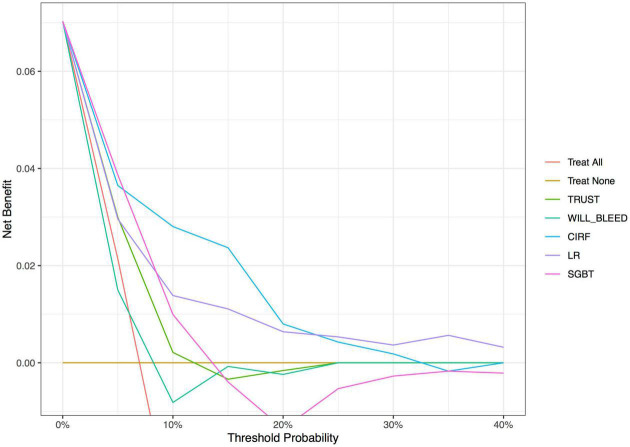
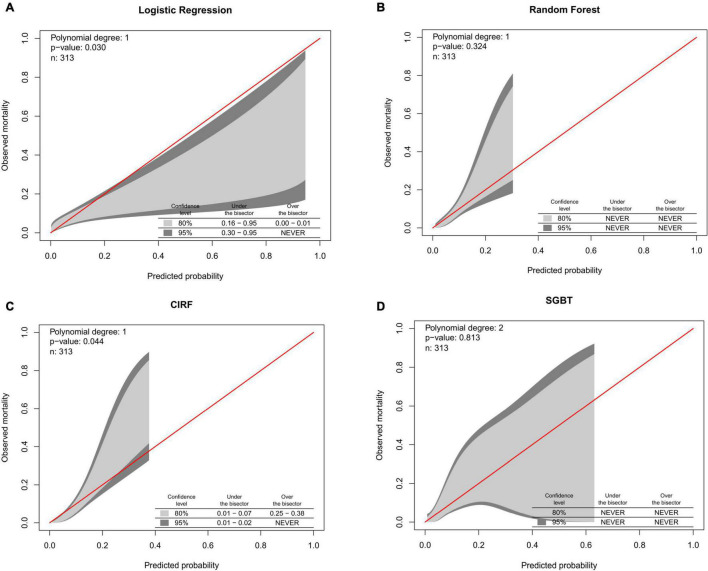
A total of 1,045 patients who underwent isolated coronary artery bypass graft surgery (CABG) were enrolled. Their datasets were assigned randomly to training (70%) or a testing set (30%). The primary outcome was major bleeding defined as the universal definition of perioperative bleeding (UDPB) classes 3-4. We constructed a reference logistic regression (LR) model using known predictors. We also developed several modern ML algorithms. In the test set, we compared the area under the receiver operating characteristic curves (AUCs) of these ML algorithms with the reference LR model results, and the TRUST and WILL-BLEED risk score. Calibration analysis was undertaken using the calibration belt method.
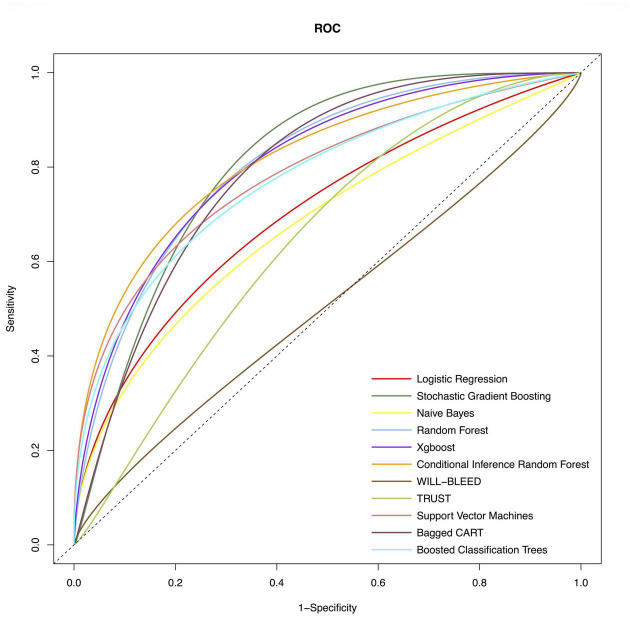
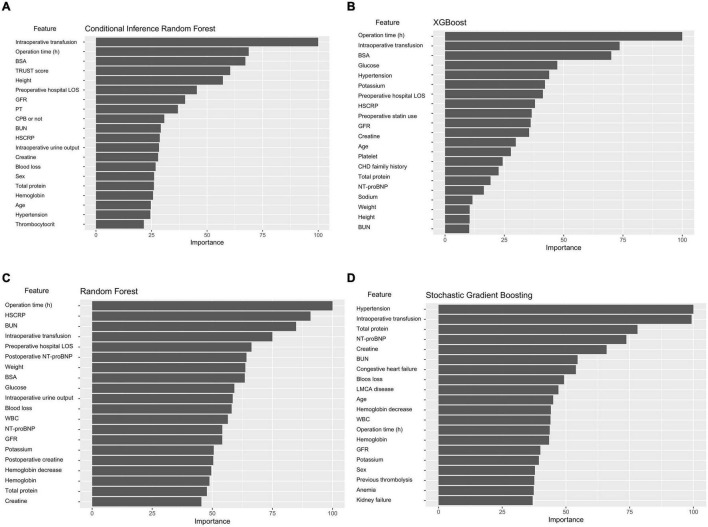
The prevalence of postoperative major bleeding was 7.1% (74/1,045). For major bleeds, the conditional inference random forest (CIRF) model showed the highest AUC [0.831 (0.732-0.930)], and the stochastic gradient boosting (SGBT) and random forest models demonstrated the next best results [0.820 (0.742-0.899) and 0.810 (0.719-0.902)]. The AUCs of all ML models were higher than [0.629 (0.517-0.641) and 0.557 (0.449-0.665)], as achieved by TRUST and WILL-BLEED, respectively.
ML methods successfully predicted major bleeding after cardiac surgery, with greater performance compared with previous scoring models. Modern ML models may enhance the identification of high-risk major bleeding subpopulations.
术后大出血是心脏手术患者的常见问题,且与不良预后相关。我们评估了机器学习(ML)方法预测术后大出血的性能。
共纳入1045例行单纯冠状动脉旁路移植术(CABG)的患者。他们的数据集被随机分配到训练集(70%)或测试集(30%)。主要结局是大出血,定义为围手术期出血通用定义(UDPB)3 - 4级。我们使用已知预测因素构建了一个参考逻辑回归(LR)模型。我们还开发了几种现代ML算法。在测试集中,我们将这些ML算法的受试者操作特征曲线下面积(AUC)与参考LR模型结果以及TRUST和WILL - BLEED风险评分进行了比较。使用校准带方法进行校准分析。
术后大出血的发生率为7.1%(74/1045)。对于大出血,条件推断随机森林(CIRF)模型显示出最高的AUC [0.831(0.732 - 0.930)],随机梯度提升(SGBT)和随机森林模型表现次之 [0.820(0.742 - 0.899)和0.810(0.719 - 0.902)]。所有ML模型的AUC均高于TRUST和WILL - BLEED分别达到的[0.629(0.517 - 0.641)和0.557(0.449 - 0.665)]。
ML方法成功预测了心脏手术后的大出血,与先前的评分模型相比性能更佳。现代ML模型可能会增强对高危大出血亚组人群的识别。