Doustmohammadian Azam, Nezhadisalami Ahmad, Safarnezhad Tameshke Fahimeh, Motamed Nima, Maadi Mansooreh, Farahmand Mohammad, Sohrabi Masoudreza, Clark Cain C T, Ajdarkosh Hossein, Faraji Amir Hossein, Nikkhah Mehdi, Sobhrakhshankhah Elham, Ebrahimi Ramin, Zamani Farhad
Gastrointestinal and Liver Diseases Research Center, Iran University of Medical Sciences, Tehran, Iran.
Alimentary Tract Research Center, Clinical Sciences Research Institute, Ahvaz Jundishapur University of Medical Sciences, Ahvaz, Iran.
Front Med (Lausanne). 2022 Jul 28;9:937554. doi: 10.3389/fmed.2022.937554. eCollection 2022.
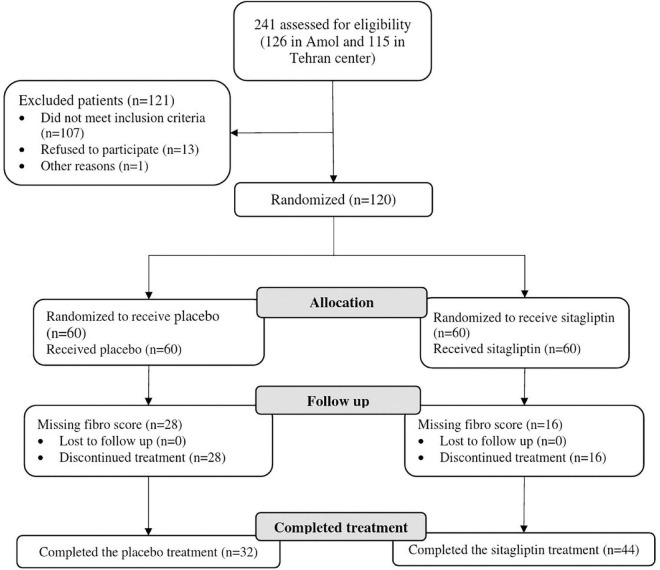
The current study aimed to evaluate the efficacy of sitagliptin vs. placebo in treating non-alcoholic fatty liver disease (NAFLD). In a triple-blind randomized clinical trial, we assigned 120 eligible subjects with NAFLD to receive daily dosing of 50 mg sitagliptin ( = 60) or the placebo ( = 60) for 56 weeks and lifestyle modification in both groups. Laboratory and anthropometric outcomes were measured, and liver stiffness was assessed using a fibroscan. The primary outcome measures were changes from baseline in fibrosis scores and liver transferases. Out of 120 patients randomized into sitagliptin and placebo groups, 76 patients completed the trial, of whom 44 were in the sitagliptin and 32 in the placebo groups. Patients receiving sitagliptin showed a significant decrease in the fibrosis scores ( = 0.001). The reductions in the alanine aminotransferase (AST) ( = 0.036) and aspartate AST ( < 0.001) levels were also statistically significant. The effect of sitagliptin in reducing fibrosis scores was significantly greater in normal-weight and overweight individuals than in obese individuals ( = 0.036, and = 0.018, respectively), whereas the effects of sitagliptin on AST levels were greater among overweight/obese patients ( = 0.028, and = 0.016, respectively). Sitagliptin reduced fibrosis scores and liver enzymes in NAFLD patients after 56 weeks of therapy. The changes in fibrosis scores were more prominent in patients with normal weight and overweight than obese patients, whereas the effects on AST levels were greater among overweight/obese patients. Other randomized trials with larger sample sizes and longer treatment durations may be required before precise results can be reached.
[https://www.irct.ir/trial/46140], identifier [IRCT20140430017505N2].
本研究旨在评估西格列汀与安慰剂治疗非酒精性脂肪性肝病(NAFLD)的疗效。在一项三盲随机临床试验中,我们将120名符合条件的NAFLD患者分为两组,一组每日服用50毫克西格列汀(n = 60),另一组服用安慰剂(n = 60),为期56周,两组均进行生活方式干预。测量实验室指标和人体测量结果,并使用肝脏弹性成像仪评估肝脏硬度。主要结局指标为纤维化评分和肝转氨酶较基线的变化。在随机分为西格列汀组和安慰剂组的120例患者中,76例完成试验,其中西格列汀组44例,安慰剂组32例。接受西格列汀治疗的患者纤维化评分显著降低(P = 0.001)。丙氨酸转氨酶(AST)水平降低(P = 0.036),天冬氨酸转氨酶(AST)水平降低(P < 0.001),差异也具有统计学意义。西格列汀降低纤维化评分的作用在正常体重和超重个体中比肥胖个体更显著(分别为P = 0.036和P = 0.018),而西格列汀对AST水平的影响在超重/肥胖患者中更大(分别为P = 0.028和P = 0.016)。治疗56周后,西格列汀降低了NAFLD患者的纤维化评分和肝酶水平。纤维化评分的变化在正常体重和超重患者中比肥胖患者更显著,而对AST水平的影响在超重/肥胖患者中更大。在得出精确结果之前,可能需要进行其他样本量更大、治疗时间更长的随机试验。