Hayashi Toshiyuki, Nakane Shunya, Mukaino Akihiro, Higuchi Osamu, Yamakawa Makoto, Matsuo Hidenori, Kimura Kazumi
Department of Neurology, Nippon Medical School, Tokyo, Japan.
Department of Neurology, Nippon Medical School, 1-1-5, Sendagi, Bunkyo-ku, Tokyo 113-8602, Japan.
Ther Adv Neurol Disord. 2022 Aug 3;15:17562864221110048. doi: 10.1177/17562864221110048. eCollection 2022.
Autoimmune autonomic ganglionopathy (AAG) is characterized by serum autoantibodies against the ganglionic acetylcholine receptor (gAChR). Immunomodulatory treatments may alleviate AAG symptoms, but the most appropriate treatment strategy is unclear.
This study aimed to confirm the effectiveness of treatments, particularly immunotherapy, in patients with seropositive AAG in Japan, as well as to determine the most effective treatment and the best assessment method for clinical response to treatment.
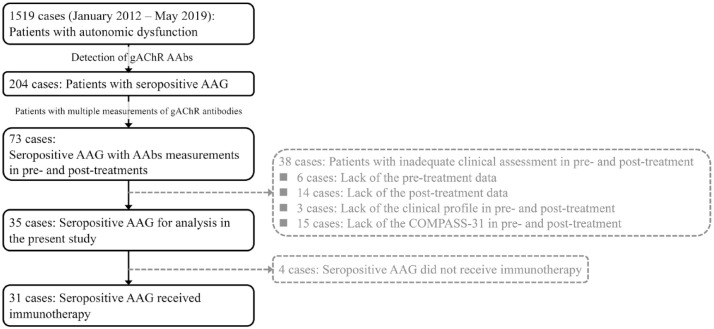
We collected data from a previous cohort study of patients with seropositive AAG. The clinical autonomic and extra-autonomic symptoms were objectively counted and subjectively assessed using the modified Composite Autonomic Symptom Score. Post-treatment changes in the gAChR antibody level were evaluated.
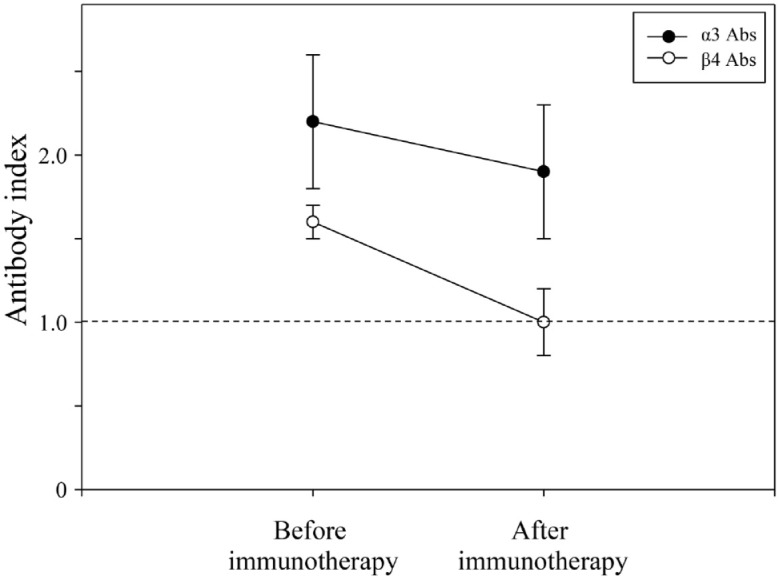
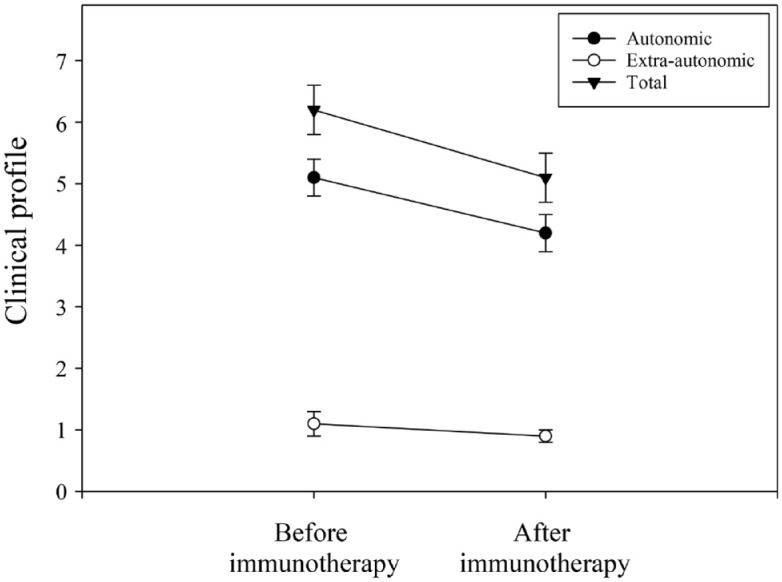
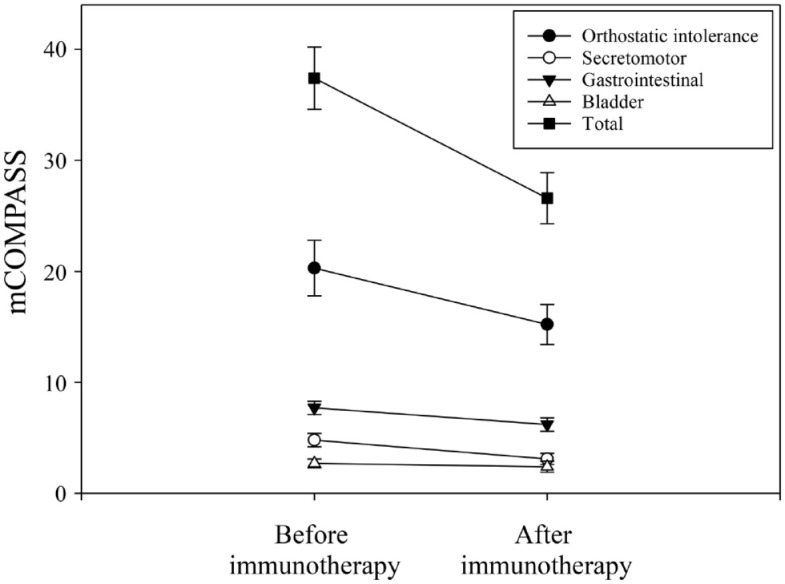
Thirty-one patients received immunotherapy. Among them, 19 patients received intravenous methylprednisolone; 27, intravenous immunoglobulin; 3, plasma exchange; 18, oral steroids; 2, tacrolimus; 1, cyclosporine; and 1, mycophenolate mofetil. Patients who received immunotherapy showed improvements in the total number of symptoms (from 6.2 ± 2.0 to 5.1 ± 2.0) and modified Composite Autonomic Symptom Score (from 37.4 ± 15.3 to 26.6 ± 12.8). Orthostatic intolerance, sicca, and gastrointestinal symptoms were ameliorated by immunotherapy. Immunotherapy decreased the antibody levels (gAChRα3 antibodies, from 2.2 ± 0.4 to 1.9 ± 0.4, = 0.08; gAChRβ4 antibodies, from 1.6 ± 0.1 to 1.0 ± 0.2, = 0.002), but antibody levels increased in 10 patients despite immunotherapy. The rate of improvement in the total number of symptoms was higher in patients with combined therapy than in patients with non-combined therapy (70.7% vs 28.6%).
The scores in many items on the rating scale decreased after immunotherapy in patients with seropositive AAG, particularly in the combined immunotherapy group. However, more accurate assessment scales for clinical symptoms and multicenter randomized, placebo-controlled prospective studies are warranted to establish future treatment strategies.
自身免疫性自主神经节病(AAG)的特征是血清中存在针对神经节乙酰胆碱受体(gAChR)的自身抗体。免疫调节治疗可能会减轻AAG症状,但最合适的治疗策略尚不清楚。
本研究旨在证实治疗方法,尤其是免疫疗法对日本血清学阳性AAG患者的有效性,并确定最有效的治疗方法以及评估治疗临床反应的最佳方法。
我们收集了先前一项血清学阳性AAG患者队列研究的数据。使用改良的综合自主神经症状评分对临床自主神经和自主神经外症状进行客观计数和主观评估。评估治疗后gAChR抗体水平的变化。
31例患者接受了免疫治疗。其中,19例接受静脉注射甲泼尼龙;27例接受静脉注射免疫球蛋白;3例接受血浆置换;18例接受口服类固醇;2例接受他克莫司;1例接受环孢素;1例接受霉酚酸酯。接受免疫治疗的患者症状总数有所改善(从6.2±2.0降至5.1±2.0),改良的综合自主神经症状评分也有所改善(从37.4±15.3降至26.6±12.8)。免疫疗法改善了直立不耐受、干燥症和胃肠道症状。免疫疗法降低了抗体水平(gAChRα3抗体,从2.2±0.4降至1.9±0.4,P=0.08;gAChRβ4抗体,从1.6±0.1降至1.0±0.2,P=0.002),但仍有10例患者在免疫治疗后抗体水平升高。联合治疗患者的症状总数改善率高于非联合治疗患者(70.7%对28.6%)。
血清学阳性AAG患者免疫治疗后,评分量表上的许多项目得分下降,尤其是联合免疫治疗组。然而,需要更准确的临床症状评估量表以及多中心随机、安慰剂对照的前瞻性研究来制定未来的治疗策略。