LR16IPT02, Laboratory of Transmission, Control and Immunobiology of Infections (LTCII), Institut Pasteur de Tunis, Tunis-Belvédère, Tunisia.
Université Tunis El Manar, Tunis, Tunisia.
Front Cell Infect Microbiol. 2022 Jul 27;12:839216. doi: 10.3389/fcimb.2022.839216. eCollection 2022.
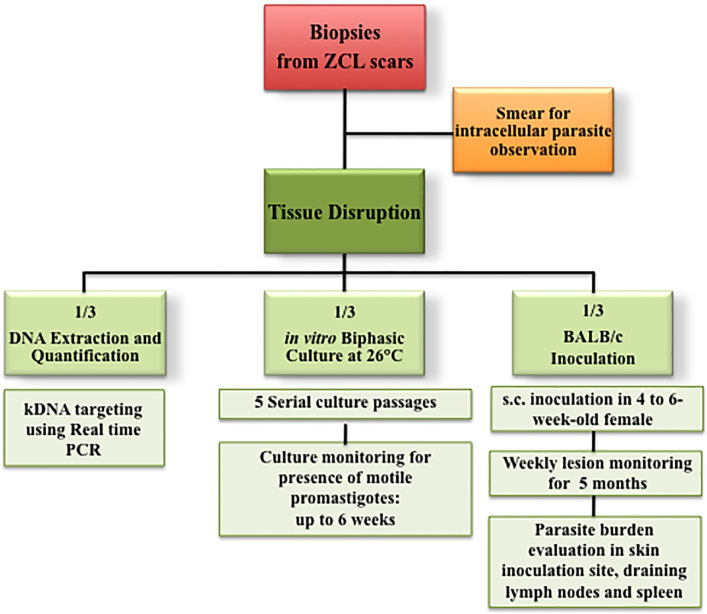
In human cutaneous leishmaniasis (HCL) caused by () , the cutaneous lesions heal spontaneously and induce a Th1-type immunity that confers solid protection against reinfection. The same holds true for the experimental leishmaniasis induced by in C57BL/6 mice where residual parasites persist after spontaneous clinical cure and induce sustainable memory immune responses and resistance to reinfection. Whether residual parasites also persist in scars of cured HCL caused by is still unknown. Cutaneous scars from 53 volunteers with healed HCL caused by were biopsied and the tissue sample homogenates were analyzed for residual parasites by four methods: i) microscope detection of amastigotes, ii) parasite culture by inoculation on biphasic medium, iii) inoculation of tissue exctracts to the footpad of BALB/c mice, an inbred strain highly susceptible to , and iv) amplification of parasite kDNA by a highly sensitive real-time PCR (RT-PCR). Our results show that the scars of healed lesions of HCL caused by do not contain detectable residual parasites, suggesting that this form likely induces a sterile cure at least within the scars. This feature contrasts with other species causing chronic, diffuse, or recidivating forms of leishmaniasis where parasites do persist in healed lesions. The possibility that alternative mechanisms to parasite persistence are needed to boost and maintain long-term immunity to , should be taken into consideration in vaccine development against infection.
在由()引起的人类皮肤利什曼病(HCL)中,皮肤损伤会自行愈合,并诱导产生 Th1 型免疫,从而提供针对再感染的牢固保护。用()在 C57BL/6 小鼠中诱导的实验性利什曼病也是如此,在自发性临床治愈后,残留寄生虫持续存在,并诱导持久的记忆免疫反应和对再感染的抵抗力。在由()引起的已治愈 HCL 的疤痕中是否也存在残留寄生虫尚不清楚。对 53 名志愿者的 HCL 治愈后的皮肤疤痕进行活检,并用 4 种方法分析组织样本匀浆中的残留寄生虫:i)检测无鞭毛体的显微镜检测,ii)接种双相培养基进行寄生虫培养,iii)接种组织提取物至对()高度易感的近交系 BALB/c 小鼠的脚掌,iv)通过高度敏感的实时 PCR(RT-PCR)扩增寄生虫 kDNA。我们的结果表明,由()引起的 HCL 治愈病变的疤痕中不存在可检测到的残留寄生虫,这表明这种形式至少在疤痕内可能诱导无菌治愈。这一特征与其他引起慢性、弥漫性或复发性利什曼病的()物种形成对比,在这些疾病中,寄生虫确实在愈合的病变中持续存在。在针对()感染的疫苗开发中,应该考虑到需要替代的寄生虫持续存在机制来增强和维持针对()的长期免疫。