Yan Yanhong, Lu Ziwei, Ding Yafang, Pu Jianhong, Hu Chunhong, Teng Zhongzhao, Hui Pinjing
Department of Stroke Center, The First Affiliated Hospital of Soochow University, Suzhou, China.
Department of Radiology, The First Affiliated Hospital of Soochow University, Suzhou, China.
Front Neurol. 2022 Jul 28;13:939001. doi: 10.3389/fneur.2022.939001. eCollection 2022.
Extracranial vertebral artery dissection (EVAD) is one of the main causes of stroke in young and middle-aged patients. However, the diagnosis is challenging. This study aimed to identify the characteristics of EVAD on color duplex ultrasonography (CDU) and high-resolution magnetic resonance imaging (hrMRI), hoping to improve the accuracy and determine the relative contribution of vessel findings and clinical factors to acute ischemic events.
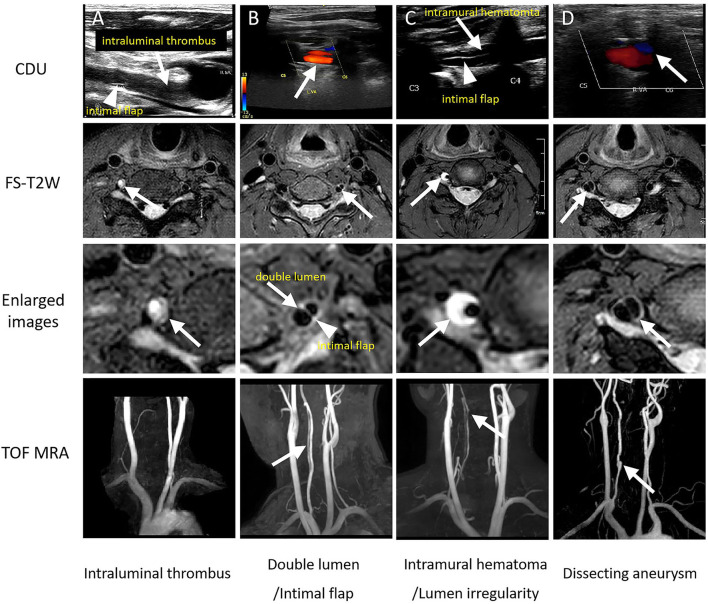
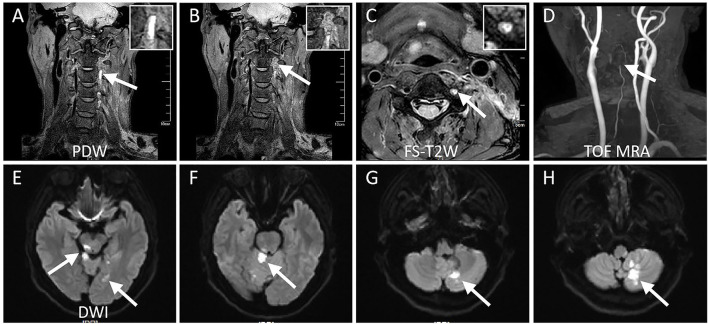
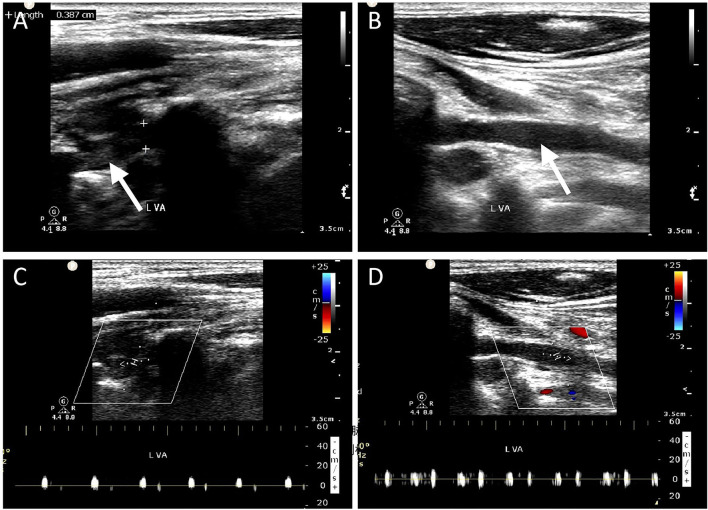
Patients with unilateral EVAD were recruited and divided into ischemia and non-ischemia groups. Clinical features of patients and the lesion location; a variety of signs which indicate dissection, including the presence of an intimal flap, double lumen, intramural hematoma, dissecting aneurysm, intraluminal thrombus, and irregular lumen; and other quantitative parameters of each dissected segment on CDU and hrMRI were reviewed, respectively. Multiple logistic regression was performed to explore the association between clinical, imaging characteristics, and ischemic events in patients with unilateral EVAD.
Ninety-six patients with unilateral EVAD who met the inclusion criteria were enrolled during a six-year period. Overall, 41 cases (42.7%) were confirmed as ischemic stroke ( = 40) or transient ischemic attack ( = 1) during the 48 h after the onset of symptoms. Men, infections during the last week, and smoking were more common in the ischemia group. Intraluminal thrombus and occlusion on CDU were more prevalent in patients with cerebral ischemia than in those without (36.6 vs. 5.5%; < 0.001, and 39.0 vs. 9.1%; = 0.001, respectively). On hrMRI, intraluminal thrombus and occlusion were also more frequent in the ischemia group than in the non-ischemia group (34.1 vs. 5.5%; < 0.001, and 34.1 vs. 9.1%; = 0.003, respectively). In addition, lesion length on hrMRI was significantly longer for patients with ischemia (81.5 ± 41.7 vs. 64.7 ± 30.8 mm; = 0.025). In multivariable logistic regression analysis, male gender, infections during the last week, and the presence of intraluminal thrombus on CDU and hrMRI were independently associated with acute ischemic events.
Male sex, infections during the last week, and the presence of intraluminal thrombus due to dissection are associated with an increased risk of ischemic events in patients with unilateral EVAD.
颅外椎动脉夹层(EVAD)是中青年患者卒中的主要原因之一。然而,其诊断具有挑战性。本研究旨在确定彩色双功超声(CDU)和高分辨率磁共振成像(hrMRI)上EVAD的特征,希望提高准确性并确定血管表现和临床因素对急性缺血事件的相对贡献。
招募单侧EVAD患者并分为缺血组和非缺血组。分别回顾患者的临床特征、病变部位;各种提示夹层的征象,包括内膜瓣、双腔、壁内血肿、夹层动脉瘤、腔内血栓和不规则管腔的存在;以及CDU和hrMRI上每个夹层节段的其他定量参数。进行多因素logistic回归分析以探讨单侧EVAD患者的临床、影像特征与缺血事件之间的关联。
在六年期间纳入了96例符合纳入标准的单侧EVAD患者。总体而言,41例(42.7%)在症状发作后48小时内被确诊为缺血性卒中(n = 40)或短暂性脑缺血发作(n = 1)。男性、上周有感染和吸烟在缺血组中更为常见。CDU上的腔内血栓和闭塞在脑缺血患者中比无缺血患者更常见(分别为36.6%对5.5%;P < 0.001,以及39.0%对9.1%;P = 0.001)。在hrMRI上,缺血组的腔内血栓和闭塞也比非缺血组更频繁(分别为34.1%对5.5%;P < 0.001,以及34.1%对9.1%;P = 0.003)。此外,缺血患者hrMRI上的病变长度明显更长(81.5±41.7对64.7±30.8 mm;P = 0.025)。在多变量logistic回归分析中,男性、上周有感染以及CDU和hrMRI上存在腔内血栓与急性缺血事件独立相关。
男性、上周有感染以及夹层导致的腔内血栓与单侧EVAD患者缺血事件风险增加相关。