Joo Sung Woo, Kim Harin, Jo Young Tak, Ahn Soojin, Choi Young Jae, Choi Woohyeok, Park Soyeon, Lee Jungsun
Department of Psychiatry, Asan Medical Center, University of Ulsan College of Medicine, Seoul, Republic of Korea.
Department of Psychiatry, Medical Foundation Yongin Mental Hospital, Yongin, Republic of Korea.
Neuropsychiatr Dis Treat. 2022 Aug 8;18:1645-1652. doi: 10.2147/NDT.S373222. eCollection 2022.
Although the use of electroconvulsive therapy (ECT) in the treatment of schizophrenia has decreased since the advent of antipsychotic drugs, ECT is still implemented in several clinical indications. However, a few population-based studies have examined its real-world effectiveness in schizophrenia.
We used data from 2010 to 2019 from the Health Insurance Review and Assessment Service database in the Republic of Korea. We selected 380 schizophrenia patients having more than six ECT sessions and 1140 patient controls matched for age, sex, calendar year at entry, and the number of psychiatric hospitalizations before the time point of start of psychiatric hospitalization for ECT. Antipsychotic treatment discontinuation, psychiatric hospitalization, and direct medical costs were used as measures of clinical outcomes. Multiple regression analysis was used for any group-by-time interaction effect, and 1-year pre- and post-ECT periods were compared within and between the groups.
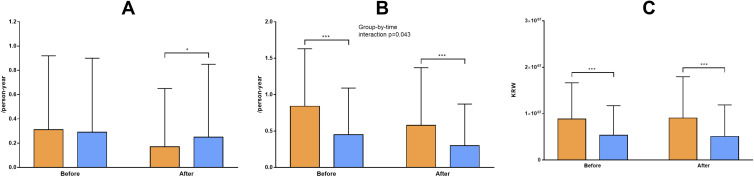
We found a significantly lower number of antipsychotic treatment discontinuations in the ECT group during the 1-year post-ECT period (t=2.195, p=0.028). A larger decrease was found in the number of psychiatric hospitalizations in the ECT group, with a group-by-time interaction effect (p=0.043). The direct medical costs in the 1-year pre- (t=-8.782, p<0.001) and post-ECT periods (t=-9.107, p<0.001) were higher in the ECT group than in the control group, with no significant change across both periods.
We found that the ECT group had a larger decrease in the number of psychiatric hospitalizations in the 1-year post-ECT period than the control group.
自抗精神病药物问世以来,电休克治疗(ECT)在精神分裂症治疗中的应用有所减少,但ECT仍用于多种临床适应症。然而,少数基于人群的研究探讨了其在精神分裂症中的实际疗效。
我们使用了韩国健康保险审查与评估服务数据库2010年至2019年的数据。我们选择了380例接受过6次以上ECT治疗的精神分裂症患者以及1140例年龄、性别、入院历年和ECT开始精神住院时间点前的精神住院次数相匹配的患者作为对照。抗精神病药物治疗中断、精神住院和直接医疗费用被用作临床结局指标。采用多元回归分析评估任何组间时间交互效应,并在组内和组间比较ECT前后1年的情况。
我们发现ECT组在ECT后1年期间抗精神病药物治疗中断的次数显著减少(t=2.195,p=0.028)。ECT组精神住院次数减少幅度更大,存在组间时间交互效应(p=0.043)。ECT组ECT前1年(t=-8.782,p<0.001)和ECT后1年(t=-9.107,p<0.001)的直接医疗费用均高于对照组,且两个时期均无显著变化。
我们发现ECT组在ECT后1年期间精神住院次数的减少幅度大于对照组。