The Bloomberg-Kimmel Institute for Immunotherapy, The Sydney Kimmel Comprehensive Cancer Center and.
Department of Neurosurgery, The Johns Hopkins University School of Medicine, Baltimore, Maryland, USA.
J Clin Invest. 2022 Aug 15;132(16). doi: 10.1172/JCI162322.
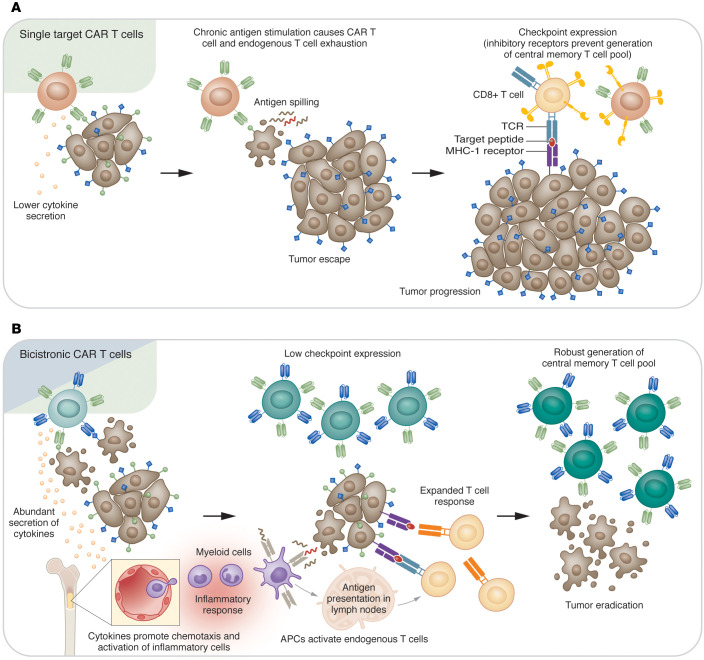
Chimeric antigen receptor (CAR) T cells have demonstrated success in treating select hematological malignancies, but their activity in solid tumors has been comparably modest. Challenges specific to treating solid tumors include trafficking and distribution throughout the tumor site, overcoming the immunosuppressive tumor microenvironment (TME), and identifying antigenic targets that are widely expressed and indispensable to tumor biology. In this issue of the JCI, Tian et al. describe the use of bicistronic CAR T cells that target multiple antigens expressed in neuroblastoma to overcome antigenic heterogeneity. Combining this approach with interventions that enhance T cell trafficking and prevent acquired dysfunction in the TME may lead to a long-awaited breakthrough in the clinical implementation of CAR T cells for the treatment of solid tumors.
嵌合抗原受体 (CAR) T 细胞在治疗某些血液系统恶性肿瘤方面已取得成功,但在实体瘤中的疗效相对有限。治疗实体瘤所面临的挑战包括在肿瘤部位的运输和分布、克服免疫抑制性肿瘤微环境 (TME) 以及识别广泛表达且对肿瘤生物学必不可少的抗原性靶标。在本期 JCI 中,Tian 等人描述了使用靶向神经母细胞瘤中多种抗原的双顺反子 CAR T 细胞来克服抗原异质性。将这种方法与增强 T 细胞运输和防止 TME 中获得性功能障碍的干预措施相结合,可能为 CAR T 细胞在实体瘤治疗中的临床应用带来期待已久的突破。