Department of Chemistry, Virginia Tech, Blacksburg, VA 24061.
Institute of Supply Chain Analytics, Dongbei University of Finance and Economics, Dalian 116025, China.
Proc Natl Acad Sci U S A. 2022 Aug 23;119(34):e2203346119. doi: 10.1073/pnas.2203346119. Epub 2022 Aug 15.
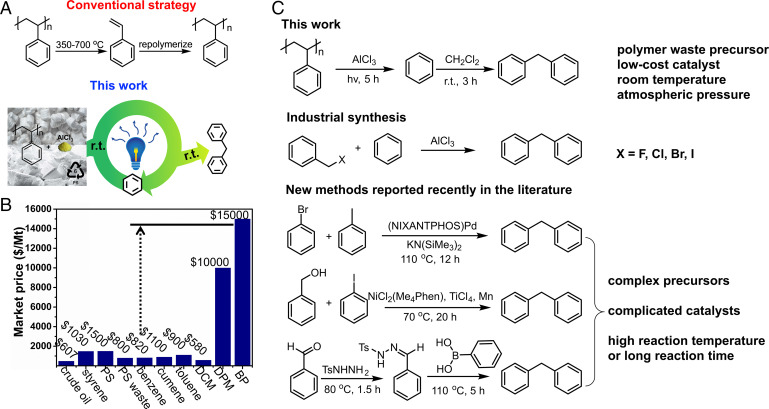
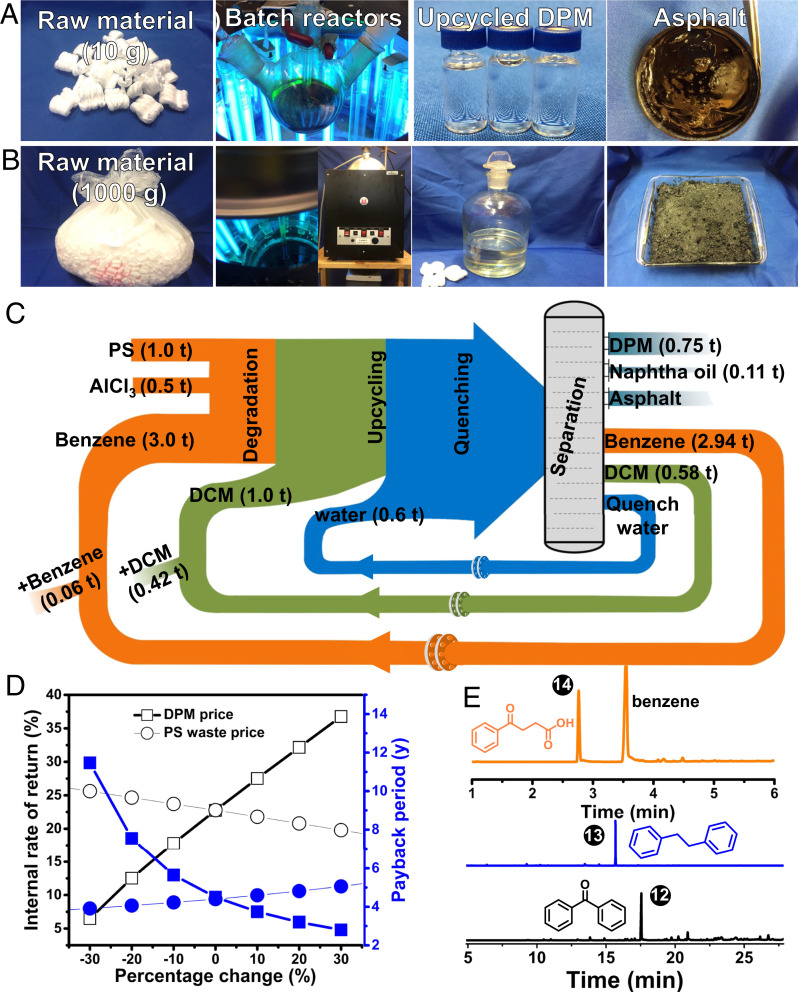
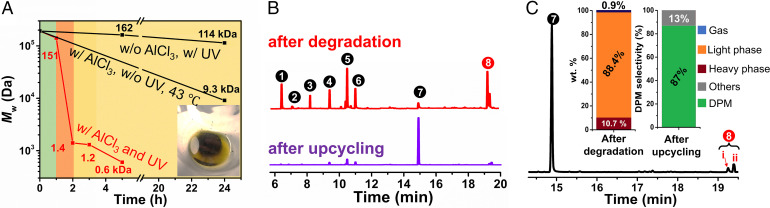
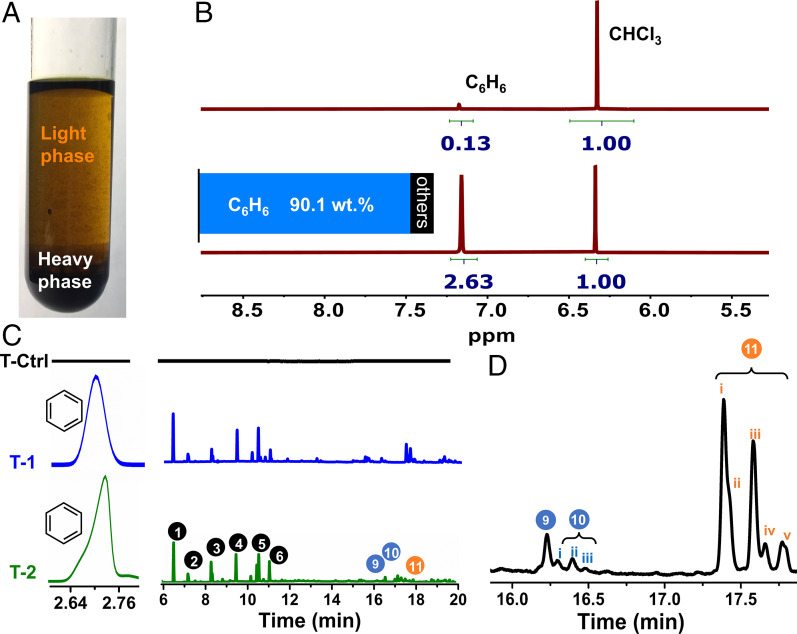
Plastic waste represents one of the most urgent environmental challenges facing humankind. Upcycling has been proposed to solve the low profitability and high market sensitivity of known recycling methods. Existing upcycling methods operate under energy-intense conditions and use precious-metal catalysts, but produce low-value oligomers, monomers, and common aromatics. Herein, we report a tandem degradation-upcycling strategy to exploit high-value chemicals from polystyrene (PS) waste with high selectivity. We first degrade PS waste to aromatics using ultraviolet (UV) light and then valorize the intermediate to diphenylmethane. Low-cost AlCl catalyzes both the reactions of degradation and upcycling at ambient temperatures under atmospheric pressure. The degraded intermediates can advantageously serve as solvents for processing the solid plastic wastes, forming a self-sustainable circuitry. The low-value-input and high-value-output approach is thus substantially more sustainable and economically viable than conventional thermal processes, which operate at high-temperature, high-pressure conditions and use precious-metal catalysts, but produce low-value oligomers, monomers, and common aromatics. The cascade strategy is resilient to impurities from plastic waste streams and is generalizable to other high-value chemicals (e.g., benzophenone, 1,2-diphenylethane, and 4-phenyl-4-oxo butyric acid). The upcycling to diphenylmethane was tested at 1-kg laboratory scale and attested by industrial-scale techno-economic analysis, demonstrating sustainability and economic viability without government subsidies or tax credits.
塑料废物是人类面临的最紧迫的环境挑战之一。为了解决已知回收方法盈利能力低和市场敏感度高的问题,人们提出了升级回收的方法。现有的升级回收方法在能源密集的条件下运行,使用贵金属催化剂,但只能生产低价值的齐聚物、单体和常见芳烃。在此,我们报告了一种串联降解-升级回收策略,以高选择性地从聚苯乙烯(PS)废物中利用高价值化学品。我们首先使用紫外线(UV)光将 PS 废物降解为芳烃,然后将中间产物升级为二苯甲烷。在环境温度和大气压下,廉价的 AlCl 可催化降解和升级回收反应。降解的中间产物可以作为加工固体塑料废物的溶剂,形成自我可持续的循环。因此,与传统的热工艺相比,这种低投入、高产出的方法在可持续性和经济可行性方面具有显著优势,传统的热工艺在高温、高压条件下运行,使用贵金属催化剂,但只能生产低价值的齐聚物、单体和常见芳烃。级联策略对来自塑料废物流的杂质具有弹性,并且可推广到其他高价值化学品(例如,二苯甲酮、1,2-二苯乙烷和 4-苯基-4-氧代丁酸)。在 1 公斤实验室规模上进行了二苯甲烷的升级回收测试,并通过工业规模的技术经济分析进行了验证,证明了在没有政府补贴或税收抵免的情况下具有可持续性和经济可行性。