Vollmer Ina, Jenks Michael J F, Mayorga González Rafael, Meirer Florian, Weckhuysen Bert M
Inorganic Chemistry and Catalysis, Debye Institute for Nanomaterials Science, Utrecht University, Universiteitsweg 99, 3584 CG, Utrecht, The Netherlands.
Angew Chem Int Ed Engl. 2021 Jul 12;60(29):16101-16108. doi: 10.1002/anie.202104110. Epub 2021 Jun 15.
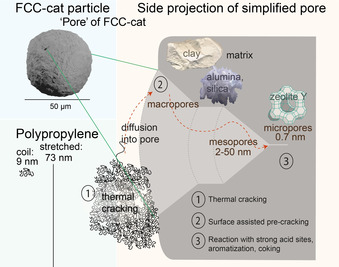
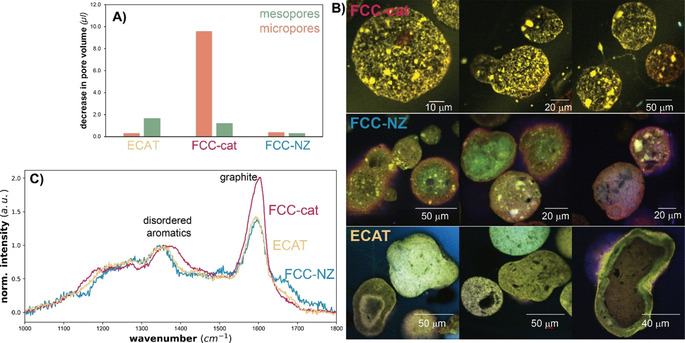
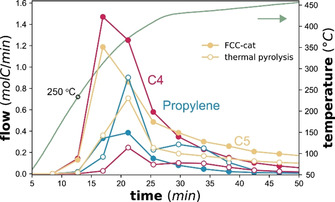
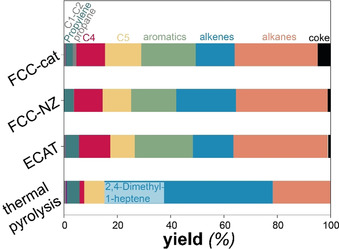
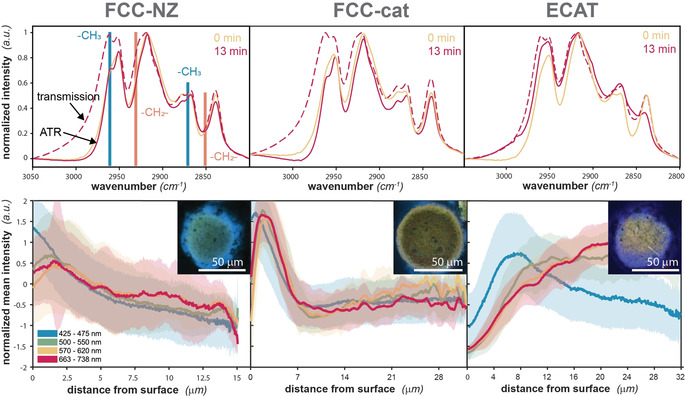
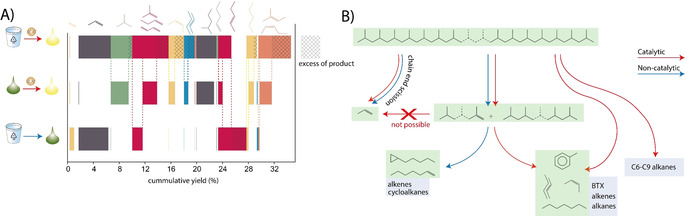
Polypropylene (PP) makes up a large share of our plastic waste. We investigated the conversion of PP over the industrial Fluid Catalytic Cracking catalyst (FCC-cat) used to produce gasoline from crude oil fractions. We studied transport limitations arising from the larger size of polymers compared to the crude oil-based feedstock by testing the components of this catalyst separately. Infrared spectroscopy and confocal fluorescence microscopy revealed the role of the FCC matrix in aromatization, and the zeolite Y domains in coking. An equilibrium catalyst (ECAT), discarded during FCC operation as waste, produced the same aromatics content as a fresh FCC-cat, while coking decreased significantly, likely due to the reduced accessibility and activity of the zeolite domains and an enhanced cracking activity of the matrix due to metal deposits present in ECAT. This mechanistic understanding provides handles for further improving the catalyst composition towards higher aromatics selectivity.
聚丙烯(PP)在我们的塑料垃圾中占很大比例。我们研究了聚丙烯在用于将原油馏分转化为汽油的工业流化催化裂化催化剂(FCC催化剂)上的转化情况。通过分别测试该催化剂的成分,我们研究了与原油基原料相比聚合物尺寸较大所导致的传质限制。红外光谱和共聚焦荧光显微镜揭示了FCC基质在芳构化中的作用,以及Y型沸石区域在结焦中的作用。一种在FCC操作过程中作为废料丢弃的平衡催化剂(ECAT),产生的芳烃含量与新鲜的FCC催化剂相同,而结焦显著减少,这可能是由于沸石区域的可及性和活性降低,以及ECAT中存在的金属沉积物导致基质的裂化活性增强。这种机理认识为进一步改进催化剂组成以提高芳烃选择性提供了方法。