Department of Ecology and Evolutionary Biology, University of California, Los Angeles, CA 90095.
Biodesign Institute, School of Life Sciences, Arizona State University, Tempe, AZ 85287.
Proc Natl Acad Sci U S A. 2022 Aug 23;119(34):e2205986119. doi: 10.1073/pnas.2205986119. Epub 2022 Aug 15.
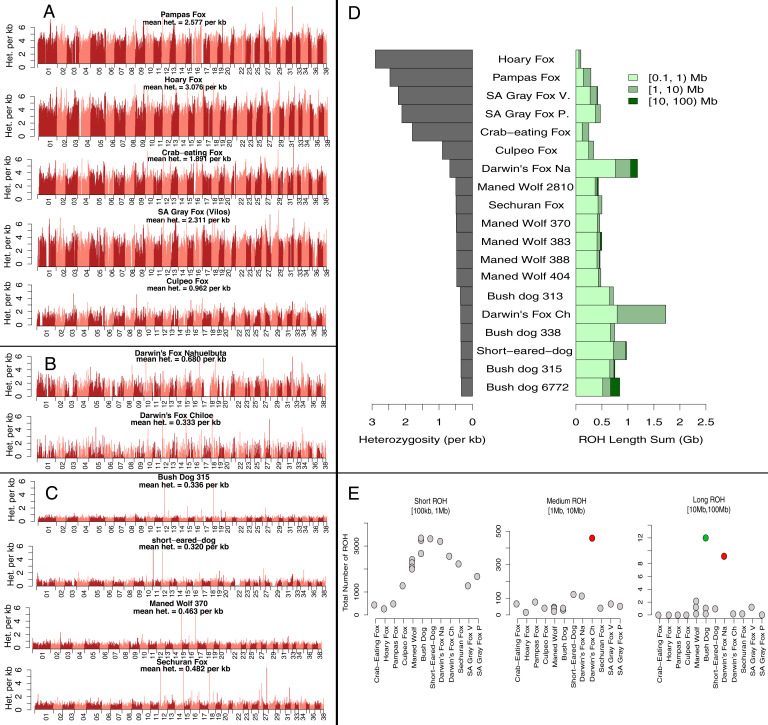
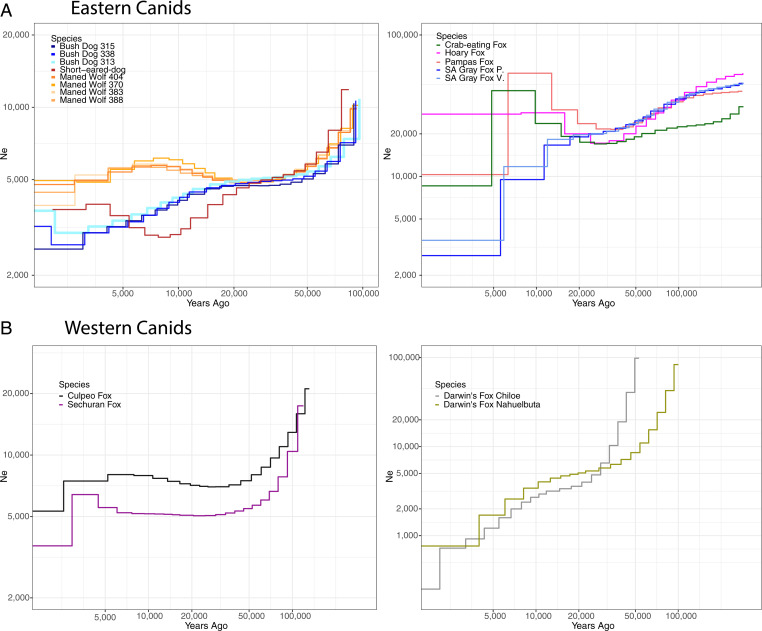
The remarkable radiation of South American (SA) canids produced 10 extant species distributed across diverse habitats, including disparate forms such as the short-legged, hypercarnivorous bush dog and the long-legged, largely frugivorous maned wolf. Despite considerable research spanning nearly two centuries, many aspects of their evolutionary history remain unknown. Here, we analyzed 31 whole genomes encompassing all extant SA canid species to assess phylogenetic relationships, interspecific hybridization, historical demography, current genetic diversity, and the molecular bases of adaptations in the bush dog and maned wolf. We found that SA canids originated from a single ancestor that colonized South America 3.9 to 3.5 Mya, followed by diversification east of the Andes and then a single colonization event and radiation of species west of the Andes. We detected extensive historical gene flow between recently diverged lineages and observed distinct patterns of genomic diversity and demographic history in SA canids, likely induced by past climatic cycles compounded by human-induced population declines. Genome-wide scans of selection showed that disparate limb proportions in the bush dog and maned wolf may derive from mutations in genes regulating chondrocyte proliferation and enlargement. Further, frugivory in the maned wolf may have been enabled by variants in genes associated with energy intake from short-chain fatty acids. In contrast, unique genetic variants detected in the bush dog may underlie interdigital webbing and dental adaptations for hypercarnivory. Our analyses shed light on the evolution of a unique carnivoran radiation and how it was shaped by South American topography and climate change.
南美洲(SA)犬科动物的显著辐射产生了 10 种现存物种,分布在各种不同的栖息地,包括短腿、超肉食性的丛林犬和长腿、主要以水果为食的鬃狼等不同形态。尽管近两个世纪以来进行了大量研究,但它们的进化历史的许多方面仍然未知。在这里,我们分析了涵盖所有现存的 SA 犬科动物物种的 31 个全基因组,以评估系统发育关系、种间杂交、历史人口动态、当前遗传多样性以及丛林犬和鬃狼适应的分子基础。我们发现,SA 犬科动物起源于一个单一的祖先,该祖先在 390 万至 350 万年前殖民了南美洲,随后在安第斯山脉以东多样化,然后是一次单一的殖民事件和西部的物种辐射。我们检测到最近分化的谱系之间存在广泛的历史基因流,并观察到 SA 犬科动物中存在明显的基因组多样性和人口历史动态模式,这可能是过去气候循环和人类引起的种群减少共同作用的结果。全基因组选择扫描表明,丛林犬和鬃狼不同的四肢比例可能源于调节软骨细胞增殖和增大的基因中的突变。此外,鬃狼的食果性可能是由于与短链脂肪酸能量摄入相关的基因中的变异所致。相比之下,在丛林犬中检测到的独特遗传变异可能是为了适应超肉食性而产生的蹼趾和牙齿适应性。我们的分析揭示了一个独特的食肉动物辐射的进化以及南美地形和气候变化如何塑造了这种辐射。