Department of Vascular and Endovascular Surgery, Albert Einstein College of Medicine and Montefiore Medical Center, Bronx, NY.
Department of Vascular and Endovascular Surgery, Albert Einstein College of Medicine and Montefiore Medical Center, Bronx, NY.
J Vasc Surg. 2022 Oct;76(4):1006-1013.e3. doi: 10.1016/j.jvs.2022.04.038. Epub 2022 Jun 13.
The inflammatory cascade caused by severe acute respiratory syndrome coronavirus 2 infection may result in arterial thrombosis and acute limb ischemia (ALI) with devastating consequences. The aims of this study were to compare outcomes of ALI in the lower extremities in patients with and without coronavirus disease 2019 (COVID-19), and to determine if ALI development in the context of COVID-19 portends a worse prognosis compared with COVID-19 without ALI.
Queries were built on TriNetX, a federated network of health care organizations across the United States that provides de-identified patient data. International Classification of Diseases, 10th revision diagnostic codes were used to identify patients with acute limb ischemia of the lower extremities and COVID-19. The study timeframe was defined as January 20, 2020 to May 20, 2021. Statistical analyses, including propensity-score matching, were done through TriNetX's internal software. Outcomes looked at are rates of mortality, stroke, myocardial infarction, major adverse limb events, re-intervention, respiratory failure, sepsis, mental health complications, and acute renal failure. Baseline cohort characteristics were also collected.
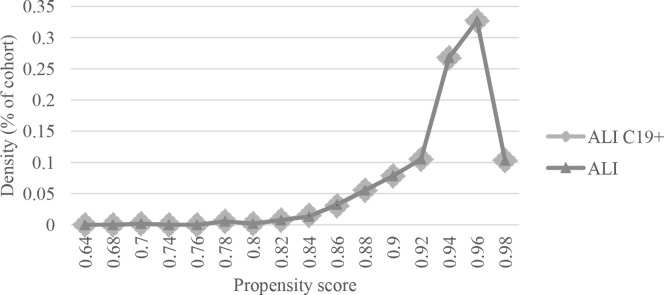
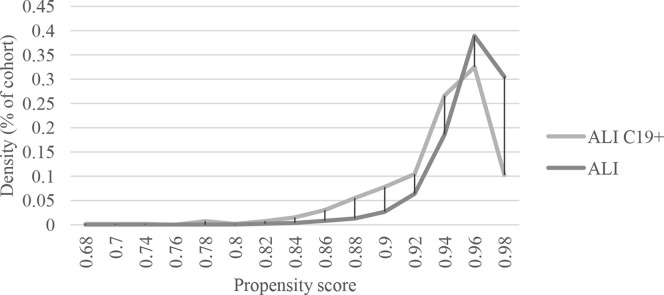
Patients with ALI with COVID-19 (ALI C19+; n = 526) were significantly less likely than patients with ALI without COVID-19 (ALI; n = 14,131) to have baseline comorbidities, including nicotine dependence (18% vs 33%; P < .0001). In contrast, ALI C19+ patients had significantly more comorbidities than hospitalized patients with COVID-19 without ALI (n = 275,903), including nicotine dependence (18% vs 10%; P < .0001). After propensity matching was performed, ALI C19+ patients had significantly higher rates of mortality (24.9% vs 9.2%; P < .0001), major adverse limb events (5.8% vs 2.9%; P = .0223), and acute renal failure (22.2% vs 14.9%; P = .0025) than patients with ALI. Compared with hospitalized patients with COVID-19 without ALI, ALI C19+ patients had higher propensity-matched rates of respiratory failure and being placed on assisted ventilation (32.9% vs 27%; P = .0369), sepsis (16.9% vs 12.2%; P = .0288), acute renal failure (22.1% vs 14.6%; P = .0019), and mortality (24.7% vs 14.4%; P < .0001).
Patients who developed ALI following COVID-19 present with significantly different demographics and comorbidities from those who develop ALI without COVID-19. After controlling for these variables, higher rates of major adverse limb events, acute renal failure, and mortality in patients with ALI with COVID-19 suggest that not only may COVID-19 precipitate ALI, but it may also exacerbate ALI sequelae. Furthermore, development of ALI in COVID-19 portends worse prognosis compared with patients with COVID-19 without ALI.
严重急性呼吸综合征冠状病毒 2 感染引起的炎症级联反应可能导致动脉血栓形成和急性肢体缺血(ALI),从而造成毁灭性后果。本研究旨在比较伴有和不伴有 2019 年冠状病毒病(COVID-19)的 ALI 下肢患者的结局,并确定 COVID-19 背景下的 ALI 发展是否预示着比无 ALI 的 COVID-19 更差的预后。
在 TriNetX 上构建查询,TriNetX 是一个由美国各地医疗保健组织组成的联合网络,提供去识别患者数据。使用国际疾病分类,第 10 次修订版诊断代码来识别急性下肢缺血和 COVID-19 的患者。研究时间范围定义为 2020 年 1 月 20 日至 2021 年 5 月 20 日。通过 TriNetX 的内部软件进行统计分析,包括倾向评分匹配。观察的结局包括死亡率、中风、心肌梗死、主要不良肢体事件、再干预、呼吸衰竭、败血症、心理健康并发症和急性肾衰竭。还收集了基线队列特征。
伴有 COVID-19 的 ALI 患者(ALI C19+;n=526)与不伴有 COVID-19 的 ALI 患者(ALI;n=14131)相比,基线合并症的可能性显著降低,包括尼古丁依赖(18%比 33%;P<0.0001)。相比之下,ALI C19+患者的合并症明显多于无 ALI 的 COVID-19 住院患者(n=275903),包括尼古丁依赖(18%比 10%;P<0.0001)。在进行倾向评分匹配后,ALI C19+患者的死亡率(24.9%比 9.2%;P<0.0001)、主要不良肢体事件(5.8%比 2.9%;P=0.0223)和急性肾衰竭(22.2%比 14.9%;P=0.0025)的发生率明显高于 ALI 患者。与无 ALI 的 COVID-19 住院患者相比,ALI C19+患者的呼吸衰竭和需要辅助通气的比例更高(32.9%比 27%;P=0.0369),败血症(16.9%比 12.2%;P=0.0288)、急性肾衰竭(22.1%比 14.6%;P=0.0019)和死亡率(24.7%比 14.4%;P<0.0001)的匹配率也更高。
与不伴有 COVID-19 的 ALI 患者相比,COVID-19 后发生 ALI 的患者在人口统计学和合并症方面存在显著差异。在控制这些变量后,ALI C19+患者的主要不良肢体事件、急性肾衰竭和死亡率的发生率更高,表明 COVID-19 不仅可能引发 ALI,还可能使 ALI 后遗症恶化。此外,COVID-19 中 ALI 的发展预示着比无 ALI 的 COVID-19 患者更差的预后。