Ngah Abdul Hafaz, Kamalrulzaman Nurul Izni, Mohamad Mohamad Firdaus Halimi, Abdul Rashid Rosyati, Harun Nor Omaima, Ariffin Nur Asma, Abu Osman Noor Azuan
Faculty of Business, Economics & Social Development, Universiti Malaysia Terengganu, 21030 Kuala Nerus, Terengganu, Co-Authors, Malaysia.
Centre for Academic Management & Quality, Universiti Malaysia Terengganu, 21030 Kuala Nerus, Terengganu, Malaysia.
Qual Quant. 2022 Aug 10:1-24. doi: 10.1007/s11135-022-01465-y.
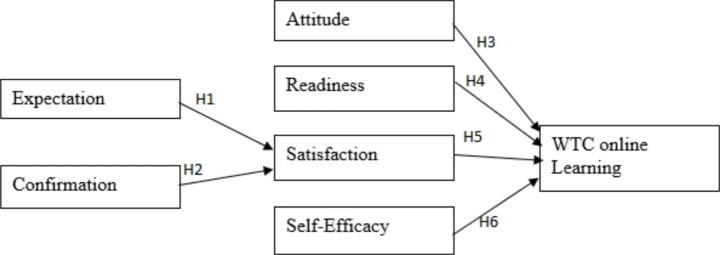
Without proper preparation by higher institutions, the COVID-19 pandemic has forced the world to rely on online learning. Even students of social science and science are looking for different knowledge and skills. Currently, both groups rely on the same method to gather knowledge for future undertakings. Given the uncertainty regarding the resolution of COVID-19, which has driven students to continue using online learning, the current study aims to identify the factors of willingness to continue online learning among social science and pure science students by extending the use of expectation-confirmation theory. Applying a purposive sampling method, 2,215 questionnaires were collected among undergraduate students from Universiti Malaysia Terengganu (UMT) using an online survey. Current study found that expectation and confirmation positively affect satisfaction. Attitude, satisfaction and readiness were found to have a positive relationship with willingness to continue online learning. Meanwhile, self-efficacy was found unsupported hypothesis for the direct effect. For multigroup analysis, readiness was found to have a significant difference between students of social science and pure science. The findings of this research enrich the literature about online learning, especially in the COVID-19 setting. Moreover, this work is useful for higher education institutions seeking to design a better strategy that allows students to return to campus.
由于高等院校没有做好充分准备,新冠疫情迫使全世界依赖在线学习。甚至社会科学和理科专业的学生也在寻求不同的知识和技能。目前,这两类学生都依靠相同的方法来获取知识,为未来的事业做准备。鉴于新冠疫情的解决存在不确定性,这促使学生继续使用在线学习,本研究旨在通过扩展期望确认理论的应用,确定社会科学和纯理科学生继续在线学习意愿的影响因素。采用目的抽样法,通过在线调查从马来西亚丁加奴大学(UMT)的本科生中收集了2215份问卷。当前研究发现,期望和确认对满意度有积极影响。态度、满意度和准备情况与继续在线学习的意愿呈正相关。同时,自我效能感被发现对直接影响没有支持作用。对于多组分析,发现社会科学和纯理科学生在准备情况方面存在显著差异。本研究的结果丰富了关于在线学习的文献,特别是在新冠疫情背景下。此外,这项工作对寻求设计更好策略以使学生重返校园的高等教育机构很有用。