Breda Giorgio, De Marco Gianluca, Cesaraccio Pierfranco, Pillastrini Paolo
Department of Biomedical and Neuromotor Sciences (DIBINEM), Alma Mater Studiorum University of Bologna, Bologna, Italy.
Department of Neurosciences (DNS), University of Padua, Padua, Italy.
Clin Shoulder Elb. 2023 Jun;26(2):182-190. doi: 10.5397/cise.2022.00948. Epub 2022 Aug 16.
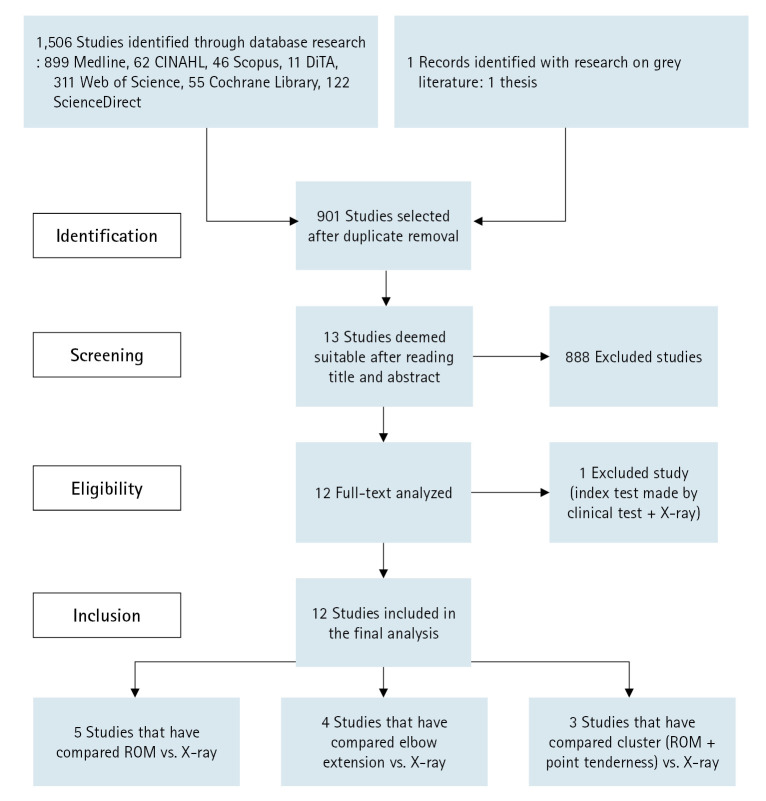
Elbow traumas represent a relatively common condition in clinical practice. However, there is a lack of evidence regarding the most accurate tests for screening these potentially serious conditions and excluding elbow fractures. The purpose of this investigation was to analyze the literature concerning the diagnostic accuracy of clinical tests for the detection or exclusion of suspected elbow fractures. A systematic review was performed using the Preferred Reporting Items for a Systematic Review and Meta-analysis of Diagnostic Test Accuracy Studies (PRISMA-DTA) guidelines. Literature databases including PubMed, Cumulative Index to Nursing and Allied Health Literature, Diagnostic Test Accuracy, Cochrane Library, the Web of Science, and ScienceDirect were searched for diagnostic accuracy studies of subjects with suspected traumatic elbow fracture investigating clinical tests compared to imaging reference tests. The risk of bias in each study was assessed independently by two reviewers using the Quality Assessment of Diagnostic Accuracy Studies 2 checklist. Twelve studies (4,485 patients) were included. Three different types of index tests were extracted. In adults, these tests were very sensitive, with values up to 98.6% (95% confidence interval [CI], 95.0%-99.8%). The specificity was very variable, ranging from 24.0% (95% CI, 19.0%-30.0%) to 69.4% (95% CI, 57.3%-79.5%). The applicability of these tests was very high, while overall studies showed a medium risk of bias. Elbow full range of motion test, elbow extension test, and elbow extension and point tenderness test appear to be useful in the presence of a negative test to exclude fracture in a majority of cases. The specificity of all tests, however, does not allow us to draw useful conclusions because there was a great variability of results obtained.
肘部创伤在临床实践中是一种相对常见的病症。然而,对于筛查这些潜在严重病症并排除肘部骨折的最准确检查方法,目前缺乏相关证据。本研究的目的是分析有关用于检测或排除疑似肘部骨折的临床检查诊断准确性的文献。我们按照诊断试验准确性研究的系统评价与Meta分析的首选报告项目(PRISMA-DTA)指南进行了一项系统评价。检索了包括PubMed、护理学与健康相关文献累积索引、诊断试验准确性、Cochrane图书馆、科学网和ScienceDirect在内的文献数据库,以查找对疑似创伤性肘部骨折患者进行临床检查与影像参考检查对比的诊断准确性研究。由两名审阅者使用诊断准确性研究质量评估2清单独立评估每项研究的偏倚风险。纳入了12项研究(4485例患者)。提取了三种不同类型的指标检查。在成人中,这些检查非常敏感,值高达98.6%(95%置信区间[CI],95.0%-99.8%)。特异性变化很大,范围从24.0%(95%CI,19.0%-30.0%)到69.4%(95%CI,57.3%-79.5%)。这些检查的适用性非常高,而总体研究显示存在中等偏倚风险。肘部全范围活动度检查、肘部伸展检查以及肘部伸展和压痛点检查在检查结果为阴性时似乎有助于在大多数情况下排除骨折。然而,所有检查的特异性都不允许我们得出有用的结论,因为所获得的结果差异很大。