Kim Du-Han, Bek Chung-Shin, Cho Chul-Hyun
Department of Orthopedic Surgery, Keimyung University Dongsan Hospital, Keimyung University School of Medicine, Daegu, Korea.
Clin Shoulder Elb. 2022 Sep;25(3):202-209. doi: 10.5397/cise.2021.00745. Epub 2022 Jul 18.
The purpose of our study was to investigate short-term outcomes of two-stage reverse total shoulder arthroplasty (RTSA) with an antibiotic-loaded cement spacer for shoulder infection.
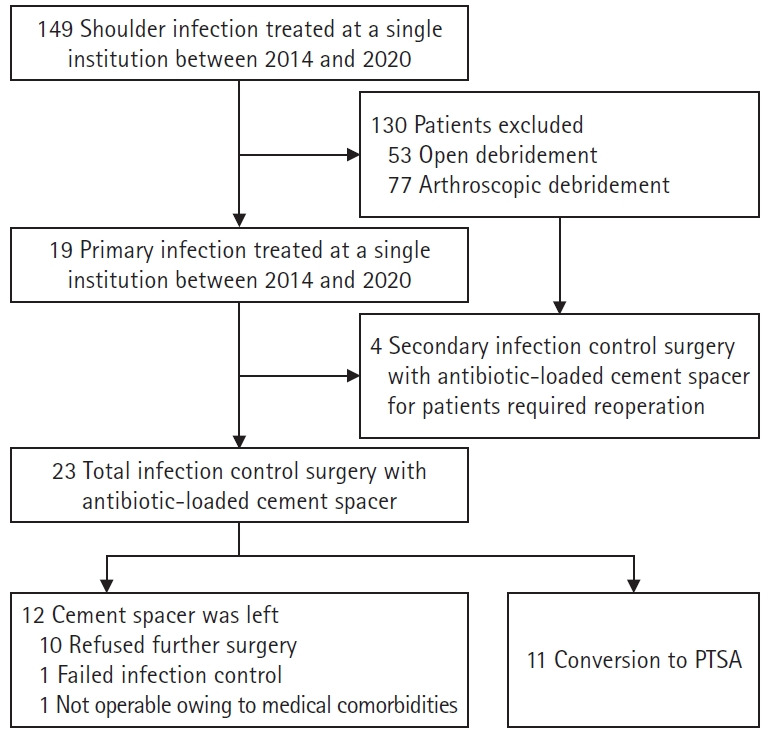
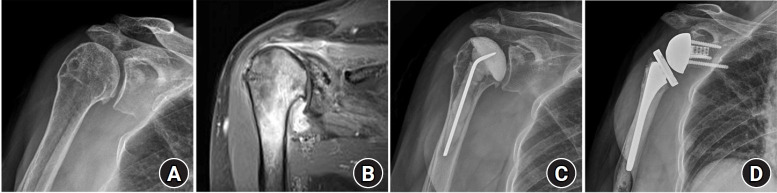
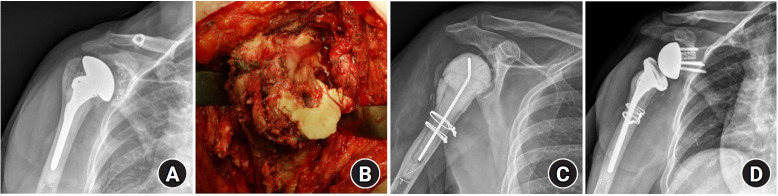
Eleven patients with shoulder infection were treated by two-stage RTSA following temporary antibiotic-loaded cement spacer. Of the 11 shoulders, nine had pyogenic arthritis combined with complex conditions such as recurrent infection, extensive osteomyelitis, osteoarthritis, or massive rotator cuff tear and two had periprosthetic joint infection (PJI). The mean follow-up period was 29.9 months (range, 12-48 months) after RTSA. Clinical and radiographic outcomes were evaluated using the visual analog scale (VAS) score for pain, American Shoulder and Elbow Surgeons (ASES) score, subjective shoulder value (SSV), and serial plain radiographs.
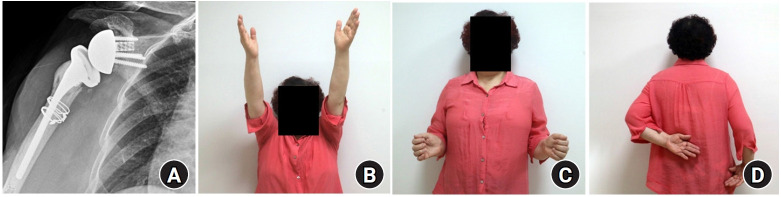
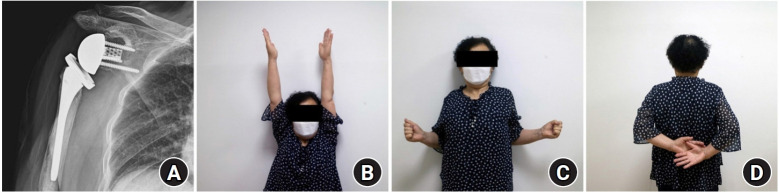
The mean time from antibiotic-loaded cement spacer to RTSA was 9.2 months (range, 1-35 months). All patients had no clinical and radiographic signs of recurrent infection at final follow-up. The mean final VAS score, ASES score, and SSV were significantly improved from 4.5, 38.6, and 29.1% before RTSA to 1.7, 75.1, and 75.9% at final follow-up, respectively. The mean forward flexion, abduction, external rotation, and internal rotation were improved from 50.0°, 50.9°, 17.7°, and sacrum level before RTSA to 127.3°, 110.0°, 51.8°, and L2 level at final follow-up, respectively.
Two-stage RTSA with antibiotic-loaded cement spacer yields satisfactory short-term clinical and radiographic outcomes. In patients with pyogenic arthritis combined with complex conditions or PJI, two-stage RTSA with an antibiotic-loaded cement spacer would be a successful approach to eradicate infection and to improve function with pain relief.
我们研究的目的是调查采用含抗生素骨水泥间隔物的两阶段反向全肩关节置换术(RTSA)治疗肩部感染的短期疗效。
11例肩部感染患者在植入临时含抗生素骨水泥间隔物后接受两阶段RTSA治疗。11个肩部中,9个患有化脓性关节炎并伴有复发性感染、广泛骨髓炎、骨关节炎或巨大肩袖撕裂等复杂情况,2个患有假体周围关节感染(PJI)。RTSA术后平均随访时间为29.9个月(范围12 - 48个月)。采用视觉模拟评分法(VAS)评估疼痛、美国肩肘外科医师学会(ASES)评分、主观肩关节评分(SSV)以及系列X线平片来评价临床和影像学结果。
从植入含抗生素骨水泥间隔物到RTSA的平均时间为9.2个月(范围1 - 35个月)。所有患者在末次随访时均无复发性感染的临床和影像学征象。末次随访时,平均最终VAS评分、ASES评分和SSV较RTSA术前的4.5、38.6和29.1%分别显著改善至1.7、75.1和75.9%。平均前屈、外展、外旋和内旋从RTSA术前的50.0°、50.9°、17.7°和骶骨水平分别改善至末次随访时的127.3°、110.0°、51.8°和L2水平。
采用含抗生素骨水泥间隔物的两阶段RTSA可产生令人满意的短期临床和影像学结果。对于患有化脓性关节炎合并复杂情况或PJI的患者,采用含抗生素骨水泥间隔物的两阶段RTSA是根除感染并改善功能、缓解疼痛的成功方法。