Department of Hematology & Hematopoietic Cell Transplantation, City of Hope, Duarte, CA.
Section of Hematology/Oncology, Department of Medicine, University of Chicago, Chicago, IL.
Blood Adv. 2023 Mar 28;7(6):963-970. doi: 10.1182/bloodadvances.2022008403.
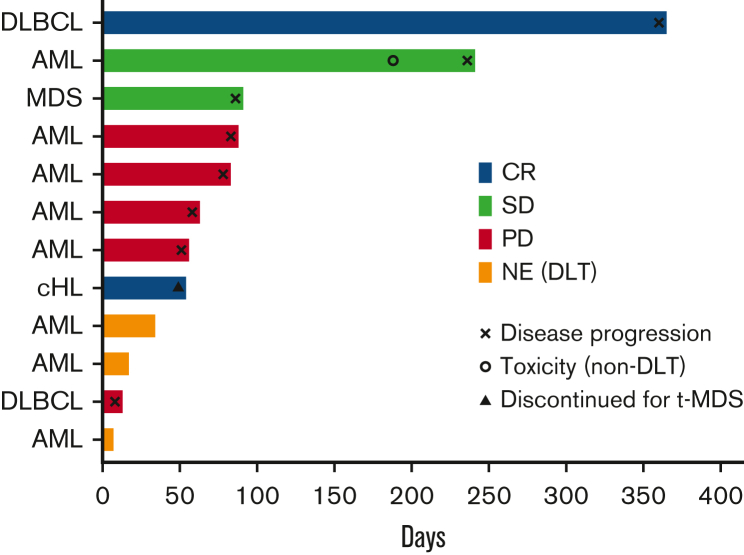
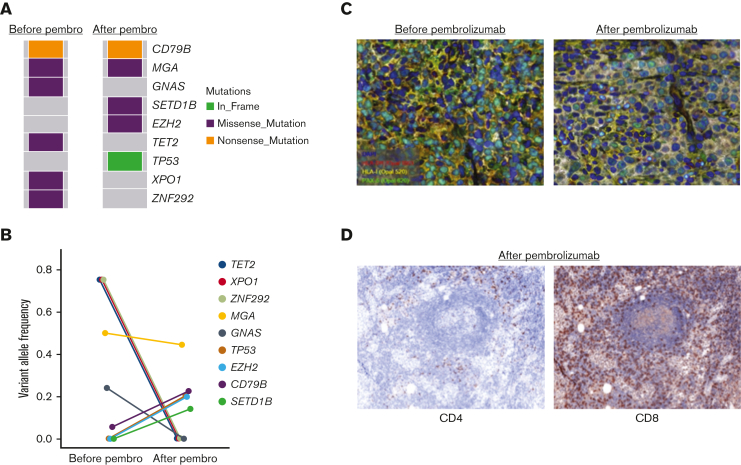
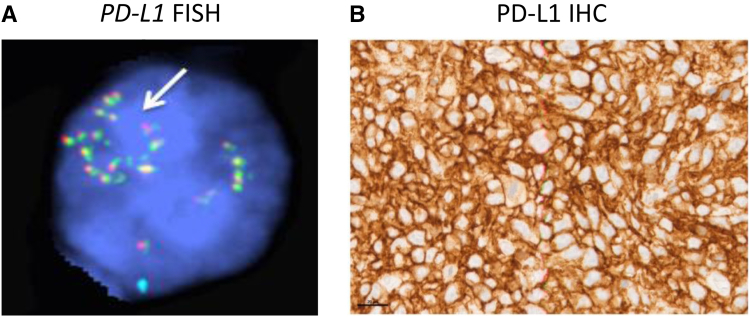
A failed graft-versus-tumor (GVT) effect is a common mechanism of relapse after allogeneic hematopoietic cell transplantation (alloHCT). Although targeting the PD-1/PD-L1 axis may restore GVT effects, PD-1 blockade exacerbates graft-versus-host disease (GVHD) in murine models, and severe GVHD can occur in patients treated with anti-PD-1 therapy after alloHCT. Therefore, we developed a prospective study to assess the safety and efficacy of pembrolizumab in patients relapsing after alloHCT. Eligible patients received pembrolizumab (200 mg every 3 weeks) for up to 2 years. Twelve patients were enrolled (8 patients with acute myeloid leukemia, 1 patient with myelodysplastic syndrome, 1 patient with classical Hodgkin lymphoma, and 2 patients with diffuse large B-cell lymphoma [DLBCL]). All participants received reduced-intensity preparative regimens with in vivo T-cell depletion. The median time from alloHCT to enrollment was 587 days (range, 101-4211). Three participants (25%) experienced grade 3 to 4 immune-related adverse events (irAE) (pneumonitis, 2 patients; hyperthyroidism, 1 patient), all occurring after 1 to 2 cycles, and resolving after pembrolizumab discontinuation and corticosteroid treatment. irAEs of any grade occurred in 5 patients (42%). No treatment-emergent GVHD was observed. Overall and complete response (CR) rates were 22% (2/9). Both patients achieving CRs had PD-L1 gene-amplified lymphomas and diffuse PD-L1 expression on pretreatment biopsies. An acquired EZH2 mutation was identified at relapse in a patient with DLBCL who achieved an initial CR to pembrolizumab, which was associated with downregulated HLA expression on malignant B cells, implicating EZH2 mutations as a potential immune escape mechanism after PD-1-blockade therapy. In conclusion, after alloHCT, treatment with pembrolizumab is feasible and associated with objective responses in relapsed lymphoid malignancies but can induce severe irAEs, requiring vigilant monitoring. This trial was registered at www.clinicaltrials.gov as #NCT02981914.
移植物抗白血病(GVL)效应失败是异基因造血细胞移植(alloHCT)后复发的常见机制。尽管靶向 PD-1/PD-L1 轴可能恢复 GVL 效应,但在小鼠模型中 PD-1 阻断会加重移植物抗宿主病(GVHD),并且在 alloHCT 后接受抗 PD-1 治疗的患者中可能会发生严重的 GVHD。因此,我们开展了一项前瞻性研究,以评估 pembrolizumab 在 alloHCT 后复发患者中的安全性和疗效。符合条件的患者接受 pembrolizumab(每 3 周 200mg)治疗,最长可达 2 年。共纳入 12 名患者(8 名急性髓系白血病患者,1 名骨髓增生异常综合征患者,1 名经典霍奇金淋巴瘤患者,2 名弥漫性大 B 细胞淋巴瘤[DLBCL]患者)。所有患者均接受了含有体内 T 细胞耗竭的减低强度预处理方案。从 alloHCT 到入组的中位时间为 587 天(范围 101-4211)。3 名患者(25%)出现 3 级到 4 级免疫相关不良事件(irAE)(肺炎 2 例;甲状腺功能亢进 1 例),均发生在 1 到 2 个周期后,在停止 pembrolizumab 治疗和皮质类固醇治疗后得到缓解。5 名患者(42%)发生任何级别的 irAE。未观察到治疗相关的 GVHD。总反应率(ORR)和完全反应率(CRR)分别为 22%(2/9)。2 名获得 CR 的患者均患有 PD-L1 基因扩增的淋巴瘤,且在预处理活检中弥漫表达 PD-L1。在一名接受 pembrolizumab 初始 CR 的 DLBCL 患者中,在复发时检测到获得性 EZH2 突变,该突变与恶性 B 细胞 HLA 表达下调相关,提示 EZH2 突变可能是 PD-1 阻断治疗后免疫逃逸的潜在机制。总之,alloHCT 后,pembrolizumab 治疗是可行的,与复发的淋巴恶性肿瘤的客观缓解相关,但可诱导严重的 irAE,需要密切监测。该试验在 www.clinicaltrials.gov 上注册,编号为 #NCT02981914。