Department of Neurology, Korea University Anam Hospital, Korea University College of Medicine, 73, Goryeodae-ro, Seongbuk-gu, Seoul, 02841, Republic of Korea.
Department of Biostatistics, Korea University College of Medicine, Seoul, Republic of Korea.
BMC Geriatr. 2022 Aug 16;22(1):676. doi: 10.1186/s12877-022-03293-z.
Handgrip strength (HGS), an indicator of overall muscle strength, is a key component in sarcopenia diagnosis. Although exercise is an effective strategy to prevent sarcopenia, the most appropriate exercise type targeting sarcopenia needs to be established. This study aimed to investigate the relationship between the physical activity (PA) patterns and HGS.
This was a cross-sectional study using the data from the 7th Korea National Health and Nutrition Examination Survey (2016-2018). The study population included 12,814 adults aged ≥ 40 years. According to the World Health Organization PA guidelines for public health, both aerobic (moderate to vigorous PA ≥ 150 min/week) and resistance exercises (≥ 2 sessions/week) are recommended. Study participants were categorized into one of the four groups depending on their adherence to each of two exercise guidelines ("neither," "aerobic only," "resistance only," and "combined"). By defining normal HGS cutoff values as the lowest quartile of HGS from the population aged 20 years and above, we classified participants as "preserved" HGS group if their HGS was equal to or above the cutoff values. A Poisson regression model was used to calculate adjusted prevalence ratios (APRs) for preserved HGS across the four PA guideline adherences stratified by age and sex groups.
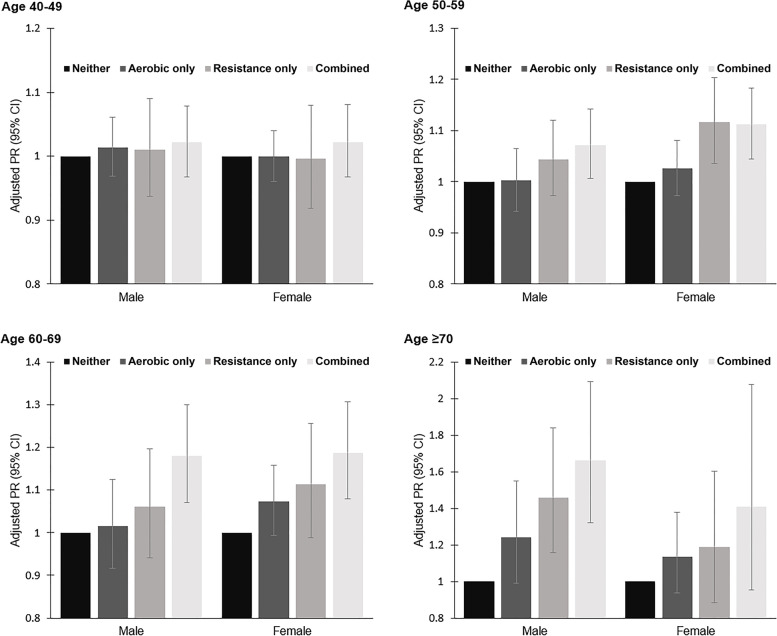
In middle-aged adults, the "combined" exercise group was independently associated with the preserved HGS (male, age 50-59 years, APR = 1.072; male, age 60-69 years, APR = 1.180; female, age 50-59 years, APR = 1.112; female, age 60-69 years, APR = 1.188). For adults aged ≥ 70 years, meeting only aerobic or resistance exercise guidelines showed a positive association with HGS before adjusting for other health-related variables. In males of ≥ 70 years, the APR of preserved HGS was highest in the "combined" exercise group ("resistance only," APR = 1.459, "combined," APR = 1.664), while in women aged ≥ 70 years, the significance was lost after adjusting for covariates.
Adults meeting both aerobic and resistance exercise guidelines were associated with the highest prevalence of preserved HGS. Performing both types of exercise might be the most effective way to prevent sarcopenia that should be investigated in future clinical trials.
握力(HGS)是整体肌肉力量的指标,是肌少症诊断的关键组成部分。尽管运动是预防肌少症的有效策略,但仍需确定针对肌少症的最适当运动类型。本研究旨在探讨体力活动(PA)模式与 HGS 的关系。
这是一项使用 2016-2018 年第 7 次韩国国家健康和营养检查调查(KNHANES)数据的横断面研究。研究人群包括 12814 名年龄≥40 岁的成年人。根据世界卫生组织针对公众健康的 PA 指南,建议进行有氧运动(适度至剧烈 PA≥150 分钟/周)和阻力运动(每周≥2 次)。根据两种运动指南中每一种的依从性,研究参与者被分为以下四组之一:“都不做”、“仅做有氧运动”、“仅做阻力运动”和“同时做”。通过将 HGS 的最低四分位数定义为 20 岁及以上人群的 HGS 正常值,我们将 HGS 等于或高于正常值的参与者归类为“保留”HGS 组。使用泊松回归模型计算了按年龄和性别分层的四个 PA 指南依从性组中“保留”HGS 的调整后患病率比(APR)。
在中年人群中,“同时做”运动组与“保留”HGS 独立相关(男性,50-59 岁年龄组,APR=1.072;男性,60-69 岁年龄组,APR=1.180;女性,50-59 岁年龄组,APR=1.112;女性,60-69 岁年龄组,APR=1.188)。对于≥70 岁的成年人,在调整其他与健康相关的变量之前,仅符合有氧运动或阻力运动指南与 HGS 呈正相关。在≥70 岁的男性中,“同时做”运动组的“保留”HGS 的 APR 最高(“仅做阻力运动”,APR=1.459;“同时做”,APR=1.664),而在≥70 岁的女性中,调整协变量后,这种显著性丧失。
同时符合有氧运动和阻力运动指南的成年人与“保留”HGS 的最高患病率相关。两种运动类型都可能是预防肌少症的最有效方法,这需要在未来的临床试验中进行调查。