Department of Family Medicine, Yonsei University College of Medicine, Seoul, Korea.
Department of Integrative Medicine, Yonsei University Graduate School, Seoul, Korea.
Clin Interv Aging. 2022 Jun 17;17:971-978. doi: 10.2147/CIA.S356947. eCollection 2022.
Chronic inflammation plays a key role in the pathophysiology of frailty and loss of physical performance, which are closely associated with sarcopenia. In women, the decline in muscle mass and strength is accelerated after menopause. Thus, we examined the association between high sensitivity C-reactive protein (hs-CRP) and relative handgrip strength (HGS) in postmenopausal women.
This cross-sectional study included 2171 postmenopausal women aged ≥45 years who participated in the Korean National Health and Nutrition Survey (KNHNES) between 2015 and 2018. Relative HGS was categorized into quartiles as follows: Q1, <0.810 (kg/BMI); Q2, 0.810-0.968 (kg/BMI); Q3, 0.969-1.119 (kg/BMI); Q4, >1.119 (kg/BMI). The odds ratios (ORs) and 95% confidence intervals (95% CIs) for high hs-CRP (>1.0 mg/L, 75 percentile of the current samples) were calculated across relative HGS quartiles using multiple logistic regression analysis.
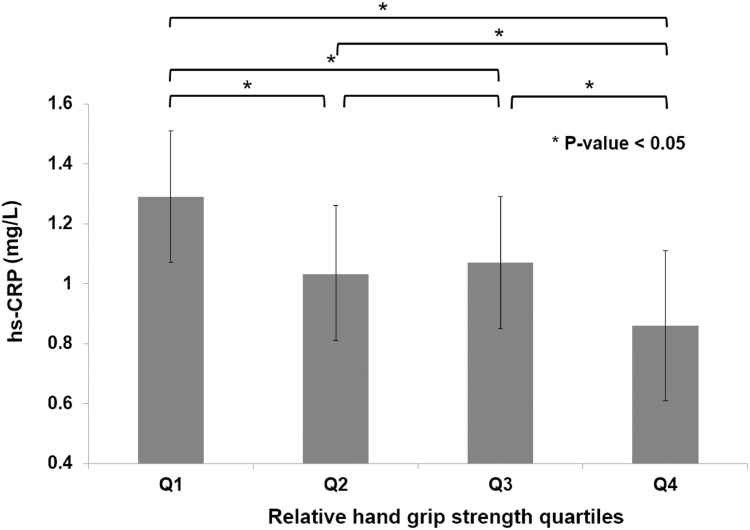
The prevalence of high hs-CRP decreased with relative HGS quartiles. Compared to the highest quartile, the OR (95% CI) of the lowest relative HGS quartile for high hs-CRP was 3.266 (2.227-4.789) after adjusting for age, hypertension, diabetes mellitus, dyslipidemia, education, household income, physical activity, strength exercise, smoking, and alcohol ingestion.
Serum hs-CRP level was inversely and independently associated with relative HGS. Our findings indicate that low-grade inflammation is inversely associated with muscle strength in postmenopausal women.
慢性炎症在衰弱和身体机能丧失的病理生理学中起着关键作用,而衰弱和身体机能丧失与肌肉减少症密切相关。在女性中,绝经后肌肉质量和力量的下降加速。因此,我们研究了绝经后妇女高敏 C 反应蛋白(hs-CRP)与相对握力(HGS)之间的关系。
本横断面研究纳入了 2171 名年龄≥45 岁的绝经后妇女,她们参加了 2015 年至 2018 年期间的韩国国家健康和营养调查(KNHNES)。相对 HGS 分为四组:Q1,<0.810(kg/BMI);Q2,0.810-0.968(kg/BMI);Q3,0.969-1.119(kg/BMI);Q4,>1.119(kg/BMI)。使用多因素逻辑回归分析计算 hs-CRP 升高(>1.0 mg/L,当前样本的 75 分位数)与相对 HGS 四分位数之间的比值比(ORs)和 95%置信区间(95% CIs)。
hs-CRP 升高的患病率随相对 HGS 四分位数的降低而降低。与最高四分位相比,在调整年龄、高血压、糖尿病、血脂异常、教育、家庭收入、体力活动、力量锻炼、吸烟和饮酒后,最低相对 HGS 四分位的 hs-CRP 升高的 OR(95% CI)为 3.266(2.227-4.789)。
血清 hs-CRP 水平与相对 HGS 呈负相关且独立相关。我们的研究结果表明,低水平炎症与绝经后妇女的肌肉力量呈负相关。