Division of Rheumatology, Huashan Hospital, Fudan University, 12 Wulumuqizhong Road, Shanghai, 200040, China.
Institute of Rheumatology, Immunology and Allergy, Fudan University, Shanghai, China.
Arthritis Res Ther. 2022 Aug 16;24(1):196. doi: 10.1186/s13075-022-02889-5.
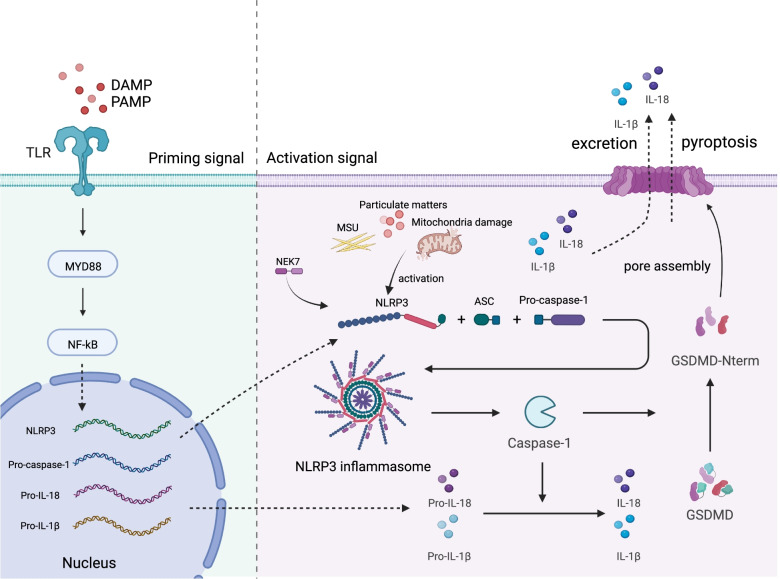
Systemic sclerosis (SSc) is an autoimmune rheumatic disease with high mortality, which is featured by inflammation, vascular damage, and aggressive fibrosis. To date, the pathogenesis of SSc remains unclear and effective treatments are still under research. Active NLRP3 recruits downstream proteins such as ASC and caspase-1 and assembles into inflammasome, resulting in excretion of inflammatory cytokines including IL-1β and IL-18, as well as in pyroptosis mediated by gasdermin D. Various studies demonstrated that NLRP3 inflammasome might be involved in the mechanism of tenosynovitis, arthritis, fibrosis, and vascular damage. The pathophysiological changes might be due to the activation of proinflammatory Th2 cells, profibrotic M2 macrophages, B cells, fibroblasts, and endothelial cells. Here, we review the studies focused on NLRP3 inflammasome activation, its association with innate and adaptive immune cells, endothelium injury, and differentiation of fibroblasts in SSc. Furthermore, we summarize the prospect of therapy targeting NLRP3 pathway.
系统性硬化症(SSc)是一种死亡率较高的自身免疫性风湿病,其特征为炎症、血管损伤和侵袭性纤维化。迄今为止,SSc 的发病机制仍不清楚,有效的治疗方法仍在研究中。活化的 NLRP3 招募下游蛋白如 ASC 和 caspase-1,并组装成炎性小体,导致包括 IL-1β和 IL-18 在内的炎症细胞因子的释放,以及由 gasdermin D 介导的细胞焦亡。多项研究表明,NLRP3 炎性小体可能参与了腱鞘炎、关节炎、纤维化和血管损伤的发病机制。这些病理生理变化可能是由于促炎 Th2 细胞、促纤维化 M2 巨噬细胞、B 细胞、成纤维细胞和内皮细胞的激活所致。在这里,我们综述了关于 NLRP3 炎性小体激活、与先天和适应性免疫细胞、内皮损伤以及 SSc 中成纤维细胞分化的关联的研究。此外,我们总结了靶向 NLRP3 通路的治疗前景。