Univ Brest, Inserm, EFS, UMR 1078, GGB, 22 Avenue Camille Desmoulins, F-29200, Brest, France.
Service de Génétique Médicale et de Biologie de la Reproduction, CHRU Brest, F-29200, Brest, France.
Hum Genomics. 2022 Aug 16;16(1):31. doi: 10.1186/s40246-022-00407-x.
The American College of Medical Genetics and Genomics (ACMG)-recommended five variant classification categories (pathogenic, likely pathogenic, uncertain significance, likely benign, and benign) have been widely used in medical genetics. However, these guidelines are fundamentally constrained in practice owing to their focus upon Mendelian disease genes and their dichotomous classification of variants as being either causal or not. Herein, we attempt to expand the ACMG guidelines into a general variant classification framework that takes into account not only the continuum of clinical phenotypes, but also the continuum of the variants' genetic effects, and the different pathological roles of the implicated genes.
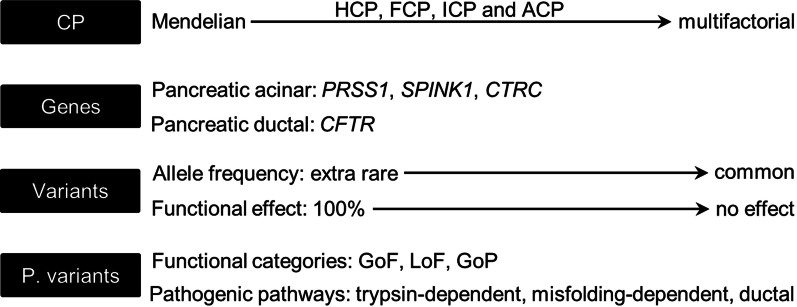
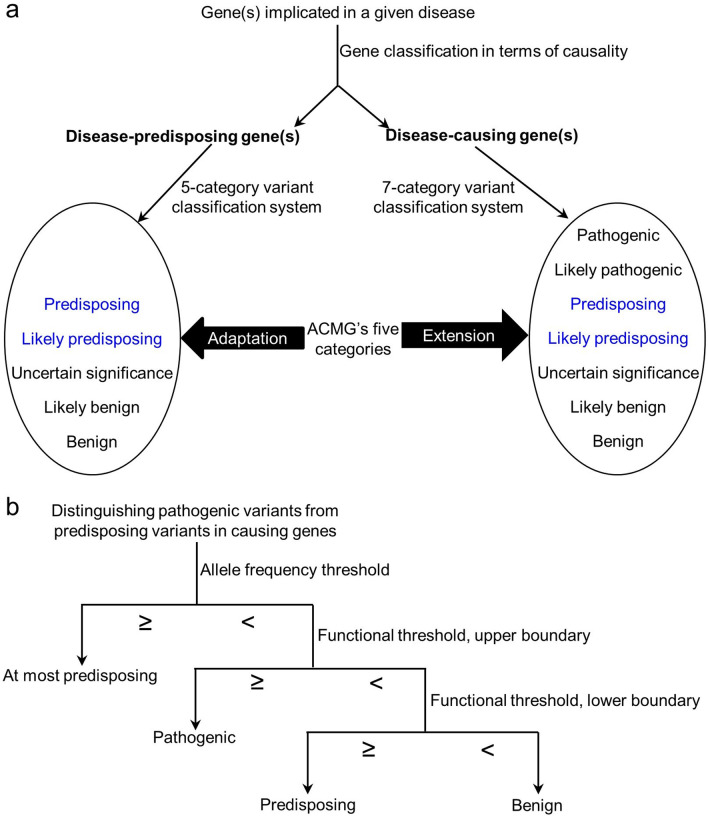
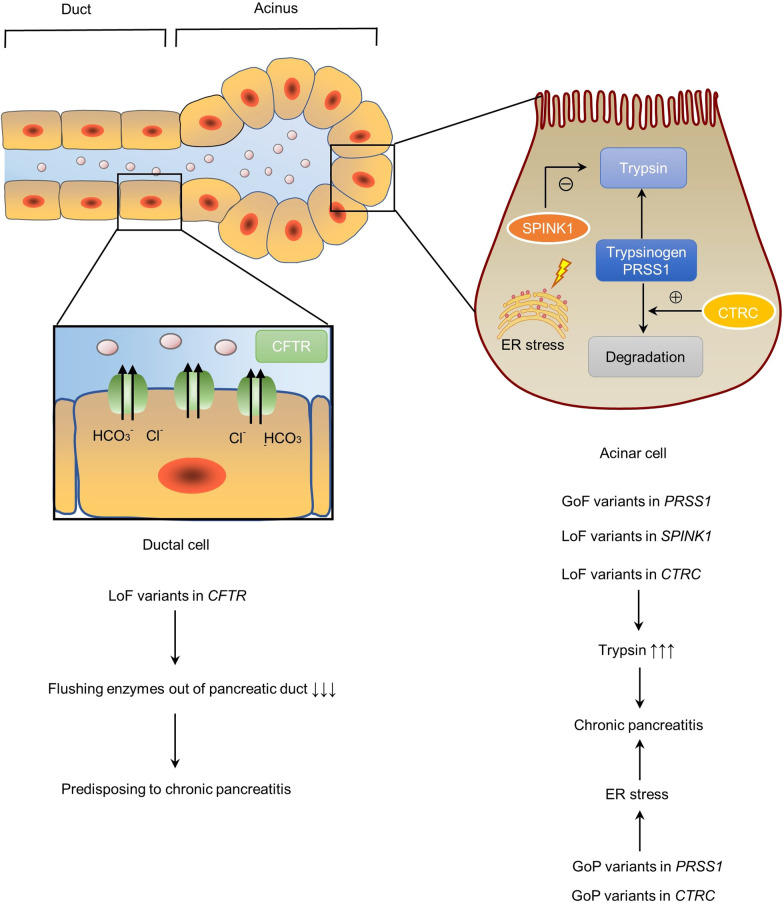
As a disease model, we employed chronic pancreatitis (CP), which manifests clinically as a spectrum from monogenic to multifactorial. Bearing in mind that any general conceptual proposal should be based upon sound data, we focused our analysis on the four most extensively studied CP genes, PRSS1, CFTR, SPINK1 and CTRC. Based upon several cross-gene and cross-variant comparisons, we first assigned the different genes to two distinct categories in terms of disease causation: CP-causing (PRSS1 and SPINK1) and CP-predisposing (CFTR and CTRC). We then employed two new classificatory categories, "predisposing" and "likely predisposing", to replace ACMG's "pathogenic" and "likely pathogenic" categories in the context of CP-predisposing genes, thereby classifying all pathologically relevant variants in these genes as "predisposing". In the case of CP-causing genes, the two new classificatory categories served to extend the five ACMG categories whilst two thresholds (allele frequency and functional) were introduced to discriminate "pathogenic" from "predisposing" variants.
Employing CP as a disease model, we expand ACMG guidelines into a five-category classification system (predisposing, likely predisposing, uncertain significance, likely benign, and benign) and a seven-category classification system (pathogenic, likely pathogenic, predisposing, likely predisposing, uncertain significance, likely benign, and benign) in the context of disease-predisposing and disease-causing genes, respectively. Taken together, the two systems constitute a general variant classification framework that, in principle, should span the entire spectrum of variants in any disease-related gene. The maximal compliance of our five-category and seven-category classification systems with the ACMG guidelines ought to facilitate their practical application.
美国医学遗传学与基因组学学会(ACMG)推荐的五种变异分类类别(致病性、可能致病性、意义不明、可能良性和良性)已在医学遗传学中得到广泛应用。然而,由于这些指南主要侧重于孟德尔疾病基因,并且将变异分为因果关系或非因果关系的二分法,因此在实践中受到了根本限制。在此,我们尝试将 ACMG 指南扩展为一个通用的变异分类框架,不仅考虑临床表型的连续体,还考虑变异遗传效应的连续体,以及所涉及基因的不同病理作用。
我们采用慢性胰腺炎(CP)作为疾病模型,其临床表现从单基因到多因素不等。鉴于任何一般概念性建议都应该基于可靠的数据,我们将分析重点放在四个研究最广泛的 CP 基因上,即 PRSS1、CFTR、SPINK1 和 CTRC。通过对多个跨基因和跨变异的比较,我们首先根据疾病病因将不同的基因分为两个不同的类别:CP 致病基因(PRSS1 和 SPINK1)和 CP 易患基因(CFTR 和 CTRC)。然后,我们采用两个新的分类类别,“易患”和“可能易患”,来替代 ACMG 指南中 CP 易患基因的“致病性”和“可能致病性”类别,从而将这些基因中所有与病理学相关的变异分类为“易患”。对于 CP 致病基因,两个新的分类类别扩展了 ACMG 的五个类别,同时引入了两个阈值(等位基因频率和功能)来区分“致病性”和“易患性”变异。
我们采用 CP 作为疾病模型,将 ACMG 指南扩展为一个五类分类系统(易患、可能易患、意义不明、可能良性和良性)和一个七类分类系统(致病、可能致病、易患、可能易患、意义不明、可能良性和良性),分别用于疾病易患基因和致病基因。这两个系统共同构成了一个通用的变异分类框架,原则上应该涵盖任何疾病相关基因中的所有变异。我们的五分类和七分类系统与 ACMG 指南的最大一致性,应该有助于它们的实际应用。