Major Kimberly, Daggubati Lekhaj C, Mau Christine, Zacharia Brad, Glantz Michael, Pu Cunfeng
Neurosurgery, Penn State Health Milton S. Hershey Medical Center, Hershey, USA.
Pathology, Penn State Health Milton S. Hershey Medical Center, Hershey, USA.
Cureus. 2022 Jul 14;14(7):e26838. doi: 10.7759/cureus.26838. eCollection 2022 Jul.
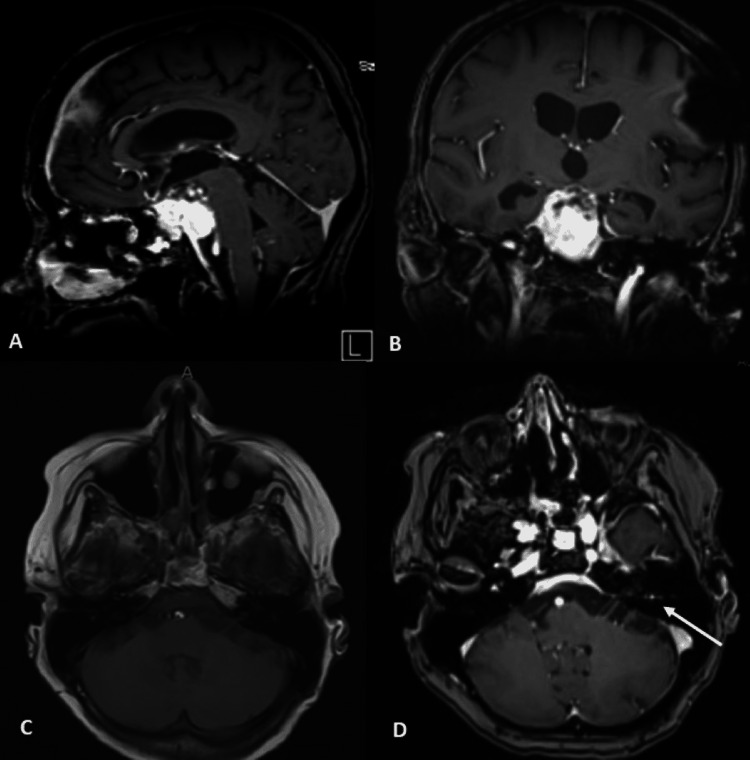
Atypical Teratoid/Rhabdoid tumors are rare, highly malignant tumors in adults, with a median survival of 20 months. We report a case of a sellar atypical teratoid/rhabdoid tumor in a 70-year-old female treated with intraventricular chemotherapy, followed by a systematic review of the current management of sellar AT/RTs.
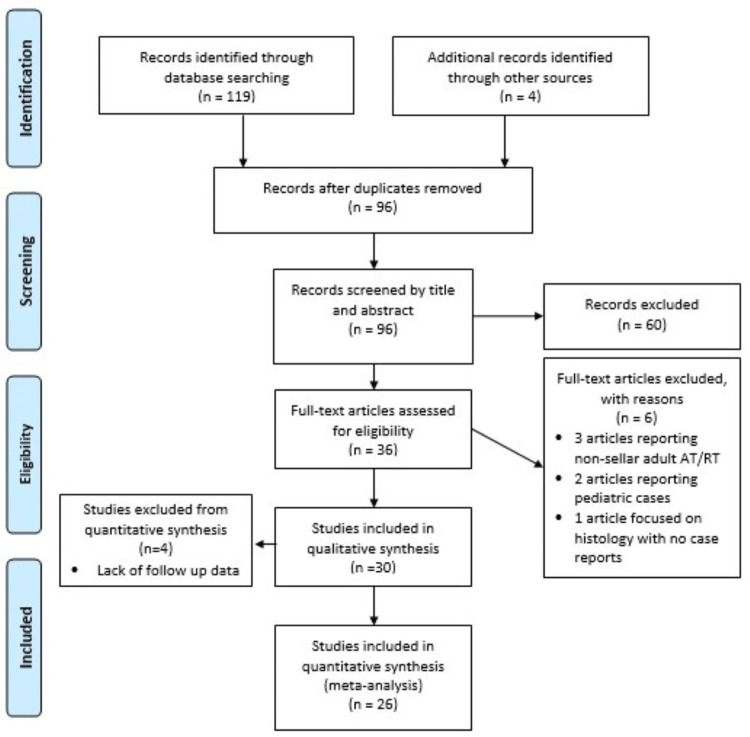
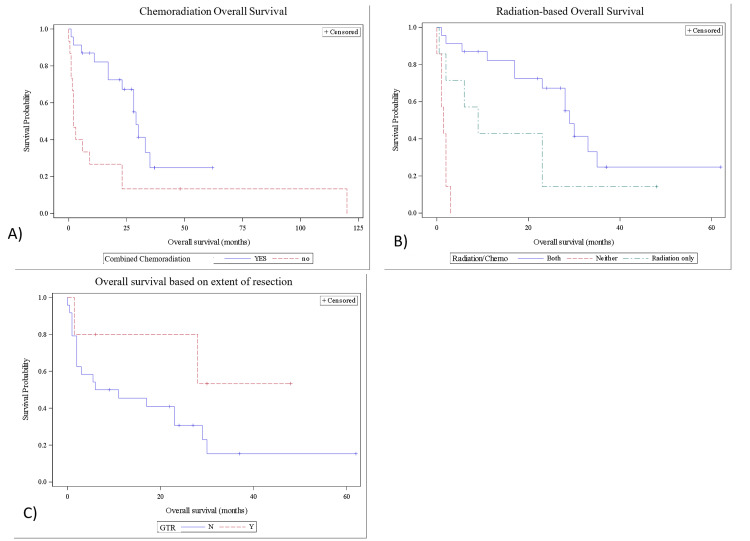
A comprehensive systematic literature search was conducted on Web of Science, Scopus, and PubMed Central using the key terms "sellar" and "atypical teratoid/rhabdoid tumors", following Preferred Reporting Items for Systematic Reviews and Meta-Analyses (PRISMA) guidelines. Data, including patient demographics, histology, treatments, and overall survival were extracted and analyzed. Kaplan-Meier survival curves and log-rank analysis were used to compare survival outcomes between different treatment regimens.
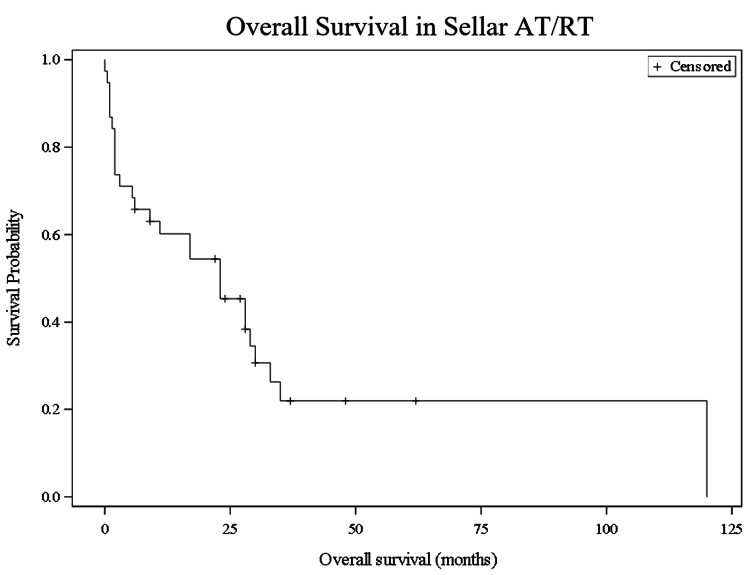
Our literature search disclosed 123 publications. After prespecified exclusions, 41 patients with sellar AT/RT from 30 manuscripts were identified, and 38 were included in the final analysis. Including our patient, the median age was 44 (range: 20-70) with a substantial female predominance (94.7%). Collectively, patients who received combined chemoradiation therapy had a significantly increased overall survival compared to those who received single modality or no adjuvant therapies (median OS 27 vs. 1.25 months; =0.0052).
Atypical teratoid/rhabdoid tumor in the sellar region carries a poor prognosis. Adjuvant chemotherapy and radiation therapy were associated with significantly increased overall survival. Early consideration of neuro-oncology and radiation-oncology referral and management is likely beneficial in this patient population. Intrathecal chemotherapy is a treatment modality that requires further exploration given the limited options and current dismal prognosis of adult sellar AT/RT.
非典型畸胎样/横纹肌样肿瘤是成人罕见的高度恶性肿瘤,中位生存期为20个月。我们报告一例70岁女性鞍区非典型畸胎样/横纹肌样肿瘤患者,接受脑室内化疗,随后对鞍区非典型畸胎样/横纹肌样肿瘤的当前治疗方法进行系统综述。
按照系统评价和Meta分析的首选报告项目(PRISMA)指南,在科学网、Scopus和PubMed Central上使用关键词“鞍区”和“非典型畸胎样/横纹肌样肿瘤”进行全面的系统文献检索。提取并分析包括患者人口统计学、组织学、治疗方法和总生存期等数据。采用Kaplan-Meier生存曲线和对数秩分析比较不同治疗方案之间的生存结果。
我们的文献检索共发现123篇出版物。经过预先设定的排除标准后,从30篇手稿中确定了41例鞍区非典型畸胎样/横纹肌样肿瘤患者,最终纳入分析38例。包括我们的患者在内,中位年龄为44岁(范围:20 - 70岁),女性占比显著(94.7%)。总体而言,与接受单一治疗方式或未接受辅助治疗的患者相比,接受放化疗联合治疗的患者总生存期显著延长(中位总生存期27个月对1.25个月;P = 0.0052)。
鞍区非典型畸胎样/横纹肌样肿瘤预后较差。辅助化疗和放疗与总生存期显著延长相关。对于该患者群体,早期考虑神经肿瘤学和放射肿瘤学转诊及管理可能有益。鉴于成人鞍区非典型畸胎样/横纹肌样肿瘤的治疗选择有限且目前预后不佳,鞘内化疗是一种需要进一步探索的治疗方式。