ICMR School of Public Health, ICMR-National Institute of Epidemiology, Chennai, Tamil Nadu, India.
Division of Epidemiology & Communicable Diseases, Indian Council of Medical Research, New Delhi, India.
Indian J Med Res. 2022 May-Jun;155(5&6):451-460. doi: 10.4103/ijmr.ijmr_668_22.
BACKGROUND & OBJECTIVES: Globally, vaccination is considered as an important public health strategy to mitigate the impact of the COVID-19 pandemic. The purpose of the current study was to conduct an in-depth inquiry to explore perceptions of community members around COVID-19 vaccines in the southern city of Chennai, Tamil Nadu. This was conducted during the early phase of the vaccine rollout programme in India.
A qualitative investigation was conducted between January-February 2021 through in-depth interviews. Healthcare workers, religious leaders, community influencers, local administrators and representatives of marginalized communities were included. The key informant interview guides and probes explored five domains; (i) vaccine availability, (ii) trust in COVID-19 vaccines, (iii) vaccine-related concerns, (iv) health/risk balance and (v) vaccine prioritization. Transcripted interviews were coded using a thematic approach and analyzed manually as well as with the help of ATLAS.ti 9 software.
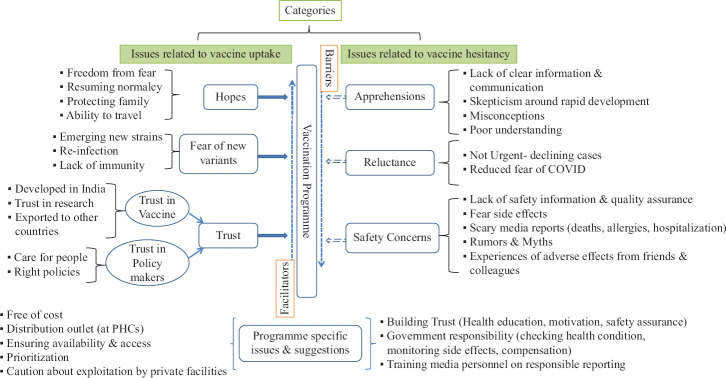
Eagerness to receive COVID-19 vaccines amongst some of the respondents was linked with freedom from fear, possible restoration of normalcy, protection of family and ability to travel and work abroad. Concerns around threat of emergence of new variants, damage caused by such viral mutants and trust in policymakers were other facilitatory influencers for vaccine uptake. On the other hand, doubts surrounding safety and fear of side effects of COVID-19 vaccine were the feeders to vaccine hesitancy. Lack of accurate information, sensational media reports and rumours exacerbated this fear and provoked anxiety among people. Apprehensions around COVID-19 vaccine in the wake of its rapid development and approval for use and reluctance to take it during the declining phase of the epidemic were identified as other inhibitory factors. Participants underlined the importance of having responsive communication strategies in place focussing on vaccine safety. Making vaccines available to people free of cost and ensuring wider access were other programmatic suggestions.
INTERPRETATION & CONCLUSIONS: In conclusion, our study findings suggest that it is essential to remain engaged with communities and execute evidence-based information dissemination strategy about the safety and efficacy of the vaccines. We identified that it is also imperative to sensitize and train media professionals on how to report side effects related to vaccines. Responsive communication strategies will thus have the potential to serve as a key public health approach pertaining to future pandemic preparedness as well as to manage the demands of clinical and public health issues in an ongoing pandemic situation.
在全球范围内,接种疫苗被认为是减轻 COVID-19 大流行影响的重要公共卫生策略。本研究的目的是深入探究印度钦奈市南部社区成员对 COVID-19 疫苗的看法。这是在印度疫苗推出计划的早期阶段进行的。
2021 年 1 月至 2 月期间通过深入访谈进行了定性调查。纳入了医疗保健工作者、宗教领袖、社区影响者、当地行政人员和边缘社区代表。关键知情人访谈指南和探针探讨了五个领域:(i)疫苗供应,(ii)对 COVID-19 疫苗的信任,(iii)疫苗相关问题,(iv)健康/风险平衡,以及(v)疫苗优先排序。转录的访谈使用主题方法进行编码,并手动分析以及使用 ATLAS.ti 9 软件进行分析。
一些受访者对接种 COVID-19 疫苗的渴望与免于恐惧、恢复正常、保护家人以及能够出国旅行和工作有关。对新变种出现的威胁、此类病毒突变造成的损害以及对政策制定者的信任等因素也促进了疫苗接种。另一方面,对疫苗安全性的怀疑和对 COVID-19 疫苗副作用的恐惧则是疫苗犹豫的助长因素。缺乏准确信息、耸人听闻的媒体报道和谣言加剧了这种恐惧,并在人们中引起焦虑。对 COVID-19 疫苗在快速开发和批准使用后以及在疫情下降阶段不愿接种的担忧被认为是其他抑制因素。参与者强调需要制定有针对性的沟通策略,重点关注疫苗的安全性。免费提供疫苗并确保更广泛的获取途径是其他方案建议。
总之,我们的研究结果表明,与社区保持联系并执行有关疫苗安全性和有效性的基于证据的信息传播策略至关重要。我们发现,还必须让媒体专业人员了解如何报告与疫苗相关的副作用,这一点也很重要。因此,有针对性的沟通策略有可能成为未来大流行准备和管理持续大流行情况下临床和公共卫生问题需求的主要公共卫生方法。