Division of Medical Oncology, Chulabhorn Hospital, Chulabhorn Royal Academy, Bangkok, Thailand.
Princess Srisavangavadhana College of Medicine, Chulabhorn Royal Academy, Bangkok, Thailand.
Hum Vaccin Immunother. 2022 Nov 30;18(6):2104058. doi: 10.1080/21645515.2022.2104058. Epub 2022 Aug 17.
Cancer patients are more vulnerable to coronavirus disease 2019 (COVID-19) owing to their compromised immune status. However, data regarding COVID-19 vaccine safety and immune response in cancer patients are scarce.
This prospective, age- and sex-matched, single-center cohort study included 61 cancer patients and 122 healthy control participants. Seropositivity was defined as anti-S IgG titer >0.8 units/ml. Primary end point was seroconversion rate of immunoglobulin (Ig)G antibodies against the severe acute respiratory syndrome coronavirus 2 (SARS-CoV-2) spike (S) protein (anti-S IgG) in cancer patients vs. healthy control participants following the second dose of COVID-19 vaccine ChAdOx1 nCoV-19 (AZD1222).
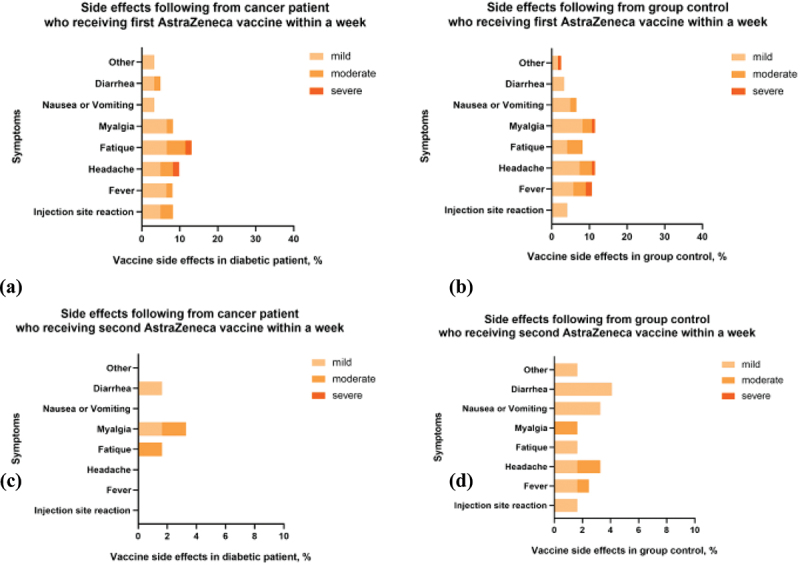
After the second-dose vaccination, there was no difference in seropositivity rate between groups (57 [93.44%] patients with cancer vs. 121 [99.18%] control participants; geometric mean ratio [GMR]: 0.39; 95%CI: 0.01-10.46; -value = 0.571). In contrast, after the first-dose vaccination, the seropositivity rate was significantly lower in the cancer patients than in the control participants (50/61 [81.97%] vs. 121/122 [99.18%]; GMR: 0.07; 95%CI: 0.01-0.71; p = 0.025). The median anti-S IgG titer after the first-and second dose vaccination were not significantly different between groups. Female sex was significantly associated with a higher anti-S IgG titer. 5FU- and taxane-based chemotherapy regimens were associated with a lower IgG titer. Side effects of vaccination were tolerable.
The anti-S IgG seropositivity rate after completing the second vaccine dose did not differ between the cancer patients and control participants. However, the anti-S IgG seropositivity rate after the first-dose vaccination was lower in cancer patients.
由于免疫功能受损,癌症患者更容易感染 2019 年冠状病毒病(COVID-19)。然而,关于癌症患者 COVID-19 疫苗安全性和免疫反应的数据仍然有限。
本前瞻性、年龄和性别匹配的单中心队列研究纳入了 61 例癌症患者和 122 例健康对照者。血清阳性定义为抗-S IgG 滴度>0.8 单位/ml。主要终点是癌症患者和健康对照者在接种第二剂 COVID-19 疫苗 ChAdOx1 nCoV-19(AZD1222)后针对严重急性呼吸综合征冠状病毒 2(SARS-CoV-2)刺突(S)蛋白的免疫球蛋白(IgG)抗体的血清转化率(抗-S IgG)。
在第二剂疫苗接种后,两组的血清阳性率没有差异(57 [93.44%] 例癌症患者与 121 [99.18%] 例对照参与者;几何均数比[GMR]:0.39;95%CI:0.01-10.46;p 值=0.571)。相反,在第一剂疫苗接种后,癌症患者的血清阳性率明显低于对照组(50/61 [81.97%] 与 121/122 [99.18%];GMR:0.07;95%CI:0.01-0.71;p=0.025)。两组之间第一剂和第二剂疫苗接种后的抗-S IgG 滴度中位数没有显著差异。女性性别与更高的抗-S IgG 滴度显著相关。5FU 和紫杉烷类化疗方案与较低的 IgG 滴度相关。疫苗接种的副作用可耐受。
完成第二剂疫苗接种后,癌症患者和对照组的抗-S IgG 血清阳性率没有差异。然而,癌症患者在接种第一剂疫苗后,抗-S IgG 血清阳性率较低。