From the University of Rochester School of Medicine and Dentistry (A.R.F., M.C.K.) and Rochester Regional Health (A.R.F.), Rochester, and Vagelos College of Physicians and Surgeons, New York Presbyterian Columbia University Irving Medical Center, Department of Medicine, Division of Infectious Diseases (M.E.S.) and the New York University Vaccine Center (M.J.M.), New York - all in New York; Biometrics (I.H.) and Infectious Diseases (J.A.G.), Late-Stage Development, Respiratory and Immunology (R.P.M.), Biopharmaceuticals Research and Development (M.N.P.), AstraZeneca, Cambridge, United Kingdom; Biometrics (S.S., K.S.) and Infectious Diseases, Late-Stage Development, Respiratory and Immunology (J.M., T. Takas, T.V., A.G.-L.), Translational Medicine, Microbial Sciences, Biopharmaceuticals Research and Development (E.J.K.), and Clinical Development, Early Global Development, Oncology Research and Development (N.M.), AstraZeneca, Gaithersburg, the Walter Reed Army Institute of Research, Silver Spring (M.L.R.), the University of Maryland School of Medicine (K.M.N.) and the Johns Hopkins Bloomberg School of Public Health (A.D.), Baltimore, the Joint Program Executive Office for Chemical, Biological, Radiological, and Nuclear Defense, Edgewood (J.C.), and the National Institute of Allergy and Infectious Diseases, National Institutes of Health, Bethesda (T. Tong, M.B.I., M.C.N.) - all in Maryland; the University of Washington (L.C., W.H.) and the Fred Hutchinson Cancer Research Center (L.C., W.H., J.H., H.E.J.), Seattle; HealthPartners Institute, St. Paul, MN (C.M.); Orlando Immunology Center, Orlando (E.D.), and JEM Headlands Research, Lake Worth Beach (L.B.) - both in Florida; Hassman Research Institute, Berlin, NJ (M.H.); the University of California San Diego, La Jolla (S.J.L.), the Lundquist Institute at Harbor-UCLA Medical Center, Torrance (E.S.D.), and the San Francisco Department of Public Health, San Francisco (S.B.) - all in California; Children's Mercy Kansas City, Kansas City, MO (B.A.P.); Tekton Research, Austin (P.P.), and Centex Studies, McAllen (J.S.) - both in Texas; Medpharmics, Albuquerque, NM (Q.O.C.); John H. Stroger, Jr. Hospital of Cook County, Chicago (T.O.); Instituto de Ciencias Biomédicas, Facultad de Medicina Universidad de Chile, Santiago, Chile (S.L.V.); Clínica Internacional Sede Lima, Lima, Peru (A.G.B.); Clinical Research Partners, Richmond, VA (R.C.); the University of Vermont Larner College of Medicine and UVM Medical Center, Burlington (B.D.K.); Mercury Street Medical Group, Butte, MT (J.P.); and the Rollins School of Public Health at Emory University, Atlanta (D.B.).
N Engl J Med. 2021 Dec 16;385(25):2348-2360. doi: 10.1056/NEJMoa2105290. Epub 2021 Sep 29.
The safety and efficacy of the AZD1222 (ChAdOx1 nCoV-19) vaccine in a large, diverse population at increased risk for severe acute respiratory syndrome coronavirus 2 (SARS-CoV-2) infection in the United States, Chile, and Peru has not been known.
In this ongoing, double-blind, randomized, placebo-controlled, phase 3 clinical trial, we investigated the safety, vaccine efficacy, and immunogenicity of two doses of AZD1222 as compared with placebo in preventing the onset of symptomatic and severe coronavirus disease 2019 (Covid-19) 15 days or more after the second dose in adults, including older adults, in the United States, Chile, and Peru.
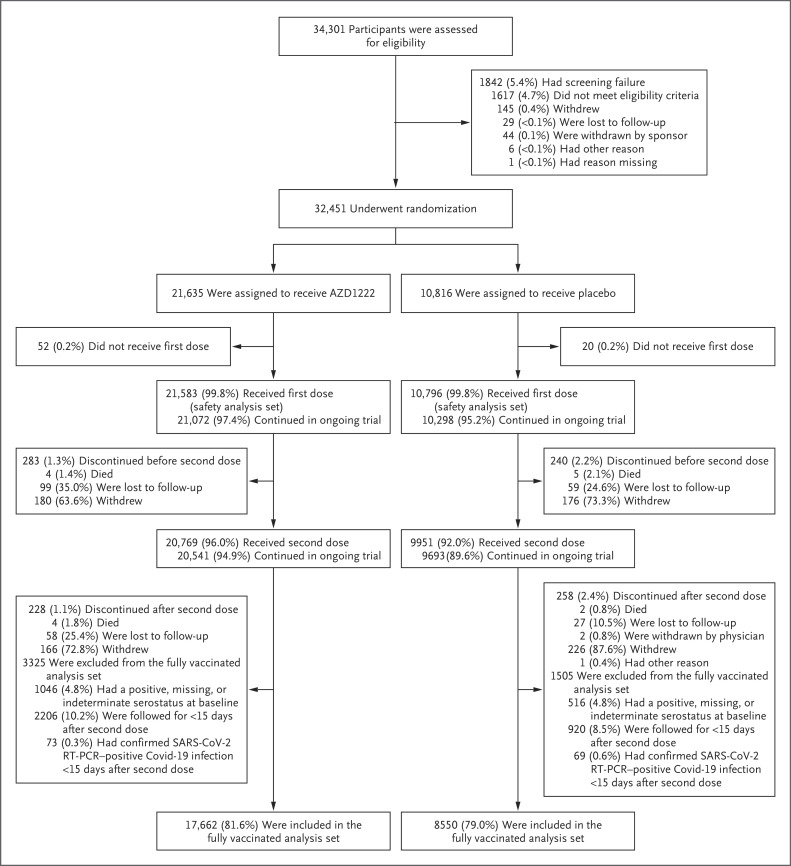
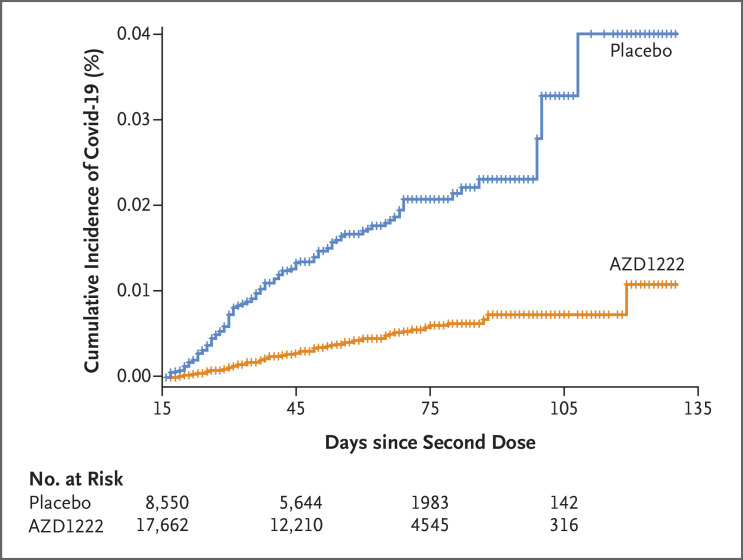
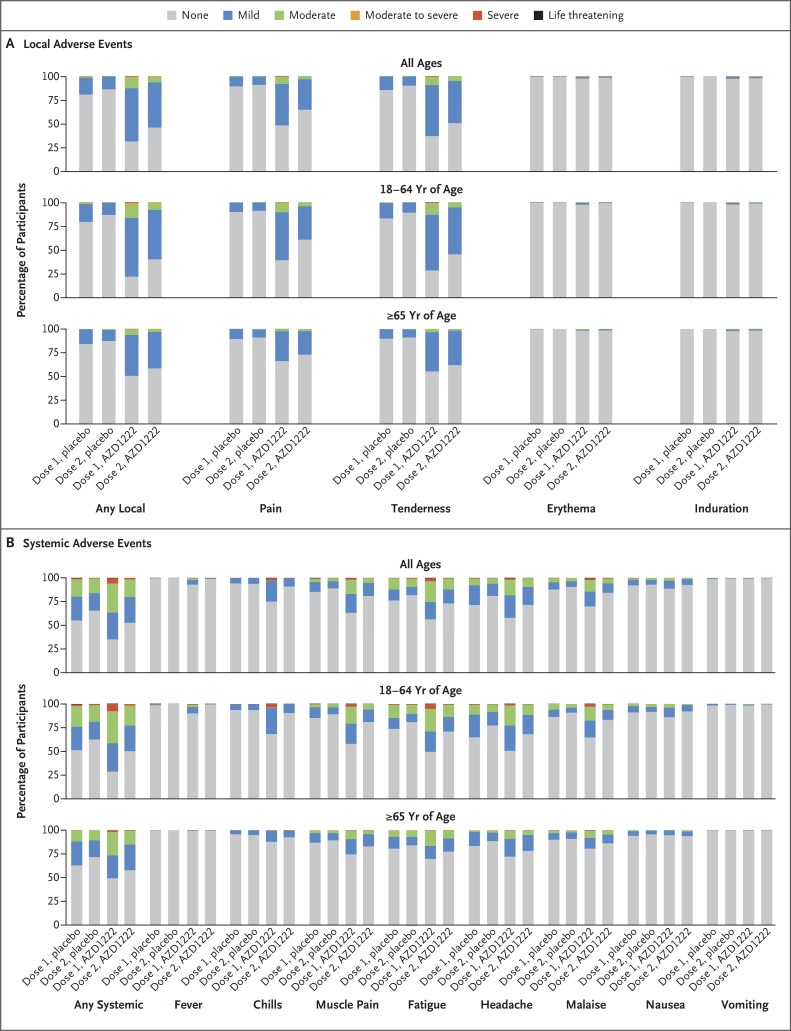
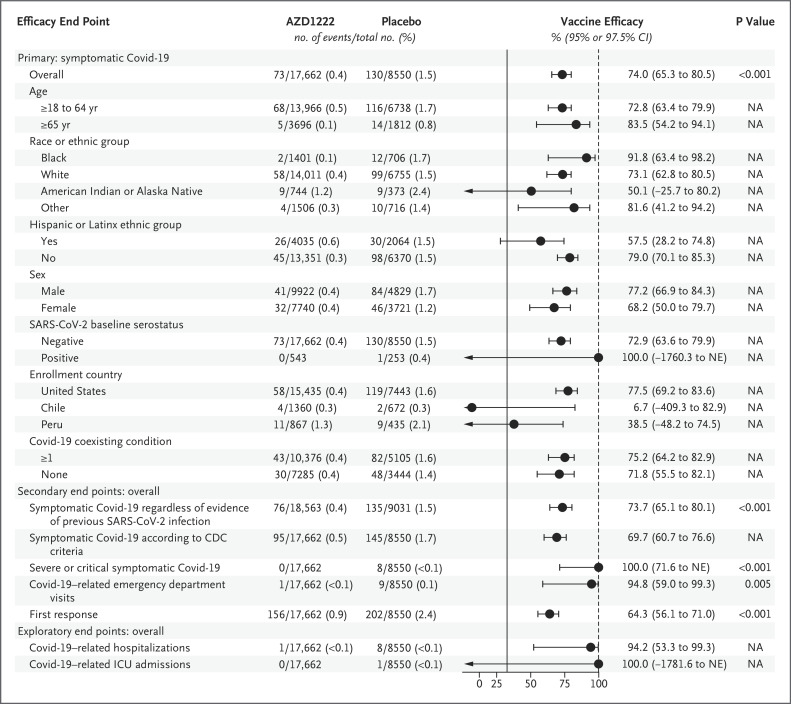
A total of 32,451 participants underwent randomization, in a 2:1 ratio, to receive AZD1222 (21,635 participants) or placebo (10,816 participants). AZD1222 was safe, with low incidences of serious and medically attended adverse events and adverse events of special interest; the incidences were similar to those observed in the placebo group. Solicited local and systemic reactions were generally mild or moderate in both groups. Overall estimated vaccine efficacy was 74.0% (95% confidence interval [CI], 65.3 to 80.5; P<0.001) and estimated vaccine efficacy was 83.5% (95% CI, 54.2 to 94.1) in participants 65 years of age or older. High vaccine efficacy was consistent across a range of demographic subgroups. In the fully vaccinated analysis subgroup, no severe or critical symptomatic Covid-19 cases were observed among the 17,662 participants in the AZD1222 group; 8 cases were noted among the 8550 participants in the placebo group (<0.1%). The estimated vaccine efficacy for preventing SARS-CoV-2 infection (nucleocapsid antibody seroconversion) was 64.3% (95% CI, 56.1 to 71.0; P<0.001). SARS-CoV-2 spike protein binding and neutralizing antibodies increased after the first dose and increased further when measured 28 days after the second dose.
AZD1222 was safe and efficacious in preventing symptomatic and severe Covid-19 across diverse populations that included older adults. (Funded by AstraZeneca and others; ClinicalTrials.gov number, NCT04516746.).
在包括美国、智利和秘鲁在内的高风险人群中,尚未明确 AZD1222(ChAdOx1 nCoV-19)疫苗的安全性和有效性。
在这项正在进行的、双盲、随机、安慰剂对照、3 期临床试验中,我们研究了两剂 AZD1222 相对于安慰剂在预防成年人(包括老年人)出现症状性和严重 2019 年冠状病毒病(Covid-19)方面的安全性、疫苗效力和免疫原性,第二次给药后 15 天或更长时间。在美国、智利和秘鲁进行。
共有 32451 名参与者随机分组,2:1 接受 AZD1222(21635 名参与者)或安慰剂(10816 名参与者)。AZD1222 是安全的,严重和需要医疗关注的不良事件以及特殊关注的不良事件发生率较低;与安慰剂组观察到的发生率相似。两组的局部和全身反应一般均为轻度或中度。总体估计疫苗效力为 74.0%(95%置信区间[CI],65.3 至 80.5;P<0.001),65 岁及以上参与者的估计疫苗效力为 83.5%(95%CI,54.2 至 94.1)。在一系列人口统计学亚组中,疫苗效力均较高。在完全接种疫苗的分析亚组中,AZD1222 组的 17662 名参与者中未观察到严重或危急症状性 Covid-19 病例;安慰剂组的 8550 名参与者中有 8 例(<0.1%)。预防 SARS-CoV-2 感染(核衣壳抗体血清转化率)的估计疫苗效力为 64.3%(95%CI,56.1 至 71.0;P<0.001)。首次给药后,SARS-CoV-2 刺突蛋白结合和中和抗体增加,第二次给药后 28 天进一步增加。
AZD1222 在包括老年人在内的不同人群中预防有症状和严重的 Covid-19 是安全有效的。(由阿斯利康及其他机构资助;临床试验.gov 编号,NCT04516746。)