ICES, Toronto, Ontario, Canada.
Dalla Lana School of Public Health, University of Toronto, Toronto, Ontario, Canada.
JAMA Health Forum. 2022 Jan 21;3(1):e214599. doi: 10.1001/jamahealthforum.2021.4599. eCollection 2022 Jan.
Persons with dementia and Parkinson disease (PD) are vulnerable to disruptions in health care and services.
To examine changes in health service use among community-dwelling persons with dementia, persons with PD, and older adults without neurodegenerative disease during the first wave of the COVID-19 pandemic.
Repeated cross-sectional analysis using population-based administrative data among community-dwelling persons with dementia, persons with PD, and adults 65 years and older at the start of each week from March 1 through the week of September 20, 2020 (pandemic period), and March 3 through the week of September 22, 2019 (historical period), in Ontario, Canada.
COVID-19 pandemic as of March 1, 2020.
Main outcomes were weekly rates of emergency department visits, hospitalizations, nursing home admissions, home care, virtual and in-person physician visits, and all-cause mortality. Poisson regression models were used to calculate weekly rate ratios (RRs) with 95% CIs comparing pandemic weeks with historical levels.
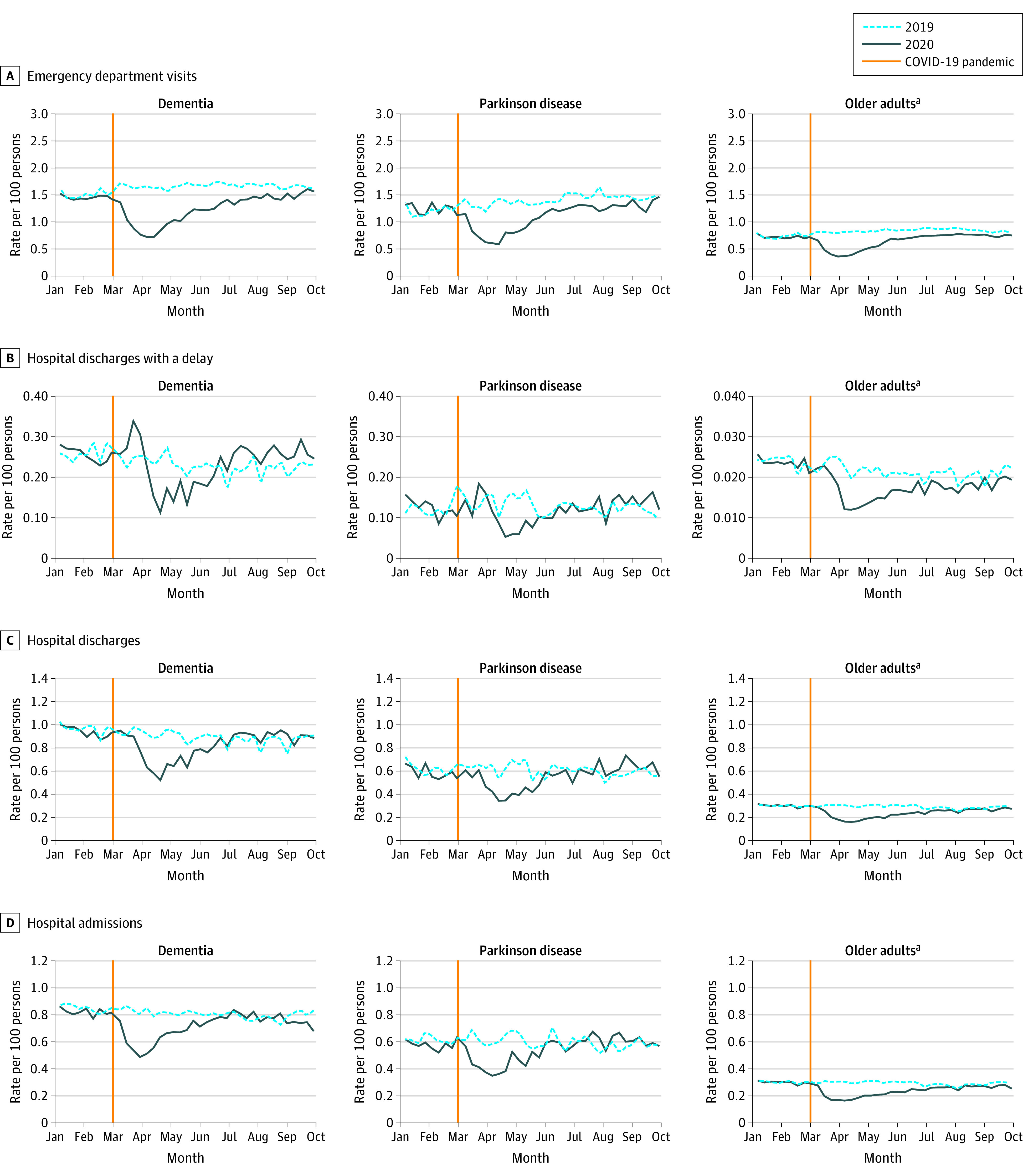
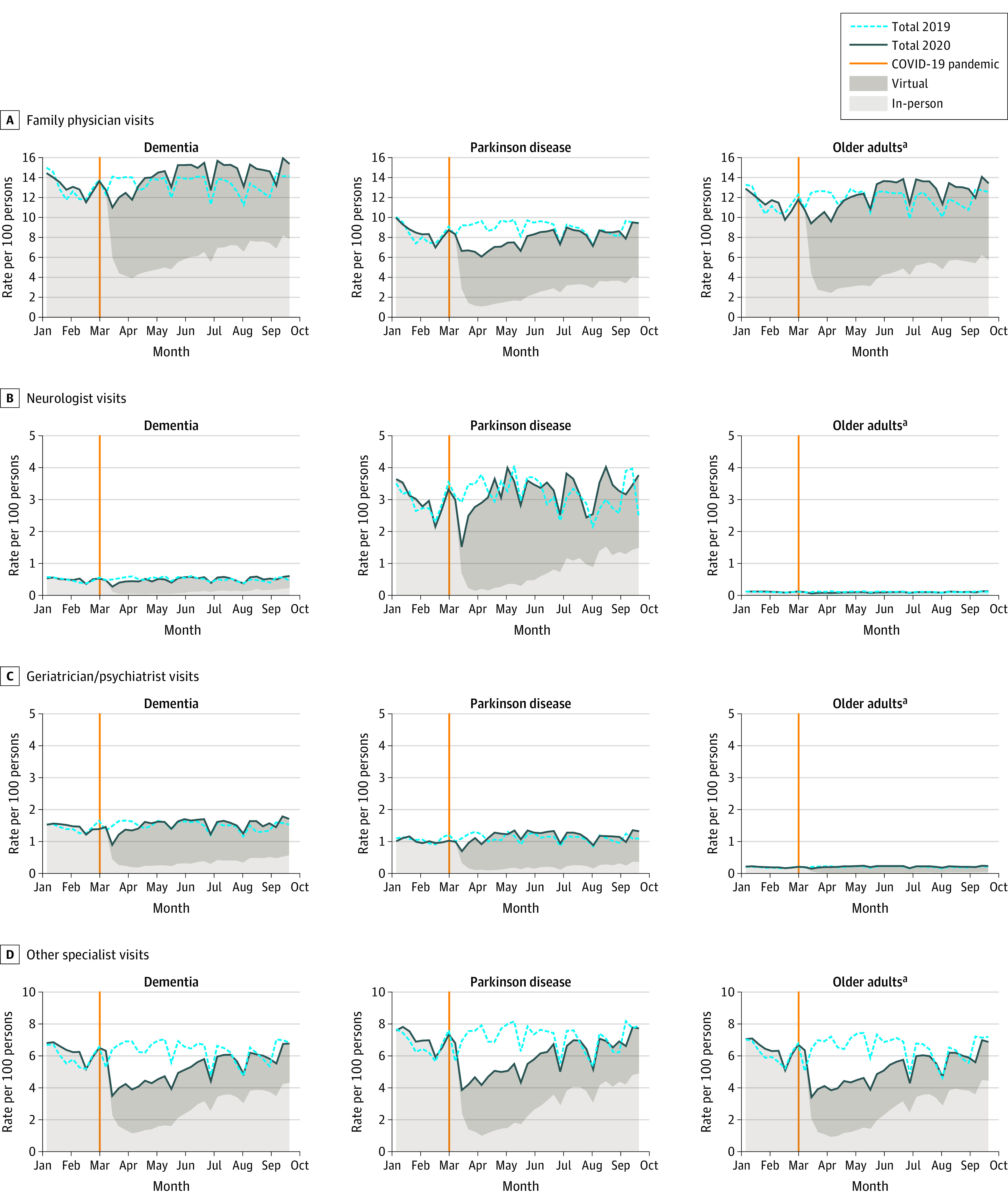
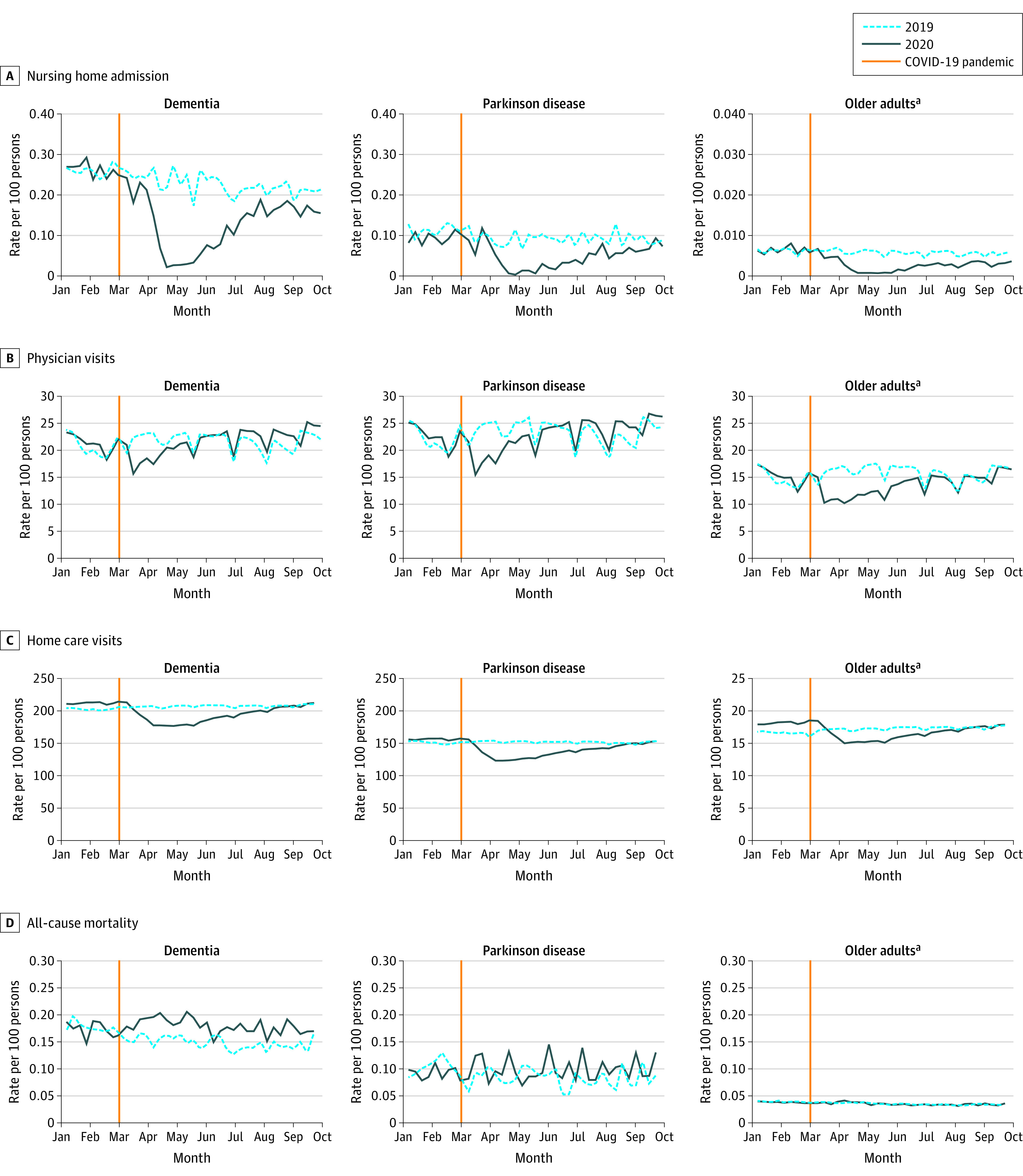
Among those living in the community as of March 1, 2020, persons with dementia (n = 131 466; mean [SD] age, 80.1 [10.1] years) were older than persons with PD (n = 30 606; 73.7 [10.2] years) and older adults (n = 2 363 742; 74.0 [7.1] years). While all services experienced declines, the largest drops occurred in nursing home admissions (RR for dementia: 0.10; 95% CI, 0.07-0.15; RR for PD: 0.03; 95% CI, 0.00-0.21; RR for older adults: 0.11; 95% CI, 0.06-0.18) and emergency department visits (RR for dementia: 0.45; 95% CI, 0.41-0.48; RR for PD: 0.40; 95% CI, 0.34-0.48; RR for older adults: 0.45; 95% CI, 0.44-0.47). After the first wave, most services returned to historical levels except physician visits, which remained elevated (RR for dementia: 1.07; 95% CI, 1.05-1.09; RR for PD: 1.10, 95% CI, 1.06-1.13) and shifted toward virtual visits. Older adults continued to experience lower hospitalizations. All-cause mortality was elevated across cohorts.
In this population-based repeated cross-sectional study in Ontario, Canada, those with dementia, those with PD, and older adults sought hospital care far less than usual, were not admitted to nursing homes, and experienced excess mortality during the first wave of the pandemic. Most services returned to historical levels, but virtual physician visits remained a feature of care. While issues of equity and quality of care are still emerging among persons with neurodegenerative diseases, policies to support virtual care are necessary.
痴呆症和帕金森病(PD)患者容易受到医疗保健和服务中断的影响。
在 COVID-19 大流行的第一波期间,检查痴呆症患者、PD 患者和无神经退行性疾病的老年人群体在社区中健康服务使用的变化。
使用基于人群的行政数据进行重复的横断面分析,纳入 2020 年 3 月 1 日至 9 月 20 日每周(大流行期间)和 2019 年 3 月 3 日至 9 月 22 日每周(历史时期)在加拿大安大略省居住在社区中的痴呆症患者、PD 患者和 65 岁及以上的成年人。
截至 2020 年 3 月 1 日的 COVID-19 大流行。
主要结果是每周急诊就诊、住院、疗养院入院、家庭护理、虚拟和面对面医生就诊和全因死亡率的比率。使用泊松回归模型计算了大流行周与历史水平相比的每周比率比(RR)和 95%CI。
截至 2020 年 3 月 1 日,在社区中居住的人(n=131466;平均[SD]年龄,80.1[10.1]岁)比 PD 患者(n=30606;73.7[10.2]岁)和年龄较大的成年人(n=2363742;74.0[7.1]岁)年长。虽然所有服务都有所下降,但最大的降幅发生在疗养院入院(痴呆症的 RR:0.10;95%CI,0.07-0.15;PD 的 RR:0.03;95%CI,0.00-0.21;老年人的 RR:0.11;95%CI,0.06-0.18)和急诊就诊(痴呆症的 RR:0.45;95%CI,0.41-0.48;PD 的 RR:0.40;95%CI,0.34-0.48;老年人的 RR:0.45;95%CI,0.44-0.47)。第一波疫情过后,大多数服务恢复到历史水平,但医生就诊除外,医生就诊仍然居高不下(痴呆症的 RR:1.07;95%CI,1.05-1.09;PD 的 RR:1.10,95%CI,1.06-1.13)并转向虚拟就诊。老年人的住院率继续下降。所有死因死亡率在所有队列中均升高。
在这项基于人群的安大略省加拿大重复横断面研究中,痴呆症、PD 患者和老年人在第一波大流行期间远远低于平时寻求医院护理,未入院疗养院,并且死亡率过高。大多数服务已恢复到历史水平,但虚拟医生就诊仍然是护理的一个特征。虽然神经退行性疾病患者的公平和护理质量问题仍在出现,但支持虚拟护理的政策是必要的。