Centre for Petroleum Science and Engineering, Skolkovo Institute of Science and Technology, Sikorsky Street 11, Moscow, Russian Federation, 121205.
Curtin University, Kent Street, Perth, Bentley, WA, 6845, Australia.
Sci Rep. 2022 Aug 17;12(1):13984. doi: 10.1038/s41598-022-17886-6.
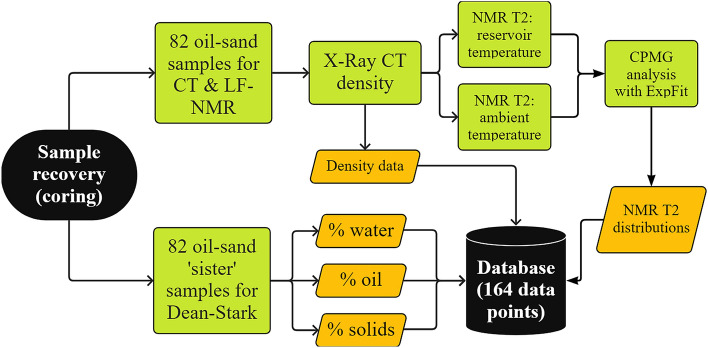
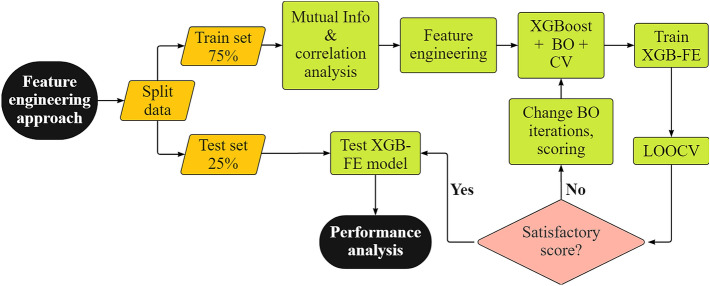
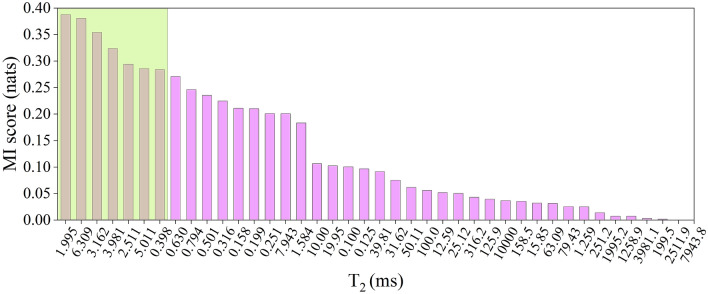
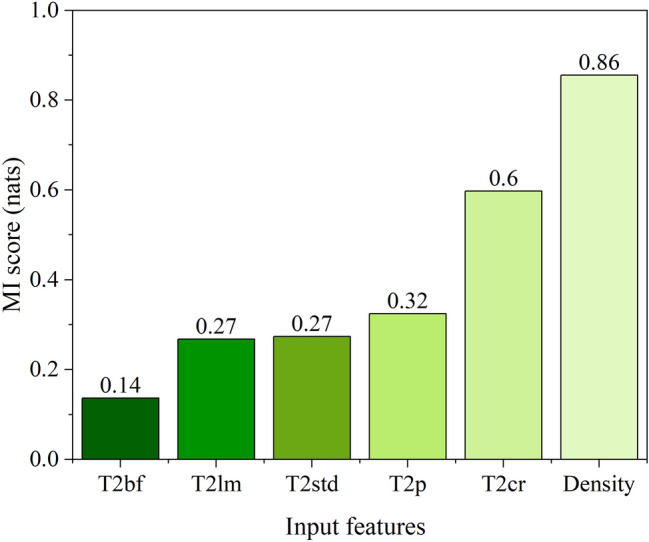
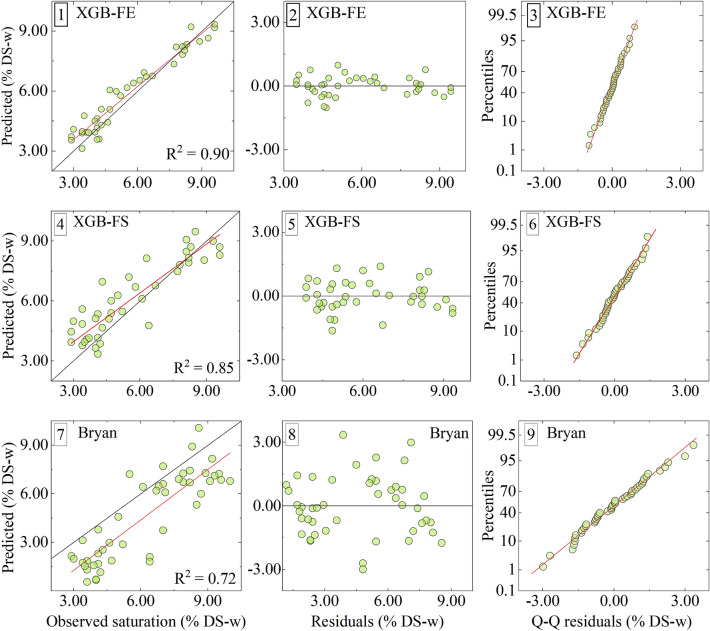
Water saturation determination is among the most challenging tasks in petrophysical well-logging, which directly impacts the decision-making process in hydrocarbon exploration and production. Low-field nuclear magnetic resonance (LF-NMR) measurements can provide reliable evaluation. However, quantification of oil and water volumes is problematic when their NMR signals are not distinct. To overcome this, we developed two machine learning frameworks for predicting relative water content in oil-sand samples using LF-NMR spin-spin (T) relaxation and bulk density data to derive a model based on Extreme Gradient Boosting. The first one facilitates feature engineering based on empirical knowledge from the T relaxation distribution analysis domain and mutual information feature extraction technique, while the second model considers whole samples' NMR T-relaxation distribution. The NMR T distributions were obtained for 82 Canadian oil-sands samples at ambient and reservoir temperatures (164 data points). The true water content was determined by Dean-Stark extraction. The statistical scores confirm the strong generalization ability of the feature engineering LF-NMR model in predicting relative water content by Dean-Stark-root-mean-square error of 0.67% and mean-absolute error of 0.53% (R = 0.90). Results indicate that this approach can be extended for the improved in-situ water saturation evaluation by LF-NMR and bulk density measurements.
水饱和度的确定是岩相测井中最具挑战性的任务之一,直接影响到烃类勘探和生产中的决策过程。低场核磁共振(LF-NMR)测量可以提供可靠的评估。然而,当油和水的 NMR 信号不明显时,它们的体积定量就成了问题。为了解决这个问题,我们开发了两种机器学习框架,使用 LF-NMR 自旋-自旋(T)弛豫和体密度数据来预测油砂样品中的相对含水量,以基于极端梯度提升的模型来进行预测。第一个框架基于 T 弛豫分布分析领域的经验知识和互信息特征提取技术来进行特征工程,而第二个模型则考虑整个样品的 NMR T 弛豫分布。对 82 个加拿大油砂样品在环境和储层温度下(164 个数据点)进行了 NMR T 分布测量。通过Dean-Stark 提取法确定了真实的含水量。统计分数证实了基于特征工程的 LF-NMR 模型在通过 Dean-Stark-root-均方误差预测相对含水量方面具有很强的泛化能力,为 0.67%,平均绝对误差为 0.53%(R=0.90)。结果表明,这种方法可以通过 LF-NMR 和体密度测量来扩展,以提高原位水饱和度评估的精度。