School of Science, Scuola Normale Superiore, Pisa, Italy.
National Research Council of Italy, Institute of Geosciences and Earth Resources (CNR-IGG), Torino, Italy.
Sci Rep. 2022 Aug 17;12(1):13948. doi: 10.1038/s41598-022-17508-1.
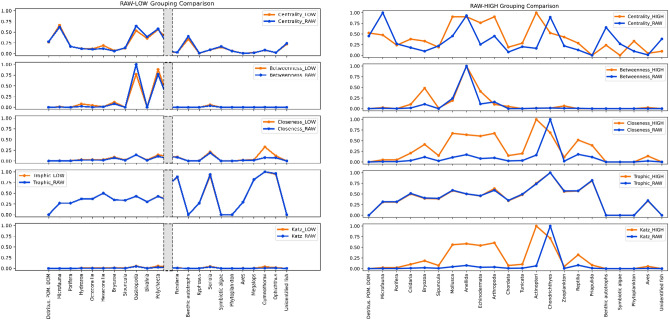
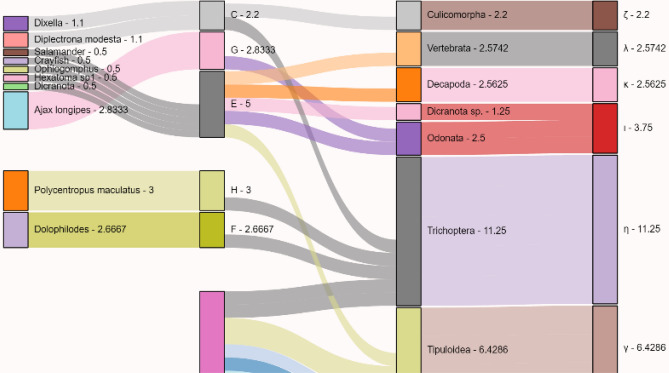
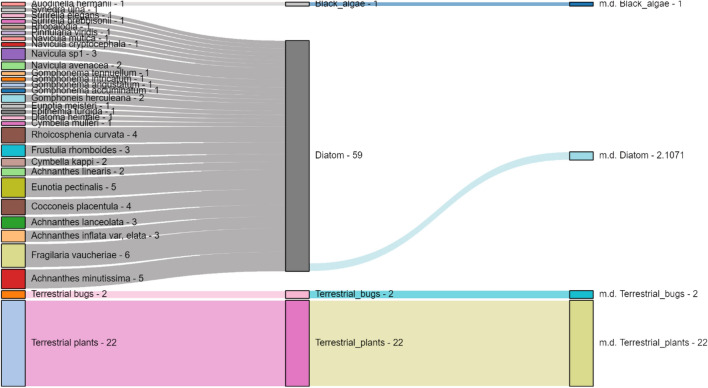
Food webs studies are intrinsically complex and time-consuming. Network data about trophic interaction across different large locations and ecosystems are scarce in comparison with general ecological data, especially if we consider terrestrial habitats. Here we present a complex network strategy to ease the gathering of the information by simplifying the collection of data with a taxonomic key. We test how well the topology of three different food webs retain their structure at the resolution of the nodes across distinct levels of simplification, and we estimate how community detection could be impacted by this strategy. The first level of simplification retains most of the general topological indices; betweenness and trophic levels seem to be consistent and robust even at the higher levels of simplification. This result suggests that generalisation and standardisation, as a good practice in food webs science, could benefit the community, both increasing the amount of open data available and the comparison among them, thus providing support especially for scientists that are new in this field and for exploratory analysis.
食物网研究本质上复杂且耗时。与一般生态数据相比,跨不同大型地点和生态系统的营养相互作用的网络数据相对较少,尤其是在考虑到陆地生境的情况下。在这里,我们提出了一种复杂的网络策略,通过使用分类关键简化数据收集来简化信息收集,从而缓解这一问题。我们测试了三种不同食物网的拓扑结构在不同简化水平下节点分辨率的结构保持情况,并且估计了这种策略可能对群落检测产生的影响。简化的第一级保留了大多数一般拓扑指数;即使在较高的简化水平下,中间性和营养级似乎也是一致且稳健的。这一结果表明,概括和标准化(食物网科学中的一种良好实践)可以使社区受益,既增加了可用公开数据的数量,又促进了它们之间的比较,从而为该领域的新手科学家和探索性分析提供了支持。