Bogris Adonis, Nikas Thomas, Simos Christos, Simos Iraklis, Lentas Konstantinos, Melis Νikolaos S, Fichtner Andreas, Bowden Daniel, Smolinski Krystyna, Mesaritakis Charis, Chochliouros Ioannis
Department of Informatics and Computer Engineering, University of West Attica, Aghiou Spiridonos, 12243, Egaleo, Greece.
Dept. of Informatics and Telecommunications, National and Kapodistrian University of Athens, 15784, Athens, Greece.
Sci Rep. 2022 Aug 17;12(1):14000. doi: 10.1038/s41598-022-18130-x.
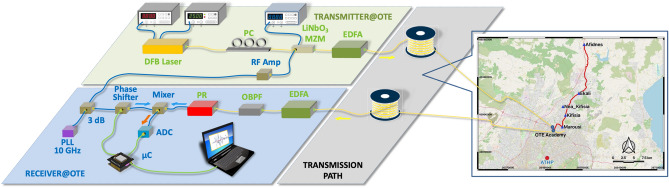
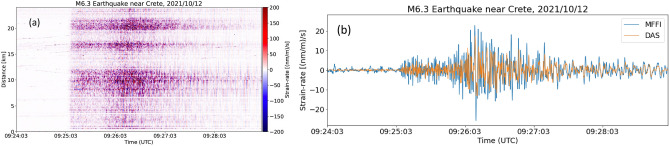
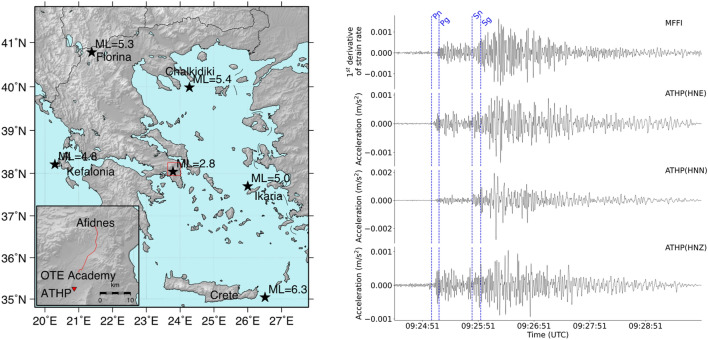
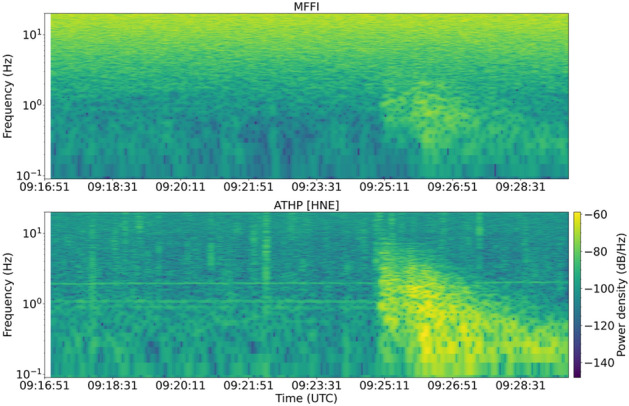
The use of fiber infrastructures for environmental sensing is attracting global interest, as optical fibers emerge as low cost and easily accessible platforms exhibiting a large terrestrial deployment. Moreover, optical fiber networks offer the unique advantage of providing observations of submarine areas, where the sparse existence of permanent seismic instrumentation due to cost and difficulties in deployment limits the availability of high-resolution subsea information on natural hazards in both time and space. The use of optical techniques that leverage pre-existing fiber infrastructure can efficiently provide higher resolution coverage and pave the way for the identification of the detailed structure of the Earth especially on seismogenic submarine faults. The prevailing optical technique for use in earthquake detection and structural analysis is distributed acoustic sensing (DAS) which offers high spatial resolution and sensitivity, however is limited in range (< 100 km). In this work, we present a novel technique which relies on the dissemination of a stable microwave frequency along optical fibers in a closed loop configuration, thereby forming an interferometer that is sensitive to deformation. We call the proposed technique Microwave Frequency Fiber Interferometer (MFFI) and demonstrate its sensitivity to deformation induced by moderate-to-large earthquakes from either local or regional epicenters. MFFI signals are compared to signals recorded by accelerometers of the National Observatory of Athens, Institute of Geodynamics National Seismic Network and by a commercially available DAS interrogator operating in parallel at the same location. Remarkable agreement in dynamical behavior and strain rate estimation is achieved and demonstrated. Thus, MFFI emerges as a novel technique in the field of fiber seismometers offering critical advantages with respect to implementation cost, maximum range and simplicity.
利用光纤基础设施进行环境传感正引起全球关注,因为光纤已成为低成本且易于获取的平台,具有大规模的陆地部署能力。此外,光纤网络具有独特优势,能够对海底区域进行观测,而由于成本和部署困难,永久性地震仪器在海底分布稀疏,这限制了高分辨率海底自然灾害信息在时间和空间上的可用性。利用现有光纤基础设施的光学技术能够有效提供更高分辨率的覆盖范围,并为识别地球的详细结构,特别是在发震海底断层方面,铺平道路。用于地震检测和结构分析的主流光学技术是分布式声学传感(DAS),它具有高空间分辨率和灵敏度,但范围有限(<100公里)。在这项工作中,我们提出了一种新技术,该技术依靠在闭环配置中沿着光纤传播稳定的微波频率,从而形成一个对变形敏感的干涉仪。我们将所提出的技术称为微波频率光纤干涉仪(MFFI),并展示了它对中到大地震(无论是本地还是区域震源)引起的变形的灵敏度。将MFFI信号与雅典国家天文台、地球动力学研究所国家地震网络的加速度计以及在同一地点并行运行的商用DAS询问器记录的信号进行了比较。在动态行为和应变率估计方面取得并展示了显著的一致性。因此,MFFI作为光纤地震仪领域的一种新技术出现,在实施成本、最大范围和简单性方面具有关键优势。