UCL Institute of Ophthalmology, University College London, London, UK.
Byers Eye Institute, Stanford University School of Medicine, Palo Alto, CA, USA.
Trials. 2022 Aug 17;23(1):669. doi: 10.1186/s13063-022-06527-y.
Diabetic macular ischaemia (DMI) is a complication of diabetic retinopathy that leads to irreversible vision loss. DMI is characterised by reduced retinal vessel density and enlargement of the foveal avascular zone (FAZ). Despite its clinical burden, there is no formal consensus on the definition of DMI, and no approved treatment. Semaphorin 3A (Sema3A) is an axonal guidance molecule that blocks revascularisation of the ischaemic retina. Sema3A modulation is therefore a promising mechanism of action for the treatment of ischaemic eye diseases. BI 764524 is an intravitreal anti-Sema3A ischaemia modulator agent.
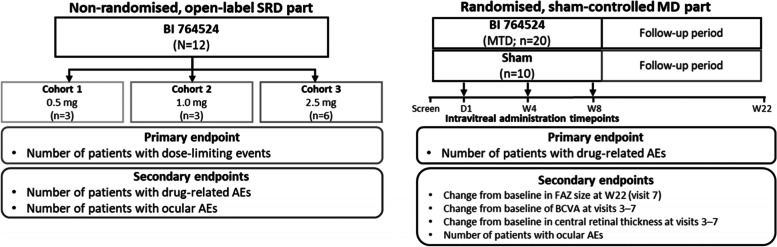
HORNBILL (NCT04424290) is a phase I/IIa trial comprising a non-randomised, open-label, single rising dose (SRD) part and a randomised, masked, sham-controlled multiple dose (MD) part to investigate the safety, tolerability and early biological response of ischaemia modulator BI 764524 in adults (≥18 years) with DMI. DMI will be defined using optical coherence tomography angiography (OCTA) as either any degree of disruption in the retinal vascularity (SRD) or a FAZ of ≥0.5 mm (MD). Subjects in the SRD part will receive 0.5, 1.0 or 2.5 mg of BI 764524; the maximum tolerated dose will then be used in the MD part. A minimum of 12 subjects will be enrolled into the SRD part; planned enrollment is 30 for the MD part. The primary endpoint of the SRD part is the number of subjects with dose-limiting adverse events (AEs) until day 8. The primary endpoint of the MD part is the number of subjects with drug-related AEs from baseline to end of study, and secondary endpoints include change from baseline in the size of the FAZ, best-corrected visual acuity and central retinal thickness.
DMI is a poorly defined condition with no treatment options. HORNBILL is the first clinical trial to assess a treatment for DMI and to use OCTA as a means to define and examine DMI. The OCTA data generated in this trial could form the basis of formal diagnostic criteria for DMI. Furthermore, the novel mechanism of action (Sema3A modulation) explored in this trial has the potential to revolutionise the treatment landscape for patients with DMI.
ClinicalTrials.gov NCT04424290 ; EudraCT 2019-004432-28. Registered on 9 June 2020.
糖尿病性黄斑缺血(DMI)是糖尿病性视网膜病变的一种并发症,可导致不可逆转的视力丧失。DMI 的特征是视网膜血管密度降低和中心凹无血管区(FAZ)扩大。尽管其具有临床负担,但对于 DMI 的定义尚未达成正式共识,也没有批准的治疗方法。神经鞘素 3A(Sema3A)是一种轴突导向分子,可阻止缺血视网膜的再血管化。因此,Sema3A 调节是治疗缺血性眼病的一种很有前途的作用机制。BI 764524 是一种玻璃体内抗 Sema3A 缺血调节剂。
HORNBILL(NCT04424290)是一项 I/IIa 期试验,包括非随机、开放标签、单次递增剂量(SRD)部分和随机、盲法、假对照多次剂量(MD)部分,以研究缺血调节剂 BI 764524 在患有 DMI 的成年人(≥18 岁)中的安全性、耐受性和早期生物学反应。DMI 将通过光学相干断层扫描血管造影(OCTA)定义为视网膜血管完整性任何程度的中断(SRD)或 FAZ 为≥0.5mm(MD)。SRD 部分的受试者将接受 0.5、1.0 或 2.5mg 的 BI 764524;然后在 MD 部分使用最大耐受剂量。SRD 部分计划入组 12 例受试者;MD 部分计划入组 30 例。SRD 部分的主要终点是第 8 天发生剂量限制不良事件(AE)的受试者数量。MD 部分的主要终点是从基线到研究结束时与药物相关的 AE 发生数量,次要终点包括 FAZ 大小、最佳矫正视力和中央视网膜厚度的基线变化。
DMI 是一种定义不明确的疾病,目前尚无治疗方法。HORNBILL 是第一项评估 DMI 治疗方法的临床试验,并使用 OCTA 作为定义和检查 DMI 的手段。该试验生成的 OCTA 数据可能成为 DMI 的正式诊断标准的基础。此外,该试验中探索的新型作用机制(Sema3A 调节)有可能彻底改变 DMI 患者的治疗格局。
ClinicalTrials.gov NCT04424290;EudraCT 2019-004432-28。于 2020 年 6 月 9 日注册。