Medway Council National Health Service, Kent, UK.
Centre for the Study of Regional Development, School of Social Sciences, Jawaharlal Nehru University, New Delhi, India.
Reprod Health. 2022 Aug 17;19(1):178. doi: 10.1186/s12978-022-01487-7.
Poor sexual and reproductive health (SRH) outcomes amongst adolescent girls in India have been associated with inadequate knowledge of SRH. Evidence suggests that social media can promote health-seeking behaviors. Our objective in this study was to determine the association between exposure to social media and SRH knowledge among adolescent girls in Bihar and Uttar Pradesh, India.
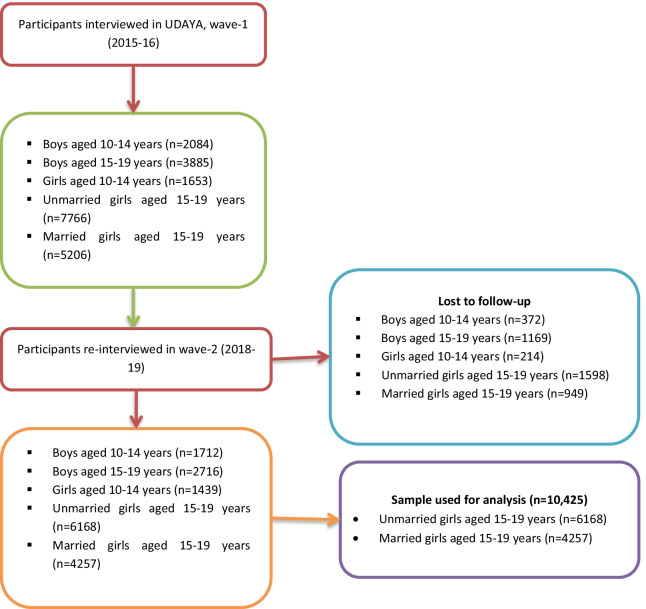
A cross-sectional study was conducted with 10,425 adolescent girls from the UDAYA survey (wave-2, 2018-19). Girls' exposure to social media was the key predictor, and SRH knowledge of sexual intercourse and pregnancy, contraceptive methods, and HIV/AIDS were outcomes of interest. Multivariable logistic regression models were performed to assess the association between exposure to social media and knowledge of SRH among adolescent girls.
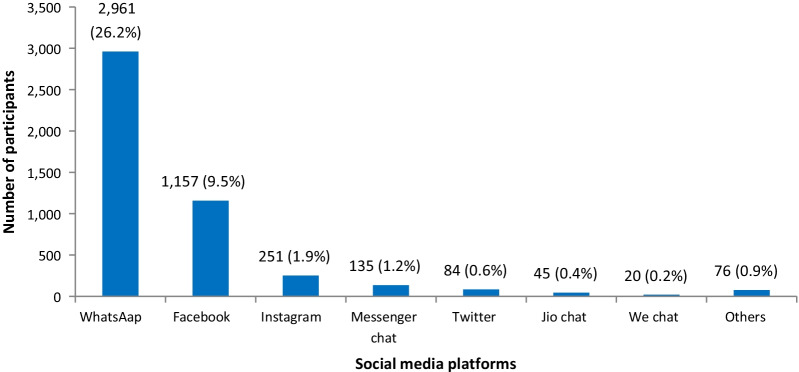
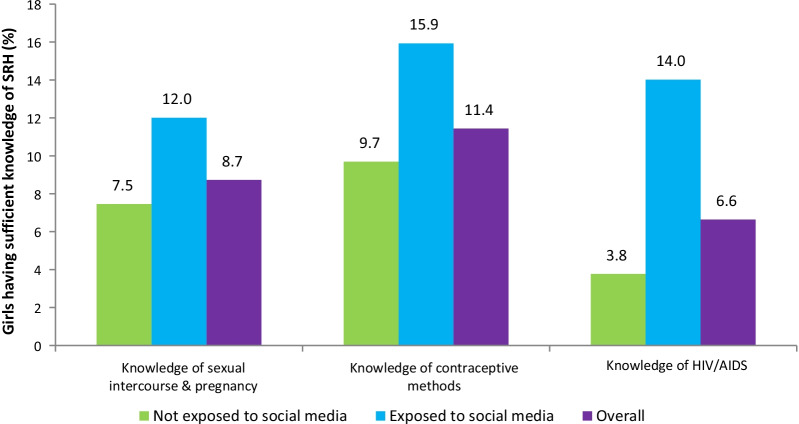
Of the study participants (n = 10,425), 28.0% (n = 3,160) had exposure to social media. Overall, 8.7%, 11.4%, and 6.6% of respondents had sufficient knowledge of sexual intercourse and pregnancy, contraceptive methods, and HIV/AIDS, respectively. Exposure to social media was associated with increased odds of knowledge of sexual intercourse and pregnancy (Odds ratio [OR]: 1.38; 95% confidence interval [CI]: 1.18, 1.61), contraceptive methods (OR: 1.46; 95% CI: 1.27, 1.67), and HIV/AIDS (OR: 2.18; 95% CI: 1.84, 2.58).
Our study shows the potency of exposure to social media in influencing SRH knowledge, which exclusively benefits female adolescents who are educated, residing in urban areas, and from wealthier families. Digital media-focused interventions inclusive of socio-cultural contexts (e.g., strategic investment in education and creating economic opportunities) are crucial to optimize social media's impact on SRH knowledge enhancements.
印度少女的性与生殖健康(SRH)状况较差,这与她们对 SRH 的了解不足有关。有证据表明,社交媒体可以促进健康行为。本研究的目的是确定在印度比哈尔邦和北方邦,少女接触社交媒体与 SRH 知识之间的关联。
采用 UDAYA 调查(2018-19 年,第 2 波)的横断面研究方法,对 10425 名少女进行研究。少女接触社交媒体是关键的预测因素,而性知识、妊娠知识、避孕方法和艾滋病毒/艾滋病知识是感兴趣的结果。采用多变量逻辑回归模型评估少女接触社交媒体与 SRH 知识之间的关联。
在研究参与者(n=10425)中,有 28.0%(n=3160)接触过社交媒体。总的来说,分别有 8.7%、11.4%和 6.6%的受访者对性知识和妊娠、避孕方法和艾滋病毒/艾滋病有足够的了解。接触社交媒体与对性知识和妊娠(比值比[OR]:1.38;95%置信区间[CI]:1.18,1.61)、避孕方法(OR:1.46;95% CI:1.27,1.67)和艾滋病毒/艾滋病(OR:2.18;95% CI:1.84,2.58)的了解增加有关。
我们的研究表明,接触社交媒体对 SRH 知识有很大影响,这对接受过教育、居住在城市地区和来自富裕家庭的女性青少年尤其有益。以数字媒体为重点的干预措施包括社会文化背景(例如,在教育方面进行战略投资和创造经济机会)至关重要,可优化社交媒体对增强 SRH 知识的影响。