Department of Rehabilitation Medicine, Seoul National University Bundang Hospital, Seongnam, Gyeonggi, Republic of Korea.
Department of Rehabilitation Medicine, The Catholic University of Korea College of Medicine, Seoul, Republic of Korea.
Trials. 2022 Aug 17;23(1):667. doi: 10.1186/s13063-022-06648-4.
Operative repair of a rotator cuff tear requires up to 12 weeks of post-operative (post-op) home-based rehabilitation. Maintaining patients' compliance in the post-op rehabilitation program is a pivotal component for generating successful outcomes. By developing a post-op rehabilitation-oriented digital healthcare system and applying it in patients who had undergone rotator cuff repair, we aim to increase the efficacy of the rehabilitation program and raise patients' compliance levels. Here, we present a protocol developed for comparing the efficacy of rehabilitation using a newly developed augmented reality (AR)-based digital healthcare system with that of conventional rehabilitation for post-op rehabilitation of rotator cuff repair.
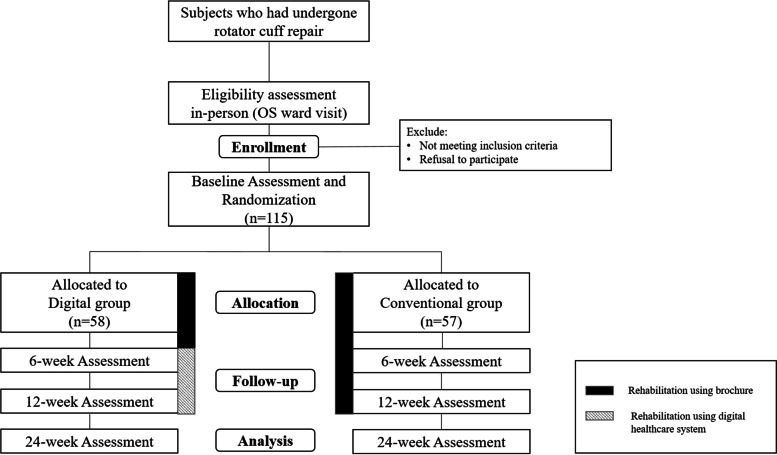
This study will recruit a total of 115 patients who had undergone rotator cuff repair within 3 days after surgery. Patients will be randomly allocated to rehabilitation using an AR-based digital healthcare system (digital group) or conventional rehabilitation (conventional group). Patients in both groups will perform brochure-based exercises from the immediate post-op period to post-op 6 weeks. From post-op 6 weeks to 12 weeks, patients in the digital group will use the AR-based system for post-op exercises, whereas patients in the conventional group will continue brochure-based rehabilitation exercises. The primary outcome will be scores on the Simple Shoulder Test at post-op 12 weeks. Secondary outcomes include numeric rating scale scores for pain, measures of range of motion and muscle strength of the affected shoulder, grip strength of the affected arm, scores on the Disabilities of the Arm, Shoulder and Hand test, the Shoulder Pain and Disability Index, and the EuroQoL-5D-5L quality-of-life measure. Analyses will be conducted using an intention-to-treat approach.
This study will examine the effectiveness of an AR-based digital healthcare system for post-op rehabilitation in the patients after rotator cuff repair. The study will add evidence for the application of digital healthcare systems in post-op rehabilitation.
ClinicalTrials.gov NCT04511377. Registered on 10 August 2020.
肩袖撕裂的手术修复需要长达 12 周的术后(术后)家庭康复。维持患者对术后康复计划的依从性是产生成功结果的关键组成部分。通过开发一种术后康复导向的数字医疗保健系统,并将其应用于接受肩袖修复的患者,我们旨在提高康复计划的效果并提高患者的依从性水平。在这里,我们提出了一种针对比较使用新开发的基于增强现实(AR)的数字医疗保健系统进行康复与常规康复对肩袖修复术后康复效果的方案。
本研究将招募总共 115 名在手术后 3 天内接受肩袖修复的患者。患者将随机分配到基于 AR 的数字医疗保健系统(数字组)或常规康复(常规组)的康复中。两组患者都将在术后即刻至术后 6 周进行基于手册的练习。从术后 6 周开始至 12 周,数字组患者将使用基于 AR 的系统进行术后锻炼,而常规组患者将继续进行基于手册的康复锻炼。主要结局是术后 12 周的简易肩部测试评分。次要结局包括疼痛的数字评分量表评分、患肩活动范围和肌肉力量的测量、患侧手臂的握力、手臂、肩部和手残疾度测试、肩部疼痛和残疾指数以及 EuroQoL-5D-5L 生活质量测量的评分。分析将采用意向治疗方法进行。
本研究将检查基于 AR 的数字医疗保健系统在肩袖修复后患者术后康复中的有效性。该研究将为数字医疗保健系统在术后康复中的应用提供证据。
ClinicalTrials.gov NCT04511377。注册于 2020 年 8 月 10 日。