Wernike Kerstin, Aebischer Andrea, Audonnet Jean-Christophe, Beer Martin
Friedrich-Loeffler-Institut, Südufer 10, 17493, Greifswald - Insel Riems, Germany.
Coordinator of ZAPI IMI Project, Retired from Boehringer Ingelheim Animal Health, Lyon, France.
One Health Outlook. 2022 Aug 17;4(1):13. doi: 10.1186/s42522-022-00069-8.
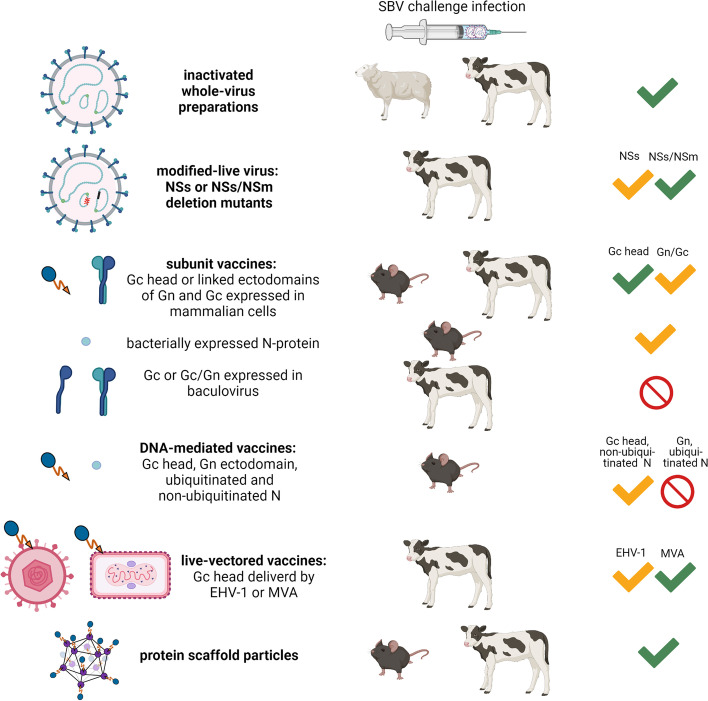
Subsequent to its first detection in 2011, the insect-transmitted bunyavirus Schmallenberg virus (SBV; genus Orthobunyavirus) caused a large-scale epizootic of fetal malformation in the European ruminant population. By now, SBV established an enzootic status in Central Europe with regular wave-like re-emergence, which has prompted intensive research efforts in order to elucidate the pathogenesis and to develop countermeasures. Since different orthobunyaviruses share a very similar structural organization, SBV has become an important model virus to study orthobunyaviruses in general and for the development of vaccines. In this review article, we summarize which vaccine formulations have been tested to prevent SBV infections in livestock animals. MAIN: In a first step, inactivated SBV candidate vaccines were developed, which efficiently protected against an experimental SBV infection. Due to the inability to differentiate infected from vaccinated animals (= DIVA capability), a series of further approaches ranging from modified live, live-vectored, subunit and DNA-mediated vaccine delivery to multimeric antigen-presentation on scaffold particles was developed and evaluated. In short, it was repeatedly demonstrated that the N-terminal half of the glycoprotein Gc, composed of the Gc head and the head-stalk, is highly immunogenic, with a superior immunogenicity of the complete head-stalk domain compared to the Gc head only. Furthermore, in all Gc protein-based vaccine candidates, immunized animals can be readily discriminated from animals infected with the field virus by the absence of antibodies against the viral N-protein.
Using SBV as a model virus, several vaccination-challenge studies in target species underscored the superior performance of antigenic domains compared to linear epitopes regarding their immunogenicity. In addition, it could be shown that holistic approaches combining immunization-challenge infection studies with structural analyses provide essential knowledge required for an improved vaccine design.
2011年首次检测到昆虫传播的布尼亚病毒——施马伦贝格病毒(SBV;正布尼亚病毒属)后,它在欧洲反刍动物群体中引发了大规模的胎儿畸形流行疫情。目前,SBV在中欧已确立了地方流行状态,并呈周期性波浪式再次出现,这促使人们展开深入研究,以阐明其发病机制并制定应对措施。由于不同的正布尼亚病毒具有非常相似的结构组织,SBV已成为研究正布尼亚病毒及开发疫苗的重要模型病毒。在这篇综述文章中,我们总结了哪些疫苗制剂已被测试用于预防家畜感染SBV。
第一步,研发了灭活的SBV候选疫苗,其能有效预防实验性SBV感染。由于无法区分感染动物和接种疫苗的动物(即缺乏鉴别诊断能力),因此又开发并评估了一系列进一步的方法,从改良活疫苗、活载体疫苗、亚单位疫苗和DNA介导的疫苗递送,到支架颗粒上的多聚体抗原呈递。简而言之,反复证明糖蛋白Gc的N端一半,由Gc头部和头柄组成,具有高度免疫原性,与仅Gc头部相比,完整的头柄结构域具有更强的免疫原性。此外,在所有基于Gc蛋白的候选疫苗中,通过检测是否存在针对病毒N蛋白的抗体,可以很容易地将免疫动物与感染野毒的动物区分开来。
以SBV为模型病毒,在目标物种中进行的多项疫苗接种-攻毒研究强调,与线性表位相比,抗原结构域在免疫原性方面具有更优异的性能。此外,还表明将免疫接种-攻毒感染研究与结构分析相结合的整体方法,为改进疫苗设计提供了必要的知识。