Lorente Leonardo, Rodriguez Sergio T, Sanz Pablo, González-Rivero Agustín F, Pérez-Cejas Antonia, Padilla Javier, Díaz Dácil, González Antonio, Martín María M, Jiménez Alejandro, Cerro Purificación, Portero Julián, Barrera Manuel A
Department ofIntensive Care, Hospital Universitario de Canarias, La Laguna 38320, Tenerife, Spain.
Intensive Care Unit, Hospital Universitario Nuestra Señora Candelaria, Santa Cruz de Tenerife 38010, Spain.
World J Hepatol. 2022 Jun 27;14(6):1182-1189. doi: 10.4254/wjh.v14.i6.1182.
Oxidative damage of DNA and RNA has been associated with mortality of patients with different diseases. However, there is no published data on the potential use of DNA and RNA oxidative damage to predict the prognosis of patients with hepatocellular carcinoma (HCC) undergoing liver transplantation (LT).
To determine whether patients with increased DNA and RNA oxidative damage prior to LT for HCC have a poor LT prognosis.
Patients with HCC who underwent LT were included in this observational and retrospective study. Serum levels of all three oxidized guanine species (OGS) were measured prior to LT since guanine is the nucleobase that forms DNA and RNA most prone to oxidation. LT mortality at 1 year was the end-point study.
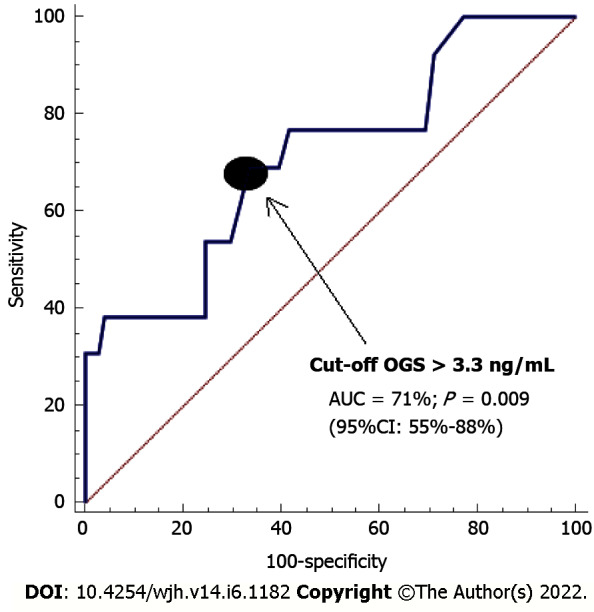
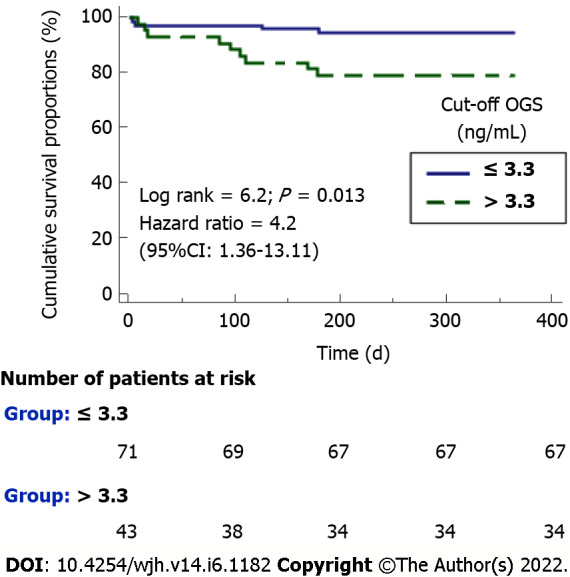
Surviving patients ( = 101) showed lower serum OGS levels ( = 0.01) and lower age of the liver donor ( = 0.03) than non-surviving patients ( = 13). An association between serum OGS levels prior to LT and 1-year LT (odds ratio = 2.079; 95% confidence interval = 1.356-3.189; = 0.001) was found in the logistic regression analysis.
The main new finding was that high serum OGS concentration prior to LT was associated with the mortality 1 year after LT in HCC patients.
DNA和RNA的氧化损伤与不同疾病患者的死亡率相关。然而,关于DNA和RNA氧化损伤在预测接受肝移植(LT)的肝细胞癌(HCC)患者预后方面的潜在用途,尚无公开数据。
确定肝癌肝移植术前DNA和RNA氧化损伤增加的患者肝移植预后是否不良。
本观察性回顾性研究纳入了接受肝移植的肝癌患者。由于鸟嘌呤是构成DNA和RNA最易氧化的核碱基,因此在肝移植术前测量了所有三种氧化鸟嘌呤物质(OGS)的血清水平。以1年时的肝移植死亡率作为研究终点。
存活患者(n = 101)的血清OGS水平(P = 0.01)和肝供体年龄(P = 0.03)均低于非存活患者(n = 13)。逻辑回归分析发现肝移植术前血清OGS水平与1年肝移植死亡率之间存在关联(比值比 = 2.079;95%置信区间 = 1.356 - 3.189;P = 0.001)。
主要的新发现是,肝癌患者肝移植术前血清OGS浓度高与肝移植术后1年死亡率相关。