Division of Hepatology, Clementino Fraga Filho University Hospital, Federal University of Rio de Janeiro, Rio de Janeiro 20941-913, Brazil.
Department of Internal Medicine, Medical School, Federal University of Rio de Janeiro, Rio de Janeiro 22750-240, Brazil.
World J Gastroenterol. 2022 Jul 7;28(25):2890-2899. doi: 10.3748/wjg.v28.i25.2890.
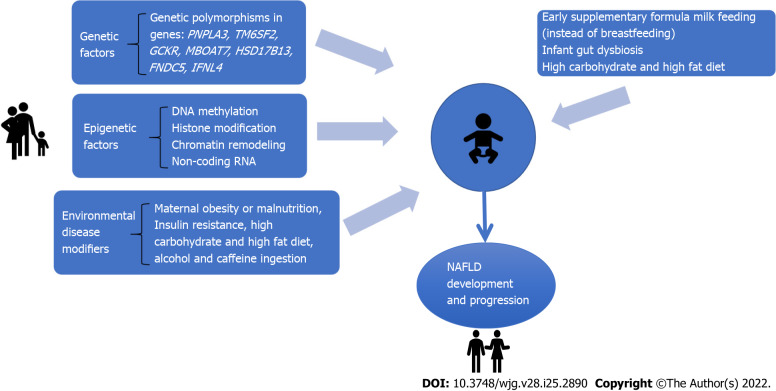
Non-alcoholic fatty liver disease (NAFLD) is the most common chronic liver disease worldwide and is strongly associated with metabolic deregulation. More recently, a significant impact of parental NAFLD in the offspring was demonstrated and has been widely discussed. However, pathogenetic pathways implicated in the inheritance by the offspring and relatives are still under debate. Probably, multiple mechanisms are involved as well as in NAFLD pathogenesis itself. Among the multifactorial involved mechanisms, genetic, epigenetic and environmental backgrounds are strongly related to NAFLD development in the offspring. Thus, based on recent evidence from the available literature concerning genetic, epigenetic and environmental disease modifiers, this review aimed to discuss the relationship between parental NAFLD and its impact on the offspring.
非酒精性脂肪性肝病 (NAFLD) 是全球最常见的慢性肝病,与代谢失调密切相关。最近,研究表明父母的 NAFLD 对后代有显著影响,并引起了广泛的讨论。然而,涉及后代和亲属遗传的发病机制仍存在争议。可能涉及多种机制,就像在 NAFLD 发病机制本身一样。在涉及的多因素机制中,遗传、表观遗传和环境背景与后代的 NAFLD 发展密切相关。因此,基于现有文献中关于遗传、表观遗传和环境疾病修饰因子的最新证据,本综述旨在讨论父母的 NAFLD 与其对后代的影响之间的关系。