Martin Clarissa, Cheng Nina, Chang Bryant, Arya Namrata, Diaz Michael Joseph, Lin Keldon, Umair Muhammad, Waller Joseph, Henry Travis
University of Pennsylvania, Philadelphia, PA 19104, USA.
Drexel University College of Medicine, Philadelphia, PA 19129, USA.
Pol J Radiol. 2022 Jul 12;87:e381-e391. doi: 10.5114/pjr.2022.118238. eCollection 2022.
The global and ongoing COVID-19 outbreak has compelled the need for timely and reliable methods of detection for SARS-CoV-2 infection. Although reverse transcription-polymerase chain reaction (RT-PCR) has been widely accepted as a reference standard for COVID-19 diagnosis, several early studies have suggested the superior sensitivity of computed tomography (CT) in identifying SARS-CoV-2 infection. In a previous systematic review, we stratified studies based on risk for bias to evaluate the true sensitivity of CT for detecting SARS-CoV-2 infection. This study revisits our prior analysis, incorporating more current data to assess the sensitivity of CT for COVID-19.
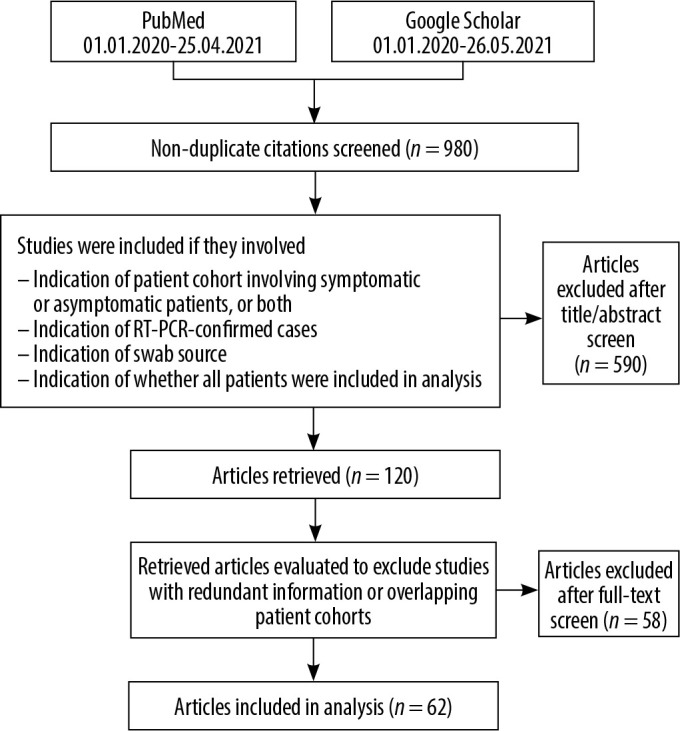
The PubMed and Google Scholar databases were searched for relevant articles published between 1 January 2020, and 25 April 2021. Exclusion criteria included lack of specification regarding whether the study cohort was adult or paediatric, whether patients were symptomatic or asymptomatic, and not identifying the source of RT-PCR specimens. Ultimately, 62 studies were included for systematic review and were subsequently stratified by risk for bias using the QUADAS-2 quality assessment tool. Sensitivity data were extracted for random effects meta-analyses.
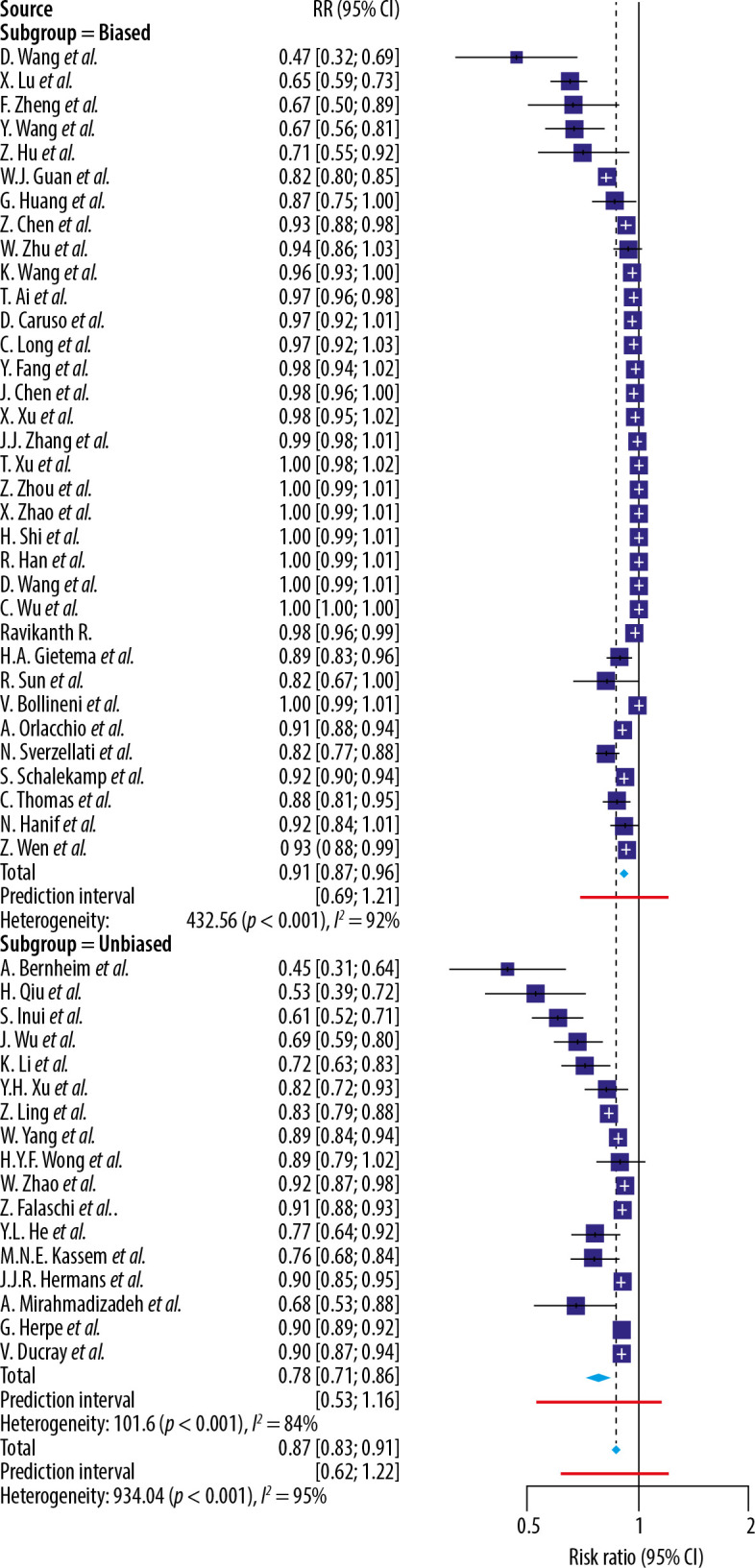
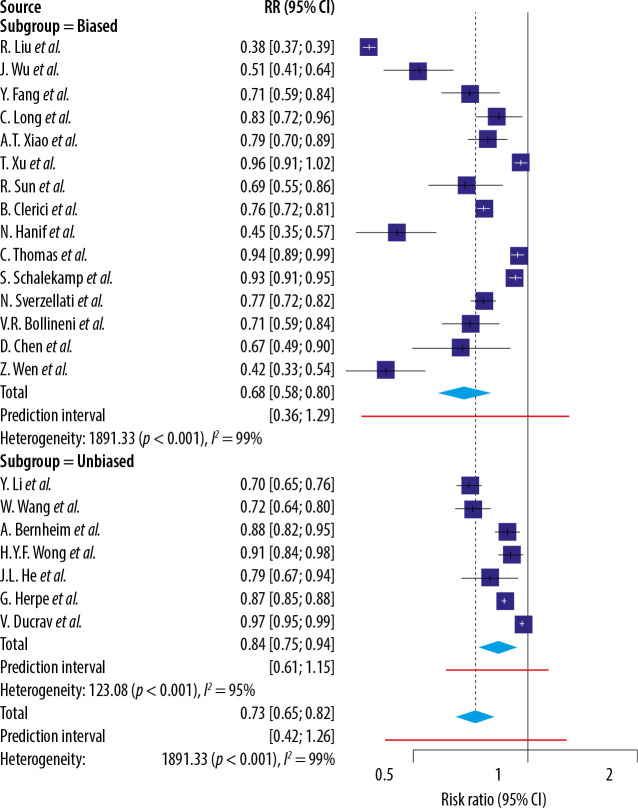
The average sensitivity for COVID-19 reported by the high-risk-of-bias studies was 68% [CI: 58, 80; range: 38-96%] for RT-PCR and 91% [CI: 87, 96; range: 47-100%] for CT. The average sensitivity reported by the low-risk-of-bias studies was 84% [CI: 0.75, 0.94; range: 70-97%] for RT-PCR and 78% [CI: 71, 0.86; range: 44-92%] for CT.
On average, the high-risk-of bias studies underestimated the sensitivity of RT-PCR and overestimated the sensitivity of CT for COVID-19. Given the incorporation of recently published low-risk-of-bias articles, the sensitivities according to low-risk-of-bias studies for both RT-PCR and CT were higher than previously reported.
全球范围内持续的新型冠状病毒肺炎(COVID-19)疫情促使人们需要及时、可靠的严重急性呼吸综合征冠状病毒2(SARS-CoV-2)感染检测方法。虽然逆转录聚合酶链反应(RT-PCR)已被广泛接受为COVID-19诊断的参考标准,但一些早期研究表明计算机断层扫描(CT)在识别SARS-CoV-2感染方面具有更高的敏感性。在之前的一项系统评价中,我们根据偏倚风险对研究进行分层,以评估CT检测SARS-CoV-2感染的真实敏感性。本研究重新审视了我们之前的分析,纳入了更多最新数据,以评估CT对COVID-19的敏感性。
检索PubMed和谷歌学术数据库中2020年1月1日至2021年4月25日发表的相关文章。排除标准包括未明确研究队列是成人还是儿童、患者是否有症状或无症状,以及未确定RT-PCR标本来源。最终,纳入62项研究进行系统评价,随后使用QUADAS-2质量评估工具根据偏倚风险进行分层。提取敏感性数据进行随机效应荟萃分析。
偏倚风险高的研究报告的COVID-19的RT-PCR平均敏感性为68%[可信区间(CI):58,80;范围:38 - 96%],CT为91%[CI:87,96;范围:47 - 100%]。偏倚风险低的研究报告的RT-PCR平均敏感性为84%[CI:0.75,0.94;范围:70 - 97%],CT为78%[CI:71,0.86;范围:44 - 92%]。
平均而言,偏倚风险高的研究低估了RT-PCR对COVID-19的敏感性,高估了CT的敏感性。鉴于纳入了最近发表的偏倚风险低的文章,根据偏倚风险低的研究,RT-PCR和CT的敏感性均高于先前报道。