Department of Dermatology, Venereology and Dermatooncology, Semmelweis University, Budapest, Hungary.
1st Department of Pathology and Experimental Cancer Research, Semmelweis University, Budapest, Hungary.
Pathol Oncol Res. 2022 Aug 1;28:1610521. doi: 10.3389/pore.2022.1610521. eCollection 2022.
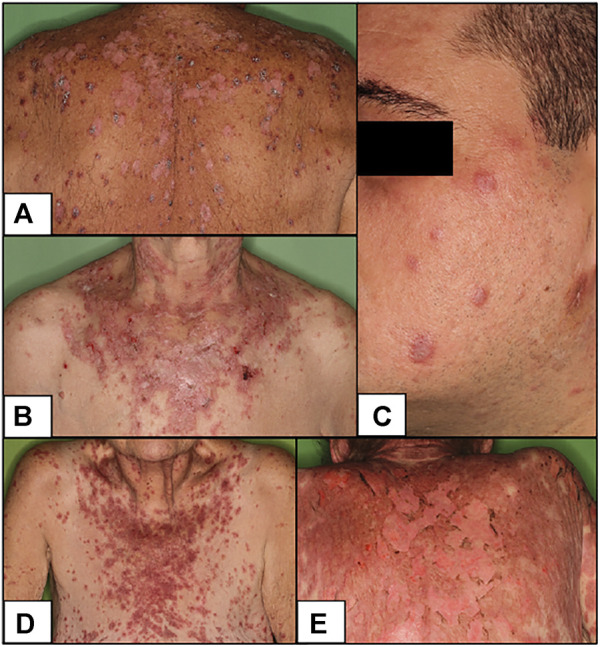
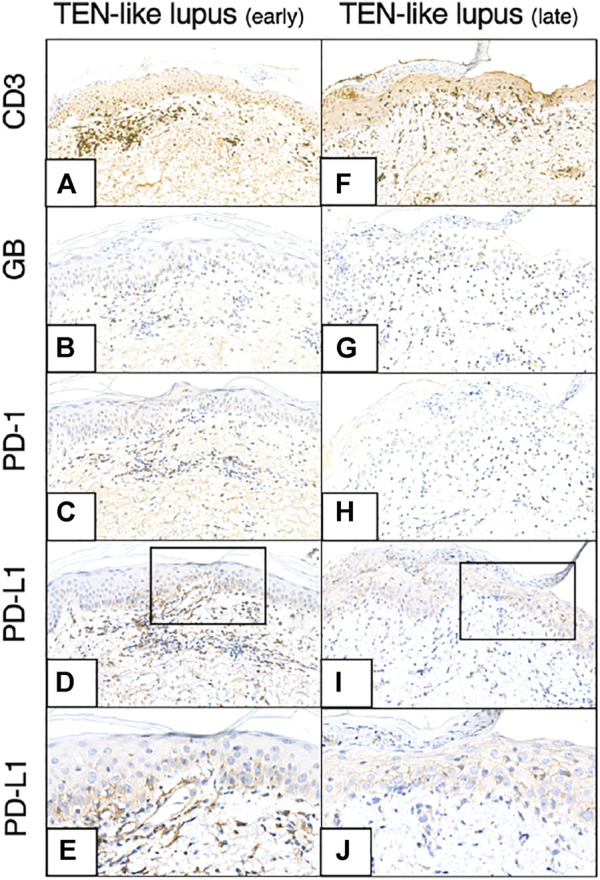
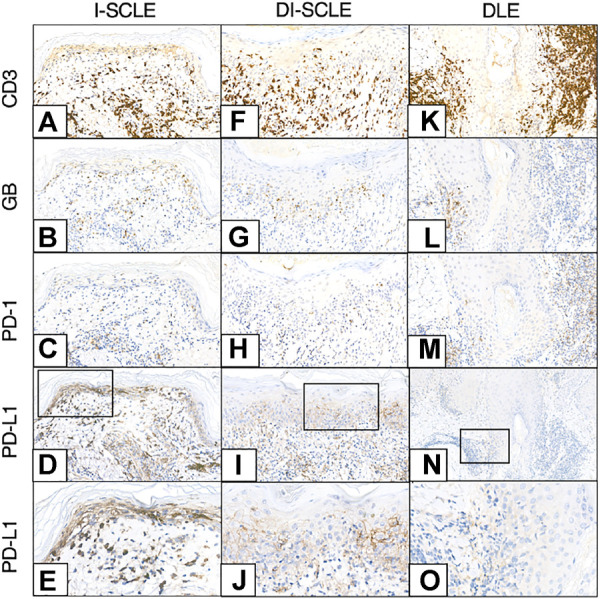
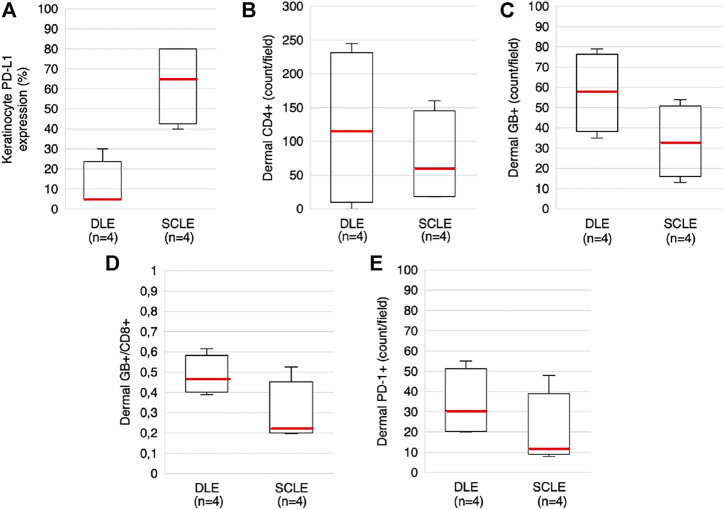
The pathomechanism of various autoimmune diseases is known to be associated with the altered function of programmed cell death 1/programmed cell death ligand 1 (PD-1/PD-L1) axis. We aimed to investigate the role of this pathway and inflammatory cell markers in subtypes of cutaneous lupus erythematosus (CLE): discoid lupus erythematosus (DLE), subacute CLE (SCLE) and toxic epidermal necrolysis (TEN)-like lupus, a hyperacute form of acute CLE (ACLE). Ten skin biopsy samples from 9 patients were analyzed with immunohistochemistry regarding the following markers: CD3, CD4, CD8, Granzyme B, CD123, CD163, PD-1, PD-L1. Our group consisted of 4 SCLE (2 idiopathic (I-SCLE) and 2 PD-1 inhibitor-induced (DI-SCLE)), 4 DLE and 1 TEN-like lupus cases. From the latter patient two consecutive biopsies were obtained 1 week apart. Marker expression patterns were compared through descriptive analysis. Higher median keratinocyte (KC) PD-L1 expression was observed in the SCLE group compared to the DLE group (65% and 5%, respectively). Medians of dermal CD4, Granzyme B (GB), PD-1 positive cell numbers and GB+/CD8 ratio were higher in the DLE group than in the SCLE group. The I-SCLE and DI-SCLE cases showed many similarities, however KC PD-L1 expression and dermal GB positive cell number was higher in the former. The consecutive samples of the TEN-like lupus patient showed an increase by time within the number of infiltrating GB+ cytotoxic T-cells and KC PD-L1 expression (from 22 to 43 and 30%-70%, respectively). Alterations of the PD-1/PD-L1 axis seems to play a role in the pathogenesis of CLE.
各种自身免疫性疾病的发病机制已知与程序性细胞死亡 1/程序性细胞死亡配体 1(PD-1/PD-L1)轴的功能改变有关。我们旨在研究该途径和炎症细胞标志物在皮肤红斑狼疮(CLE)的亚型中的作用:盘状红斑狼疮(DLE)、亚急性 CLE(SCLE)和毒性表皮坏死松解症(TEN)样狼疮,一种急性 CLE(ACLE)的超急性形式。我们使用免疫组织化学分析了 9 名患者的 10 个皮肤活检样本,分析了以下标志物:CD3、CD4、CD8、颗粒酶 B、CD123、CD163、PD-1、PD-L1。我们的研究小组包括 4 例 SCLE(2 例特发性(I-SCLE)和 2 例 PD-1 抑制剂诱导(DI-SCLE))、4 例 DLE 和 1 例 TEN 样狼疮病例。从后一位患者中连续获得了 2 个间隔 1 周的活检样本。通过描述性分析比较了标志物表达模式。与 DLE 组相比,SCLE 组的角质形成细胞(KC)PD-L1 表达中位数更高(分别为 65%和 5%)。DLE 组的真皮 CD4、颗粒酶 B(GB)、PD-1 阳性细胞数和 GB+/CD8 比值中位数高于 SCLE 组。I-SCLE 和 DI-SCLE 病例有许多相似之处,但前者 KC PD-L1 表达和真皮 GB 阳性细胞数更高。TEN 样狼疮患者的连续样本显示,随着时间的推移,浸润性 GB+细胞毒性 T 细胞和 KC PD-L1 表达的数量增加(分别从 22 到 43 和 30%-70%)。PD-1/PD-L1 轴的改变似乎在 CLE 的发病机制中起作用。