ISP, UMR1282, Université de Tours, INRAE, Tours, France.
CHRU de Tours, Service de Bactériologie-Virologie-Hygiène, Tours, France.
Microbiol Spectr. 2022 Oct 26;10(5):e0063522. doi: 10.1128/spectrum.00635-22. Epub 2022 Aug 18.
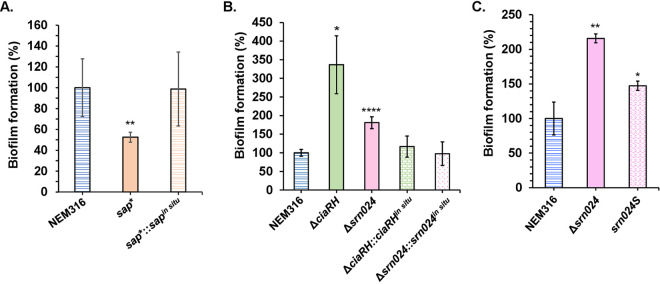
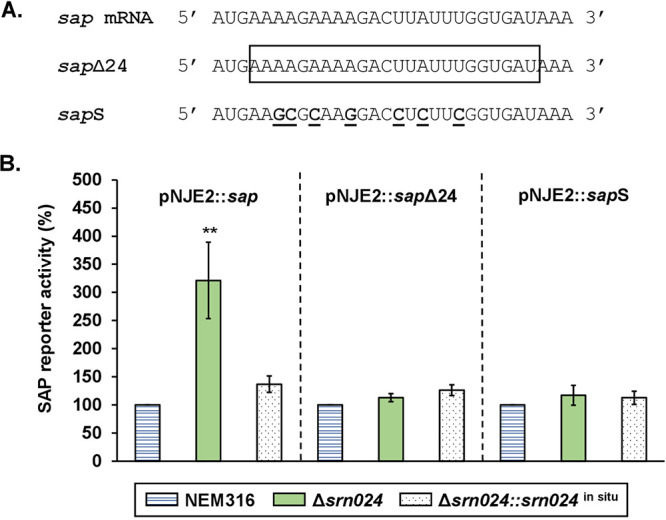
Regulatory small RNAs (sRNAs) are involved in the adaptation of bacteria to their environment. CiaR-dependent sRNAs (csRNAs) are controlled by the regulatory two-component system (TCS) CiaRH, which is widely conserved in streptococci. Except for Streptococcus pneumoniae and Streptococcus sanguinis, the targets of these csRNAs have not yet been investigated. Streptococcus agalactiae, the leading cause of neonatal infections, has four conserved csRNA genes, namely, , , , and . Here, we demonstrate the importance of the direct repeat TTTAAG-N5-TTTAAG in the regulation of these csRNAs by CiaRH. A 24-nucleotide Srn024- RNA base-pairing region is predicted . The gene encodes a LPXTG-cell wall-anchored pullulanase. This protein cleaves α-glucan polysaccharides such as pullulan and glycogen present in the environment to release glucose and is involved in adhesion to human cervical epithelial cells. Inactivation of S. agalactiae pullulanase (SAP) leads to no bacterial growth in a medium with only pullulan as a carbon source and reduced biofilm formation, while deletion of and genes significantly increases bacterial growth and biofilm formation. Using a new translational fusion vector, we demonstrated that Srn024 is involved in the posttranscriptional regulation of expression. Complementary base pair exchanges in S. agalactiae suggest that Srn024 interacts directly with mRNA and that disruption of this RNA pairing is sufficient to yield the biofilm phenotype of Srn024 deletion. These results suggest the involvement of Srn024 in the adaptation of S. agalactiae to environmental changes and biofilm formation, likely through the regulation of the gene. Although Streptococcus agalactiae is a commensal bacterium of the human digestive and genitourinary tracts, it is also an opportunistic pathogen for humans and other animals. As the main cause of neonatal infections, it is responsible for pneumonia, bacteremia, and meningitis. However, its adaptation to these different ecological niches is not fully understood. Bacterial regulatory networks are involved in this adaptation, and the regulatory TCSs (e.g., CiaRH), as well as the regulatory sRNAs, are part of it. This study is the first step to understand the role of csRNAs in the adaptation of S. agalactiae. This bacterium does not currently exhibit extensive antibiotic resistance. However, it is crucial to find alternatives before multidrug resistance emerges. Therefore, we propose that drugs targeting regulatory RNAs with Srn024-like activities would affect pathogens by reducing their abilities to form biofilm and to adapt to host niches.
调控小 RNA(sRNAs)参与细菌对环境的适应。依赖 CiaR 的 sRNAs(csRNAs)受调控两成分系统(TCS)CiaRH 控制,该系统在链球菌中广泛保守。除肺炎链球菌和血链球菌外,这些 csRNAs 的靶标尚未被研究。导致新生儿感染的主要病原体无乳链球菌有四个保守的 csRNA 基因,即 、 、 、 。在这里,我们证明了 CiaRH 对这些 csRNAs 的调控中直接重复 TTTAAG-N5-TTTAAG 的重要性。预测到一个 24 个核苷酸的 Srn024-RNA 碱基配对区域 。 基因编码一种 LPXTG-细胞壁锚定的普鲁兰酶。这种蛋白可以切割环境中存在的 α-葡聚糖多糖,如普鲁兰和糖原,释放葡萄糖,并参与与人类宫颈上皮细胞的黏附。无乳链球菌普鲁兰酶(SAP)的失活导致仅以普鲁兰为碳源的培养基中细菌生长停止,生物膜形成减少,而 和 基因的缺失则显著增加细菌生长和生物膜形成。使用新的翻译融合载体,我们证明 Srn024 参与 表达的转录后调控。无乳链球菌中的互补碱基交换表明 Srn024 与 mRNA 直接相互作用,并且破坏这种 RNA 配对足以产生 Srn024 缺失的生物膜表型。这些结果表明 Srn024 参与了无乳链球菌对环境变化和生物膜形成的适应,可能是通过调节 基因。 虽然无乳链球菌是人类消化道和泌尿生殖道的共生菌,但它也是人和其他动物的机会致病菌。作为新生儿感染的主要原因,它会导致肺炎、菌血症和脑膜炎。然而,它在这些不同生态位的适应还不完全清楚。细菌调节网络参与了这种适应,调节 TCS(如 CiaRH)以及调节 sRNAs 是其中的一部分。这项研究是了解 csRNAs 在无乳链球菌适应中的作用的第一步。这种细菌目前没有广泛的抗生素耐药性。然而,在多药耐药性出现之前,找到替代药物是至关重要的。因此,我们建议靶向具有 Srn024 样活性的调节 RNA 的药物可以通过降低病原体形成生物膜和适应宿主小生境的能力来影响病原体。