Department of Research, The Chinese People's Liberation Army Strategic Support Force Medical Center, Beijing, China.
Department of Virology, State Key Laboratory of Pathogen and Biosecurity, Beijing Institute of Microbiology and Epidemiology, Academy of Military Medical Sciences (AMMS), Beijing, China.
Microbiol Spectr. 2022 Oct 26;10(5):e0224622. doi: 10.1128/spectrum.02246-22. Epub 2022 Aug 18.
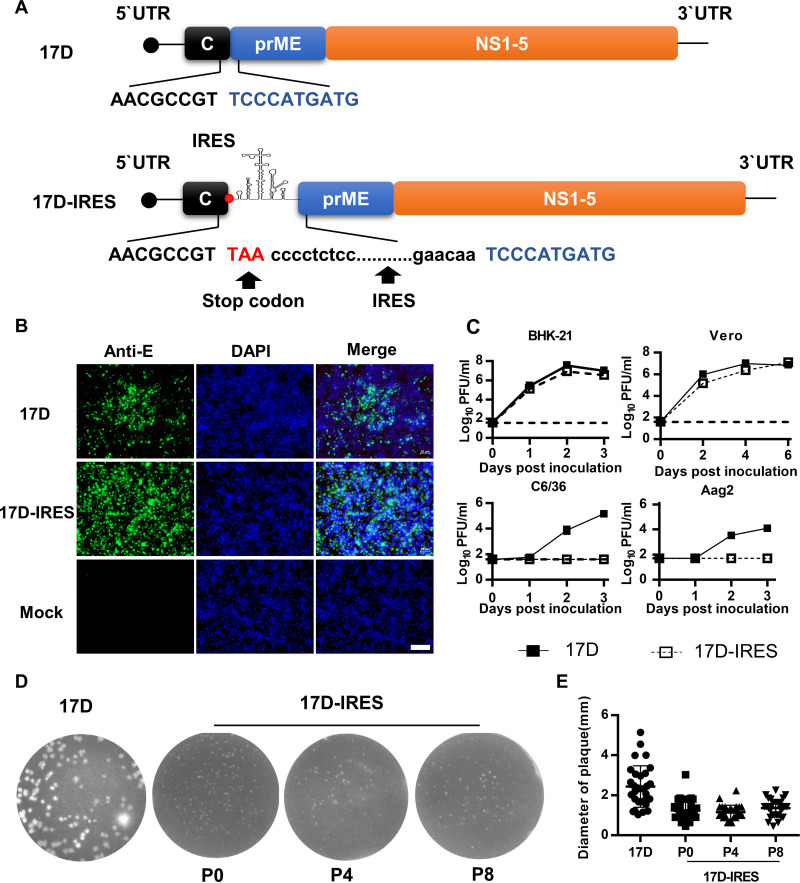
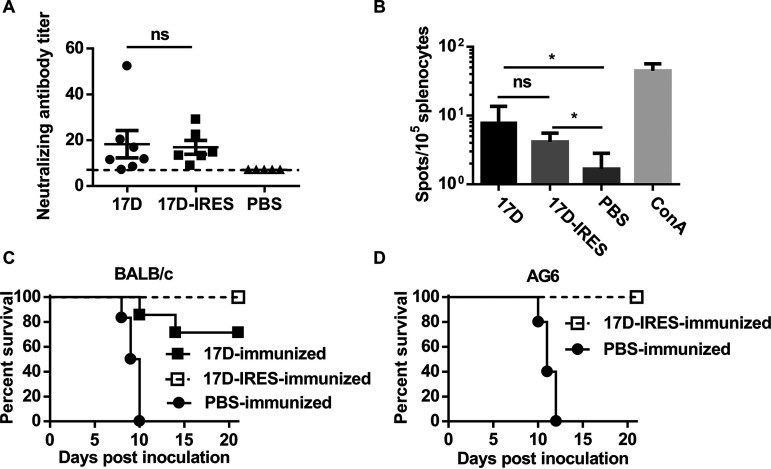
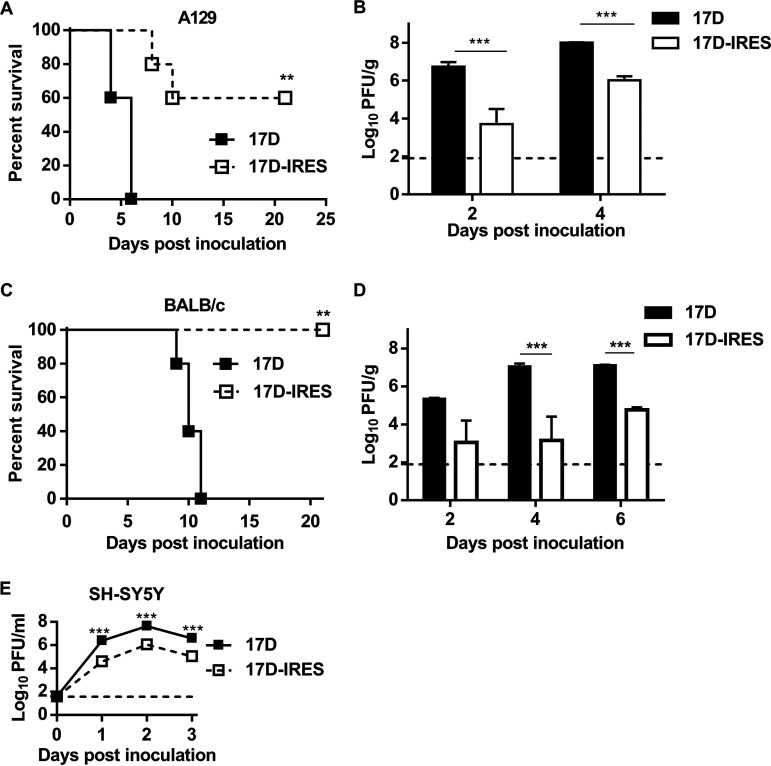
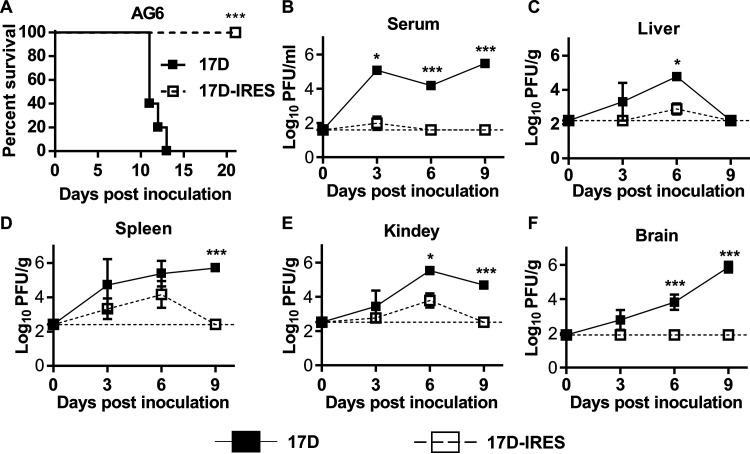
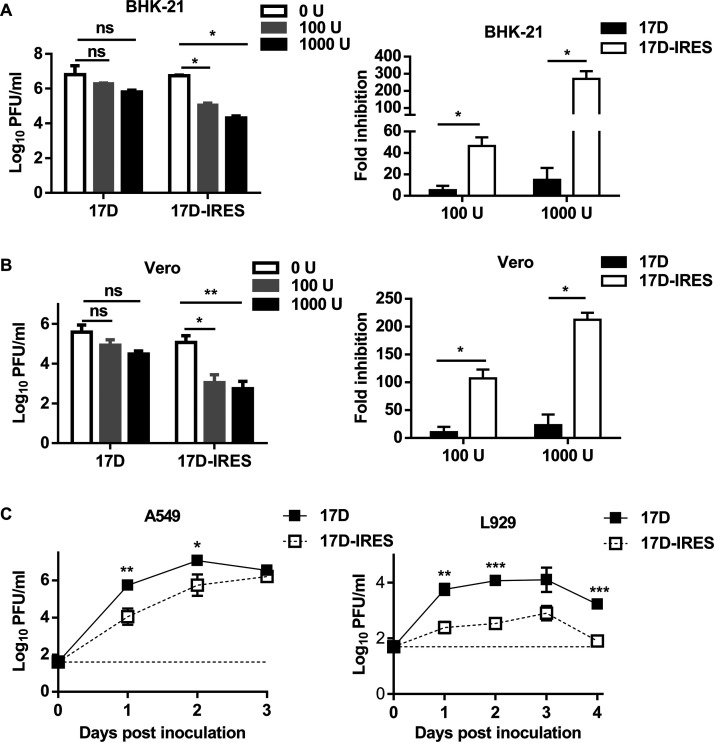
The yellow fever (YF) live attenuated vaccine strain 17D (termed 17D) has been widely used for the prevention and control of YF disease. However, 17D retains significant neurovirulence and viscerotropism in mice, which is probably linked to the increased occurrences of serious adverse events following 17D vaccination. Thus, the development of an updated version of the YF vaccine with an improved safety profile is of high priority. Here, we generated a viable bicistronic YF virus (YFV) by incorporating the internal ribosome entry site (IRES) from virus into an infectious clone of YFV 17D. The resulting recombinant virus, 17D-IRES, exhibited similar replication efficiency to its parental virus (17D) in mammalian cell lines, while it was highly restricted in mosquito cells. Serial passage of 17D-IRES in BHK-21 cells showed good genetic stability. More importantly, in comparison with the parental 17D, 17D-IRES displayed significantly decreased mouse neurovirulence and viscerotropism in type I interferon (IFN)-signaling-deficient and immunocompetent mouse models. Interestingly, 17D-IRES showed enhanced sensitivity to type I IFN compared with 17D. Moreover, immunization with 17D-IRES provided solid protection for mice against a lethal challenge with YFV. These preclinical data support further development of 17D-IRES as an updated version for the approved YF vaccine. This IRES-based attenuation strategy could be also applied to the design of live attenuated vaccines against other mosquito-borne flaviviruses. Yellow fever (YF) continually spreads and causes epidemics around the world, posing a great threat to human health. The YF live attenuated vaccine 17D is considered the most efficient vaccine available and helps to successfully control disease epidemics. However, side effects may occur after vaccination, such as viscerotropic disease (YEL-AVD) and neurotropic adverse disease (YEL-AND). Thus, there is an urgent need for a safer YF vaccine. Here, an IRES strategy was employed, and a bicistronic YFV was successfully developed (named 17D-IRES). 17D-IRES showed effective replication and genetic stability and high attenuation . Importantly, 17D-IRES induced humoral and cellular immune responses and conferred full protection against lethal YFV challenge. Our study provides data suggesting that 17D-IRES, with its prominent advantages, could be a vaccine candidate against YF. Moreover, this IRES-based bicistronic technology platform represents a promising strategy for developing other live attenuated vaccines against emerging viruses.
黄热病(YF)活减毒疫苗株 17D(简称 17D)已被广泛用于预防和控制黄热病疾病。然而,17D 在小鼠中仍具有显著的神经毒力和内脏嗜性,这可能与 17D 接种后严重不良事件的发生率增加有关。因此,开发一种具有改进安全性特征的 YF 疫苗更新版本是当务之急。在这里,我们通过将病毒的内部核糖体进入位点(IRES)插入 YFV 17D 的传染性克隆中,生成了一种可行的双顺反子 YFV(YFV)。与亲本病毒(17D)相比,所得重组病毒 17D-IRES 在哺乳动物细胞系中的复制效率相似,而在蚊子细胞中则受到高度限制。17D-IRES 在 BHK-21 细胞中的连续传代显示出良好的遗传稳定性。更重要的是,与亲本 17D 相比,17D-IRES 在 I 型干扰素(IFN)信号缺陷和免疫功能正常的小鼠模型中显示出明显降低的小鼠神经毒力和内脏嗜性。有趣的是,与 17D 相比,17D-IRES 对 I 型 IFN 的敏感性显著增强。此外,17D-IRES 免疫可为小鼠提供针对 YFV 致死性挑战的可靠保护。这些临床前数据支持进一步开发 17D-IRES 作为已批准 YF 疫苗的更新版本。这种基于 IRES 的衰减策略也可应用于设计针对其他蚊媒黄病毒的活减毒疫苗。
黄热病(YF)持续传播并在全球范围内引发流行,对人类健康构成巨大威胁。黄热病活减毒疫苗 17D 被认为是最有效的疫苗,有助于成功控制疾病流行。然而,接种疫苗后可能会出现副作用,例如内脏嗜性疾病(YEL-AVD)和神经嗜性疾病(YEL-AND)。因此,迫切需要一种更安全的 YF 疫苗。在这里,采用了 IRES 策略,成功开发了一种双顺反子 YFV(命名为 17D-IRES)。17D-IRES 显示出有效的复制和遗传稳定性,高度衰减。重要的是,17D-IRES 诱导了体液和细胞免疫应答,并完全保护免受致死性 YFV 挑战。我们的研究提供的数据表明,17D-IRES 具有突出的优势,可能成为 YF 的疫苗候选物。此外,这种基于 IRES 的双顺反子技术平台代表了开发针对新兴病毒的其他活减毒疫苗的有前途的策略。