Yum Hye Yung, Lee Ji Su, Bae Jung Min, Lee Sooyoung, Kim Yun Hee, Sung Myongsoon, Yang Song-I, Lee Jeongmin, Lee Mi-Hee, Lee Dong Hun
Department of Pediatrics, Seoul Medical Center, Seoul, South Korea.
Department of Dermatology, Seoul National University Hospital, Seoul, South Korea.
World Allergy Organ J. 2022 Aug 3;15(8):100671. doi: 10.1016/j.waojou.2022.100671. eCollection 2022 Aug.
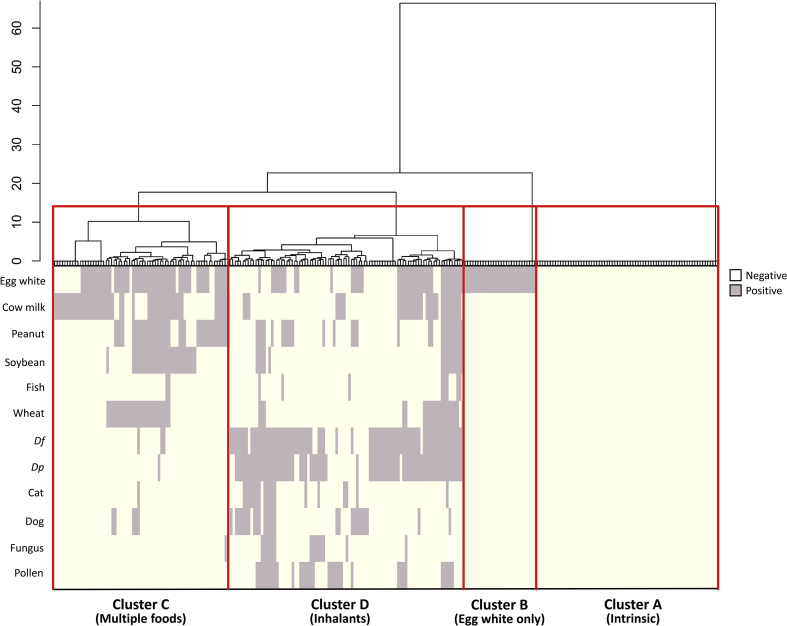
A cluster study to classify atopic dermatitis (AD) phenotypes into subgroups is required to better understand and manage the disease owing to the heterogeneity of its clinical features. This study aimed to identify the phenotypic subgroups of childhood AD according to allergic sensitization. In 258 children with AD, hierarchical cluster analysis based on specific immunoglobulin (Ig) E sensitization revealed four distinct clusters. Cluster A (n = 71) revealed no IgE sensitization, whereas cluster B (n = 28) showed sensitization to egg white only. Cluster B was highly associated with early-onset AD (<3 months) and a family history of atopic diseases. Cluster C (n = 68) and D (n = 91), sensitized to multiple foods and inhalants, respectively, showed a higher prevalence of skin infection within the last 1 year than others. Cluster D was related to late-onset AD (>12 months) and had more atopic comorbidities. In addition, cluster D showed the most severely impaired health-related quality of life and more frequent use of immunosuppressants. Therefore, childhood AD can be classified into 4 clusters based on the allergic sensitization status, and clinical phenotypes and treatment strategy may be different according to clusters.
由于特应性皮炎(AD)临床特征的异质性,需要进行一项聚类研究将其表型分类为亚组,以便更好地理解和管理该疾病。本研究旨在根据过敏致敏情况确定儿童AD的表型亚组。在258例AD患儿中,基于特异性免疫球蛋白(Ig)E致敏的层次聚类分析揭示了四个不同的聚类。A组(n = 71)未显示IgE致敏,而B组(n = 28)仅对蛋清致敏。B组与早发型AD(<3个月)和特应性疾病家族史高度相关。C组(n = 68)和D组(n = 91)分别对多种食物和吸入物致敏,在过去1年内皮肤感染的患病率高于其他组。D组与晚发型AD(>12个月)相关,且有更多的特应性合并症。此外,D组的健康相关生活质量受损最严重,免疫抑制剂的使用频率更高。因此,儿童AD可根据过敏致敏状态分为4个聚类,临床表型和治疗策略可能因聚类不同而有所差异。