Lisik Daniil, Basna Rani, Dinh Tai, Hennig Christian, Shah Syed Ahmar, Wennergren Göran, Goksör Emma, Nwaru Bright I
Krefting Research Centre, Institute of Medicine, Sahlgrenska Academy, University of Gothenburg, Box 424, 405 30, Gothenburg, Sweden.
Division of Geriatric Medicine, Department of Clinical Sciences in Malmö, Lund University, 214 28, Malmö, Sweden.
Eur J Pediatr. 2024 Dec 21;184(1):98. doi: 10.1007/s00431-024-05925-5.
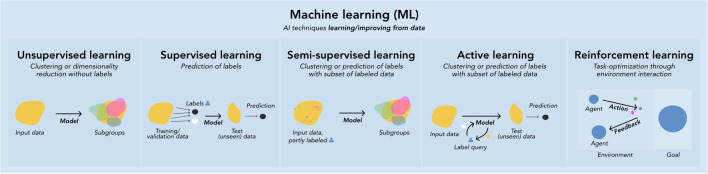
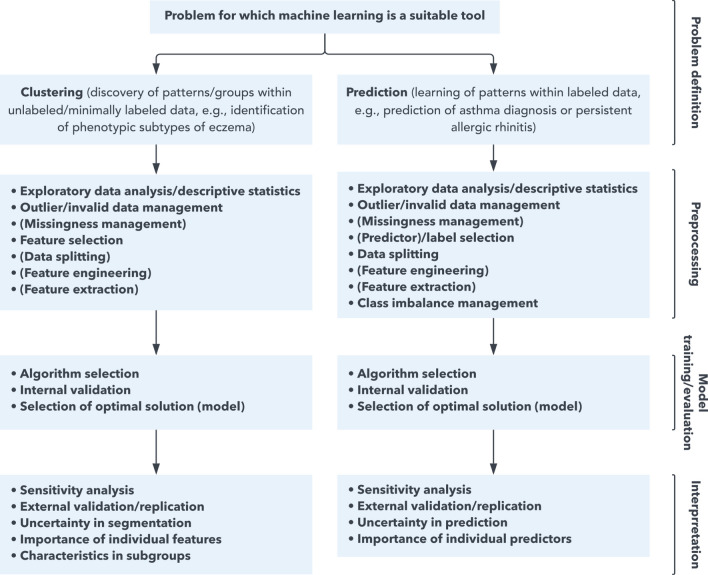
Atopic dermatitis, food allergy, allergic rhinitis, and asthma are among the most common diseases in childhood. They are heterogeneous diseases, can co-exist in their development, and manifest complex associations with other disorders and environmental and hereditary factors. Elucidating these intricacies by identifying clinically distinguishable groups and actionable risk factors will allow for better understanding of the diseases, which will enhance clinical management and benefit society and affected individuals and families. Artificial intelligence (AI) is a promising tool in this context, enabling discovery of meaningful patterns in complex data. Numerous studies within pediatric allergy have and continue to use AI, primarily to characterize disease endotypes/phenotypes and to develop models to predict future disease outcomes. However, most implementations have used relatively simplistic data from one source, such as questionnaires. In addition, methodological approaches and reporting are lacking. This review provides a practical hands-on guide for conducting AI-based studies in pediatric allergy, including (1) an introduction to essential AI concepts and techniques, (2) a blueprint for structuring analysis pipelines (from selection of variables to interpretation of results), and (3) an overview of common pitfalls and remedies. Furthermore, the state-of-the art in the implementation of AI in pediatric allergy research, as well as implications and future perspectives are discussed.
AI-based solutions will undoubtedly transform pediatric allergy research, as showcased by promising findings and innovative technical solutions, but to fully harness the potential, methodologically robust implementation of more advanced techniques on richer data will be needed.
• Pediatric allergies are heterogeneous and common, inflicting substantial morbidity and societal costs. • The field of artificial intelligence is undergoing rapid development, with increasing implementation in various fields of medicine and research.
• Promising applications of AI in pediatric allergy have been reported, but implementation largely lags behind other fields, particularly in regard to use of advanced algorithms and non-tabular data. Furthermore, lacking reporting on computational approaches hampers evidence synthesis and critical appraisal. • Multi-center collaborations with multi-omics and rich unstructured data as well as utilization of deep learning algorithms are lacking and will likely provide the most impactful discoveries.
特应性皮炎、食物过敏、过敏性鼻炎和哮喘是儿童期最常见的疾病。它们是异质性疾病,在发展过程中可能共存,并与其他疾病以及环境和遗传因素表现出复杂的关联。通过识别临床上可区分的群体和可采取行动的风险因素来阐明这些错综复杂的关系,将有助于更好地理解这些疾病,从而加强临床管理,并造福社会以及受影响的个人和家庭。在这种情况下,人工智能(AI)是一种很有前景的工具,能够在复杂数据中发现有意义的模式。儿科过敏领域已经开展并将继续开展大量研究,主要用于描述疾病的内型/表型,并开发预测未来疾病结果的模型。然而,大多数研究都使用了来自单一来源的相对简单的数据,如调查问卷。此外,还缺乏方法论方法和报告。本综述为在儿科过敏领域开展基于人工智能的研究提供了一份实用的实践指南,包括(1)人工智能基本概念和技术介绍,(2)构建分析流程的蓝图(从变量选择到结果解释),以及(3)常见陷阱和补救措施概述。此外,还讨论了人工智能在儿科过敏研究中的应用现状,以及影响和未来展望。
正如有前景的研究结果和创新技术解决方案所展示的那样,基于人工智能的解决方案无疑将改变儿科过敏研究,但要充分发挥其潜力,需要在更丰富的数据上以方法学上稳健的方式实施更先进的技术。
• 儿科过敏是异质性且常见的,会造成巨大的发病率和社会成本。• 人工智能领域正在迅速发展,在医学和研究的各个领域中的应用日益增加。
• 已有关于人工智能在儿科过敏方面有前景的应用报道,但实施在很大程度上落后于其他领域,特别是在使用先进算法和非表格数据方面。此外,缺乏关于计算方法的报告阻碍了证据综合和批判性评估。• 缺乏多中心合作以及多组学和丰富的非结构化数据的利用,深度学习算法的应用也不足,而这些可能会带来最有影响力的发现。